

The Royal Oak may be Audemars Piguet’s most recognizable watch, but it isn’t automatically the right choice for every buyer. This Audemars Piguet buying guide explains what distinguishes the brand, how Royal Oak models differ, and what to consider when choosing a pre-owned watch.
Audemars Piguet’s appeal comes from more than a distinctive design. Founded in 1875, the manufacture is known for technical watchmaking and for the Royal Oak, introduced in 1972. For buyers, that heritage matters most when it connects to the details they’ll live with: case size, movement, materials, complications, condition, and provenance.
Use these practical points to narrow your choice. Learn how Royal Oak prices vary by model and condition, how to compare the standard collection with other Audemars Piguet lines, and what to examine before buying pre-owned. The goal is a considered decision based on the watch itself, not its reputation alone.
Key Takeaways
- Compare Royal Oak references by case size, movement, complication, and condition rather than relying on the collection name alone.
- Consider whether the Offshore’s bolder proportions or the Concept’s technical focus better suits how you plan to wear the watch.
- Match a complication to your needs, since added functions can affect both the watch’s operation and ownership considerations.
- Assess Code 11.59 by its distinctive case construction and movement options, not by how closely it resembles the Royal Oak.
- Weigh the benefits of an authorized-dealer purchase against the broader model selection available in the pre-owned market, including provenance and condition.
1. How Much Does an Audemars Piguet Royal Oak Cost?
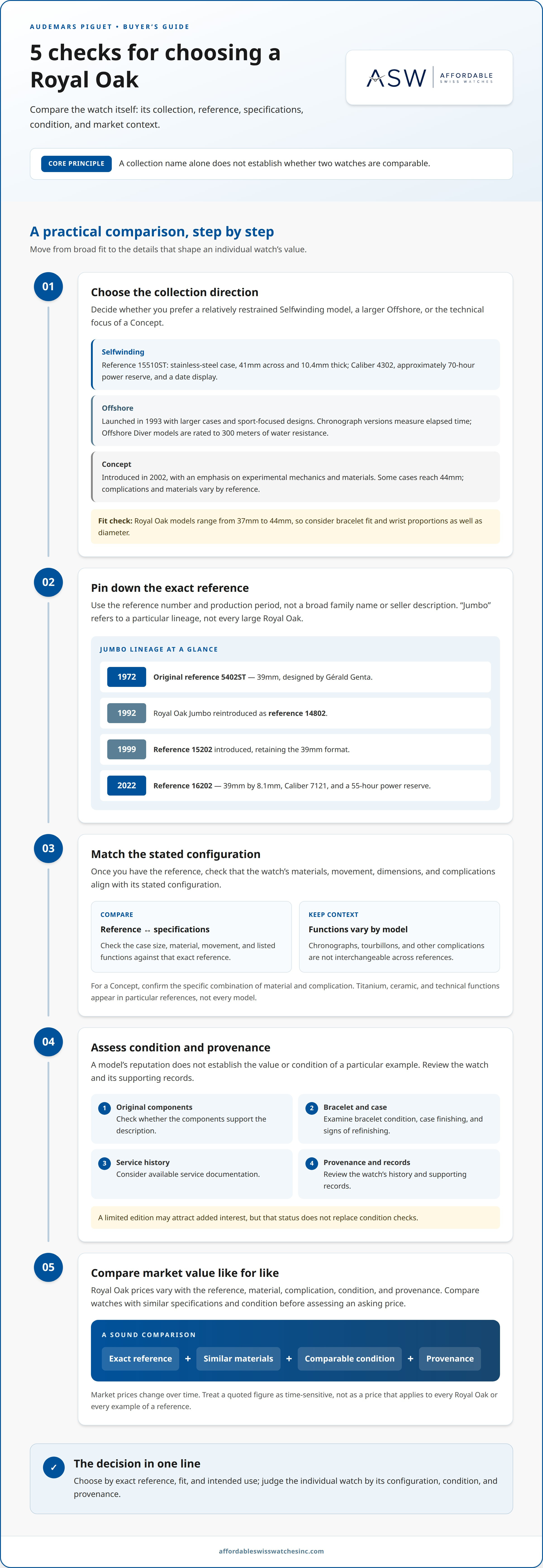
There isn’t one price for an Audemars Piguet Royal Oak. The reference, material, complication, condition, and provenance all affect its market value. A steel Royal Oak Selfwinding and a precious-metal model with a complex complication are not direct comparisons. For a useful estimate, identify the exact reference, then compare watches with similar materials and condition. Market prices change over time, so treat any figure as time-sensitive rather than permanent.
The cost question makes more sense alongside Audemars Piguet’s history. Founded in 1875, the Swiss manufacture built its identity around mechanical watchmaking. The Royal Oak, introduced in 1972, marked a major change in luxury sports-watch design. Gérald Genta designed its distinctive case and integrated bracelet. The original reference 5402ST measured 39mm, a size that helped define the model’s enduring proportions.
The Royal Oak’s design details explain why references should not be treated as interchangeable. Its octagonal bezel, visible screws, and integrated bracelet create a distinctive silhouette, while case size, movement, and dial distinguish generations. “Jumbo” refers to a particular lineage, not every large Audemars Piguet Royal Oak. Compare the reference number and production period rather than relying on a seller’s use of “Jumbo” alone.
Audemars Piguet reintroduced the Royal Oak Jumbo as reference 14802 in 1992, then introduced reference 15202 in 1999. The 15202 retained the 39mm format and became a key modern link to the original design. In 2022, reference 16202 continued that extra-thin approach, measuring 39mm by 8.1mm and using Caliber 7121, with a 55-hour power reserve. Those specifications provide a clearer basis for comparing models than the family name alone.
For a pre-owned purchase, assess value in a consistent order: confirm the reference, check that the stated materials and movement match it, then evaluate condition and provenance. Original components, bracelet condition, documented service history, and signs of refinishing can affect desirability and price. A limited edition may attract added interest, but that status does not replace condition checks. Since the Royal Oak encompasses a broad family of watches, compare like with like before deciding whether an asking price is reasonable.
That figure is best treated as a market reference for that specific model, not a price applicable to every Royal Oak or every example of the 15202. An asking price still needs to be judged against the watch’s condition, provenance, originality, and supporting records, since those are relevant to a like-for-like comparison.
Before relying on a quoted price, match the reference and stated materials to the watch, then consider whether its bracelet, components, and service documentation support the description. A premium for the model name alone does not show whether an individual watch is fairly priced. This approach distinguishes a model’s market position from the value of a particular example.
2. Royal Oak Offshore, Concept, and Self-Winding variations
The Royal Oak changed expectations for a luxury sports watch by pairing a steel case with an integrated bracelet and refined finishing. Its design brought sportier proportions to a category often associated with precious metals and formal dress. The collection remains defined by that combination, but its watches now differ substantially in scale, function, and wear. Start by deciding whether you want a relatively restrained Selfwinding model, a larger Offshore, or a technically expressive Concept.
The Royal Oak Selfwinding reference 15510ST offers a useful modern point of comparison. Its stainless-steel case measures 41mm across and 10.4mm thick. Caliber 4302 provides an approximately 70-hour power reserve, while the dial includes a date display. These specifications make it a practical benchmark when comparing case presence and everyday functions. Other Royal Oak models range from 37mm to 44mm, so bracelet fit and wrist proportions matter as much as the diameter.
The Offshore takes a more assertive direction. Audemars Piguet launched the collection in 1993, with larger cases and sport-focused designs that differ clearly from the original Royal Oak’s slimmer profile. Chronograph versions add elapsed-time measurement, and their date display sits between four and five o’clock. Offshore Diver models are rated to 300 meters of water resistance. That rating is a technical specification, not a substitute for checking the particular watch’s condition and service history.
Royal Oak Concept models place greater emphasis on experimental mechanics and materials. The collection began in 2002, and some Concept cases reach 44mm. Complications can include a tourbillon, which supports precise timekeeping through a rotating mechanism, or a chronograph integrated with other functions. Titanium and ceramic appear in particular references, but materials and complications vary by model. Match the reference number to its specific configuration before comparing it with another Concept watch.
Prices differ across Selfwinding, Offshore, and Concept watches because materials, complications, production periods, and condition vary. A steel automatic model and a limited-production Concept with a tourbillon are not direct price comparisons. Pre-owned examples also call for attention to bracelet wear, case finishing, completeness, and service records. Compare the exact reference and condition before judging value; a collection name alone cannot explain a price. The best fit is the watch whose size, function, and construction suit how you intend to wear it.
3. What Makes Audemars Piguet Unique in the Luxury Watch Market?
Audemars Piguet’s identity combines traditional complications with designs that challenge familiar luxury-watch conventions. The manufacture created its first minute-repeating wristwatch movement in 1892 and its first perpetual calendar wristwatch in 1957. Those milestones help explain why its appeal extends beyond the Royal Oak’s case and bracelet. For buyers, the distinction lies in each reference’s movement and function, not the complication’s name alone.
Complications add functions beyond basic time display, but they also affect how a watch is used. A perpetual calendar tracks calendar information, while a minute repeater signals time acoustically. Audemars Piguet released its first Grande Complication wristwatch in 1996, combining demanding functions in one timepiece. Before choosing a complicated model, identify its reference and understand how its functions operate. A mechanism you won’t use may add complexity without improving daily wear.
For a first Audemars Piguet, the Royal Oak reference 15500 is identified as a starting-point option. Its 41mm case gives buyers a clear way to assess the collection’s wrist presence before considering more specialized models. “Entry-level” describes a point of entry into the brand, not a simple or inexpensive watch. Compare its design and functions with your preferences rather than treating the label as a measure of quality.
The [RE]Master collection, introduced in 2020, takes a vintage-inspired approach. Its designs draw on the brand’s past, making the exact reference and edition important. A historical look does not mean a watch is an original period example. If you’re considering a [RE]Master model, distinguish its modern production context from the older design that informs it. This helps frame its place within the wider collection.
Skeleton watches offer another view of Audemars Piguet’s technical work. The manufacture developed a skeleton watch in 1934, using an open design that reveals parts of the movement. That visibility can help a buyer appreciate the arrangement and finishing of the mechanism. It also makes legibility and personal taste important considerations. Choose a skeleton model because you value seeing its construction, not solely because the movement is exposed.
For an online purchase, assess how clearly the seller explains the transaction. Look for a detailed description of the specific watch, photographs showing its actual condition, and written terms covering payment, returns, and any warranty. The seller’s answers should address the reference and stated configuration directly. Generic images or unclear terms make comparison harder. Prefer a seller who documents the offering plainly and provides consistent information before purchase.
4. Code 11.59 design and movements
Audemars Piguet introduced the CODE 11.59 collection in 2019 as a distinct design direction within its catalogue. Its aesthetic differs from the integrated-bracelet profile associated with the Royal Oak. That contrast matters when choosing: CODE 11.59 suits buyers drawn to a more formal, round-watch appearance. Judge the specific reference on its own details, including dial layout, case finish, strap condition, and how the watch sits on your wrist.
Movement choice is central to comparing CODE 11.59 timepieces. The collection includes watches with different functions, so begin by identifying the exact reference and its stated caliber. Then compare that caliber with the watch’s documentation and examine whether the listed functions match the dial and controls. A chronograph, for example, requires more than attractive subdials; its pushers and indications should correspond to the reference’s intended operation.
Complications can change how a CODE 11.59 is used and maintained. A time-and-date watch offers a different ownership experience from a chronograph or a perpetual calendar. Decide which functions you will use regularly, then focus your comparison on models with those functions. For a complicated example, review service records and operating instructions with particular care. The added mechanism makes documentation and condition relevant parts of the purchase decision.
Case and dial details deserve close attention on a pre-owned CODE 11.59. View the watch under direct and angled light, and look for consistent finishing across the case surfaces. Examine the crystal and dial for marks that could affect legibility or appearance. Check the strap, buckle, and attachment points for wear, since these influence comfort and may affect replacement decisions. Compare the visible details with the exact reference, rather than relying on a collection name alone.
CODE 11.59 buyers should also separate design preference from market reputation. Its aesthetic is intentionally different from the Royal Oak, so popularity in one collection does not establish which model suits you. Consider the case proportions, dial readability, movement function, and wearing comfort together. If you are comparing two references, write down their differences before weighing condition and provenance. That keeps the choice grounded in the particular timepiece rather than assumptions about the broader brand.
For any CODE 11.59 purchase, use a consistent review: identify the reference, match the movement and functions, assess visible condition, then evaluate the accompanying records. Give special attention to complicated models, where correct operation is as important as exterior presentation. A well-documented example with functions you understand is a more considered choice than a reference selected for its name alone. This method also makes comparisons between CODE 11.59 models clearer and more useful.
5. Authorized dealer versus pre-owned buying
An authorized purchase and a pre-owned purchase serve different priorities. Buying through an Audemars Piguet-authorized channel gives access to watches in the brand’s current offering. The pre-owned market can provide earlier references, discontinued models, and configurations no longer produced. Decide whether you value a current model in new condition or a particular watch that may only be available pre-owned. That preference clarifies the choice without treating either route as universally better.
Think about the specific configuration you want. A stainless-steel Royal Oak, a ceramic Offshore, and a diamond-set model differ in material, appearance, and how they fit into a collection. Authorized channels focus on current production, while pre-owned inventory can cover a wider range of production periods. If a particular dial, case material, or bracelet is essential, identify it before comparing purchase routes. Otherwise, the current collection may be a more direct starting point.
Access can affect timing. Popular steel Royal Oak references have boutique waitlists exceeding 12 to 24 months, according to 2026 market information. A pre-owned watch may suit someone focused on a specific reference rather than waiting for a current allocation. That convenience has a trade-off: the selection depends on what is available, and the asking price reflects the individual watch and market conditions. Availability and market values are time-sensitive, so treat them as part of the decision rather than fixed expectations.
The buying experience also differs. An authorized purchase follows the brand’s current retail process. A pre-owned transaction is with the seller, so review the written terms: understand the condition description, included items, payment arrangements, and applicable return and warranty provisions before committing. These details shape what happens after the sale. A clear agreement is especially useful for an older reference or a watch with features that differ from current models.
Consider how the watch fits your ownership plans. Someone seeking a particular discontinued dial may prefer the pre-owned route, while a buyer set on a current Selfwinding model may prioritize authorized access. Complicated watches also call for attention to how their functions are explained and supported after purchase. For a simpler comparison, start with a model whose design and use you already understand, then decide whether a specific alternative’s benefits justify its added complexity.
Choose an authorized purchase if a current model and the direct brand retail experience are your priorities. Choose pre-owned if an earlier reference or specific configuration matters more and you’re comfortable reviewing the seller’s terms. Either way, define the model, material, and functions you want before comparing options. The right route fits your priorities and gives you a clear understanding of the transaction.
Affordable Swiss Watches: Audemars Piguet Watches
Affordable Swiss Watches Inc. is an independent dealer offering Audemars Piguet watches for buyers comparing pre-owned and unworn options. It is not an authorized Audemars Piguet dealer. Each pre-owned watch undergoes in-house, multi-step authentication and includes a 2-year limited warranty. If a watch is found not genuine, a full money-back guarantee applies.
Consider reaching out when you have a reference in mind or want to discuss condition, provenance, and details relevant to your comparison. Rolex Submariner, Rolex Datejust, and Rolex Land-Dweller watches are also available to consider.
Contact Affordable Swiss Watches Inc. with questions about Audemars Piguet watches.
Make the Reference Fit Your Life
The strongest choice is an Audemars Piguet you’ll enjoy wearing after its initial appeal has settled. Before deciding, consider where it will fit in your rotation, whether its proportions feel right, and which functions you’ll use. A reference that suits your habits is easier to assess than one chosen mainly for its reputation or resale discussion.
Use this Audemars Piguet buying guide as a starting point, then narrow your shortlist to specific references. Note the features you value most and the condition details you’re willing to accept. If your preferences extend beyond Audemars Piguet, Affordable Swiss Watches Inc. also offers Rolex Submariner, Rolex Datejust, and Rolex Land-Dweller watches. Comparing models can help clarify what matters in your next purchase.
For another look at available watches, browse the collection at Affordable Swiss Watches Inc. Take the time to choose a watch whose design and use make sense for you.
Frequently Asked Questions
What Makes Audemars Piguet Unique in the Luxury Watch Market?
Audemars Piguet combines established watchmaking with a willingness to develop distinct design directions. The manufacture has remained family-controlled for nearly 150 years, a rare feature among major luxury watchmakers. For buyers, that identity appears across different kinds of watches, from the Royal Oak’s integrated-bracelet design to the more formal CODE 11.59. Compare the specific reference and its construction rather than assuming every model reflects the same style.
Entry-level AP Watches: Which Audemars Piguet Model Should I Buy First?
The Royal Oak reference 15500 is a practical first model to consider if you want a recognizable Audemars Piguet design without beginning with a highly complicated watch. Its 41mm case makes wrist fit an important part of the decision. Compare its proportions with other references, then focus on condition, provenance, and the features you’ll use. “Entry-level” describes a starting point within the brand, not a low-cost purchase.
How Much Does an Audemars Piguet Royal Oak Cost?
There is no single price for a Royal Oak. The specific reference, material, complication, production period, condition, and completeness all affect its market value. A steel automatic model and a precious-metal watch with a complex complication are not direct comparisons. Assess examples of the same reference in similar condition, and account for potential service needs when setting your overall ownership budget. Market values can change over time.