

A limited-edition watch isn't automatically a good investment. Whether limited-edition watches are a good investment depends on more than the production number: brand reputation, sustained collector demand, condition, and complete documentation all influence resale appeal. Rarity can help, but it cannot create lasting value on its own.
The edition's story and how it was produced matter, too. A model tied to a meaningful event or a brand's history may attract lasting interest, while a limited run with little collector demand may struggle to hold its value. The price paid and the reliability of the seller also affect investment potential.
This guide explains how to assess these factors without treating a limited-edition label as a promise of future returns. You'll learn what distinguishes lasting collector interest from short-term hype, why condition and original papers matter, and how a careful purchase can support confidence in the watch and a more informed view of its resale prospects.
Key Takeaways
- Assess a limited edition’s brand heritage and collector demand, not just its production number.
- Compare the edition’s retail premium with the appeal of its standard counterpart and its resale prospects.
- Consider how launch timing can affect what you pay, especially while early excitement is high.
- Evaluate buying sources by the clarity of their authentication and provenance information.
- Account for condition, original packaging, and documentation when judging a watch’s future resale appeal.
What Brands Are Known for Valuable Limited Edition Watches?
Rolex, Omega, Audemars Piguet, and Breitling have issued limited editions that attract collector interest. Brand prestige alone doesn’t establish investment potential. Assess the specific reference, its connection to the maker's history, its production run, and the strength of collector demand. A numbered caseback identifies a watch within its edition, but numbering cannot create desirability by itself. The movement, design, authenticity, and provenance also shape how collectors assess a timepiece.
Rolex draws on recognizable models and a long history of watchmaking. The Submariner 50th Anniversary is an example of an edition linked to a core model's heritage. Rolex Daytona Ref. 6239 watches with Paul Newman dials were produced in the 1960s and early 1970s. Their collector interest is tied to the specific dial and model history, not simply a limited-edition label. This distinction matters: a celebrated standard reference can attract demand without being a numbered special release. Brand popularity helps sustain attention, but each watch's condition and provenance still influence its appeal.
Omega’s Speedmaster editions demonstrate how historical context can give a release a clear story. NASA gave Omega the Silver Snoopy Award in 1970 for the Speedmaster’s role in the Apollo 13 mission. During that mission, the crew used Speedmasters to time a 14-second engine burn. Omega later released the Speedmaster Apollo 11 50th Anniversary in 2019, commemorating the Moon landing with a production run of 6,969 pieces. The Speedmaster "Snoopy Award" released in 2015 was limited to 1,970 pieces. These examples connect specific references to events and institutional recognition. That context can support collector interest, though it doesn’t establish future resale performance.
Audemars Piguet editions show why production numbers need context. The Royal Oak Offshore "LeBron James" Edition was limited to 600 pieces in 2013. The Royal Oak Concept Black Panther Flying Tourbillon followed in 2021, with 250 pieces. Their distinct identities and connection to the Royal Oak family give collectors more to assess than scarcity alone. Breitling’s Navitimer 1959 Re-Edition had a run of 1,959 pieces. The historical model reference helps explain the edition’s appeal. A low number can make a watch scarce, but a compelling design and brand heritage help determine whether collectors want it.
For a practical assessment, start with the edition’s reason for existing. A 40-, 50-, or 100-year anniversary can provide meaningful context when it relates directly to a model or milestone. Then consider whether the release fits the brand’s horological identity and whether the design has lasting appeal. Compare its story with the standard reference and examine its production number as one factor, not the conclusion. Limited-edition watches can be attractive to collectors, but the strongest case rests on the specific watch’s history, craftsmanship, authenticity, and sustained demand.
Hype vs. Genuine Collector Value in Watches
A limited production run can attract attention, but resale value depends on whether collectors continue to want that specific watch. The difference between initial excitement and lasting demand becomes clearer through pricing, condition, and completed sales.
Retail Premiums and Resale Prices
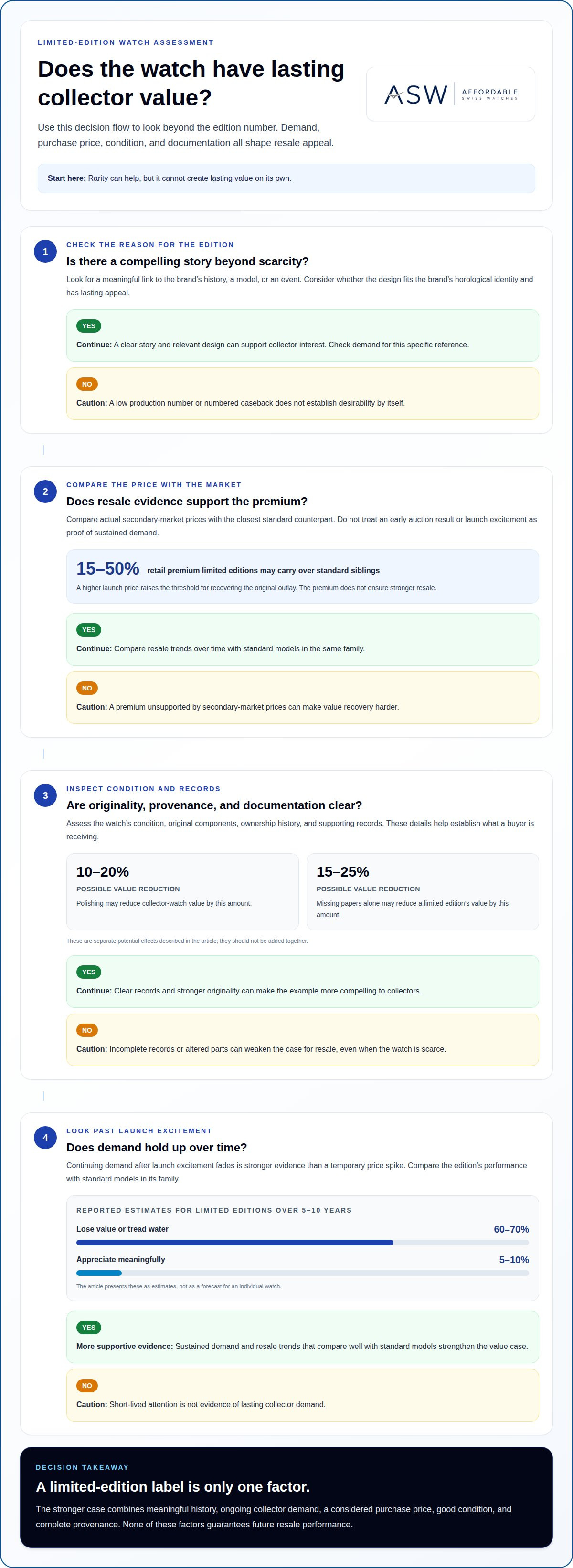
A retail premium is the extra amount charged for a limited edition compared with its standard counterpart; resale price is what a later buyer pays. The gap matters because a higher launch price creates a higher threshold for recovering the original outlay. Limited editions may carry a 15-50% retail premium over standard siblings, yet that premium does not ensure stronger resale.
Some editions fail to outperform their standard models after resale. A reported estimate puts that share at 70-80%. Compare actual secondary-market prices for the limited edition and its closest standard counterpart, rather than treating the launch premium as evidence of future appreciation. An early auction result can attract attention, but one sale does not establish sustained demand across later transactions.
Rarity, Condition, and Provenance
Rarity describes limited supply; provenance records a watch's ownership and supporting history. Both can influence resale, but collectors also weigh condition, originality, and the edition's desirability. An engraving or edition number such as 001/500 can identify a watch's place in its run. It does not prove that buyers will value the reference more than a widely produced model.
Condition can change the comparison: polishing may reduce collector-watch value by 10-20%, while missing papers alone may reduce a limited edition's value by 15-25%. Original components, a clear ownership history, and complete documentation help establish what a buyer is receiving. For example, a scarce watch with altered parts or incomplete records may be less compelling than a less rare example with stronger originality and provenance.
Resale Performance and Value Retention
Resale performance is the price a watch achieves later, while value retention describes how closely it holds its purchase value. The distinction matters because a watch can remain desirable yet still sell below its original retail price. Estimates suggest 60-70% of limited editions lose value or tread water over five to ten years; 5-10% appreciate meaningfully over that period.
Rarity is only one part of the equation. Brand prestige, historical significance, craftsmanship, and collector demand all affect whether a limited run attracts lasting interest. Frequent special releases can divide attention and dilute the appeal of individual editions. Compare resale trends over time with those of standard models in the same family. Continuing demand after launch excitement fades is stronger evidence than a temporary price peak.
Investment Comparisons and Ownership Costs
A limited-edition watch isn't inherently a better investment than stocks, gold, or other collectibles. Its resale depends on the individual reference and buyer demand, while a comparison must also account for liquidity and transaction costs. Auction-house buyer's premiums can reduce a seller's net proceeds when a watch is bought through auction.
Other costs can include seller commissions, shipping, insurance, and taxes. Tax treatment depends on the transaction and circumstances, so the sale proceeds alone don't show the final return. Add purchase and selling costs before comparing a watch with another asset. For market context, review current watch selections alongside comparable references and their resale appeal.
What Are Common Mistakes When Buying a Limited Edition Watch?
A frequent mistake is treating launch excitement or a low production number as proof of future resale strength. A more measured decision weighs timing, reference history, condition, and whether the watch's design will remain appealing beyond its release.
Timing Purchases After Launch
Waiting 1-2 years after a watch's initial launch can help buyers avoid paying an early hype premium. The interval gives launch excitement time to settle and offers more resale history to assess. It won't guarantee a lower price: collector demand may remain strong, and a sought-after special edition may become harder to find. The point is to judge actual market interest rather than assume launch-day scarcity signals lasting value.
Research and Buying Patience
Research means examining a reference's resale price history over 24-36 months before committing. That view can reveal whether prices are holding, rising, or retreating after initial attention. It also helps distinguish sustained interest from a short-lived spike. If waiting a few months gives you time to save for a preferred watch, that patience may be wiser than stretching your budget for an edition whose resale is uncertain.
Another mistake is buying a special edition for its anniversary or complication without assessing its connection to the model's history. A commemorative date gives a release context, but collectors still need a reason to value that specific reference. Consider whether the design fits the brand's established identity and appeals beyond the event being marked. A Patek Philippe complication, for example, should be assessed as a specific watch, not assumed to appreciate because of its maker or technical category.
Don't confuse a fixed edition number with guaranteed demand. The marking identifies a piece within its production run; it doesn't show how many future buyers want it. Compare the edition with its standard counterpart and consider whether its dial, materials, or engraving give it lasting distinction. A narrow production run can still disappoint if the release feels repetitive or its design has limited appeal.
Overlooking the full set can weaken a later resale. Original packaging, certificate, and related documentation help support provenance and give the next buyer a more complete purchase. Keep those materials together and preserve them in their original condition. Missing papers can make a watch less appealing to some buyers, so a lower initial price may not compensate for incomplete documentation.
Finally, avoid choosing a watch solely because it fits a short-lived trend. A watch bought for a temporary look may be harder to resell when tastes shift. Consider whether you would still want to wear it decades from now, even if it doesn't appreciate. This keeps personal enjoyment in the decision and makes resale potential one factor, rather than the only reason to buy.
Auction houses and reputable purchasing options
Auction records show what a particular watch sold for, but they don't predict every resale. For a purchase decision, distinguish a headline result from steady demand for comparable watches.
Auction Results and Market Liquidity
Auction results show completed sales and offer evidence of buyer interest, while secondary-market liquidity reflects how readily a watch can find another buyer. Both matter: a high sale price is less useful if similar watches rarely sell. Compare the same reference and edition, then account for differences in condition, provenance, and completeness before treating results as comparable.
One record-setting sale can draw attention to a model, but it doesn't establish a reliable trend. The Rolex Daytona Ref. 6239 associated with Paul Newman's dial illustrates the distinction: a notable auction result for one watch doesn't mean every Daytona or limited edition has the same demand. The broader secondary-watch market fell roughly 40% from its 2022 peak before stabilizing, according to a 2024 report. That shift shows why a buyer should consider market conditions alongside a model's heritage and scarcity.
Auction Records and Investment Potential
An auction record is a prominent sale result, not a forecast of future investment performance. Paul Newman's personal Rolex Daytona Ref. 6239 sold at auction in 2017, drawing attention to that watch's history and provenance. Its result is an exceptional example, not a dependable benchmark for another reference. The specific watch, its condition, and the sale context all affect what the result can tell a buyer.
Before relying on an auction result, compare the model, edition, condition, included documentation, and provenance. A watch with a distinctive ownership history may attract buyers for reasons that don't apply to a standard example. Auction records can help establish collector interest, but listings and completed sales for similar watches offer more relevant context. Scarcity matters most when demand extends beyond one headline sale.
A reliable seller should make the watch's identity, condition, and available ownership history clear. Auction catalogues can provide details about a specific lot, while a specialist dealer may present a watch with supporting records. In either case, assess the actual piece rather than relying on claims about its rarity. A clear record of what is included helps you judge whether the purchase terms and the watch's heritage fit your needs.
Condition, original packaging, and documentation
To assess authenticity and edition size, compare the watch's identifying marks and edition number with its supporting certificate and manufacturer information. Documentation should correspond to the specific piece; a number engraved on a caseback alone doesn't establish authenticity or prove the stated production run.
Start with the case, dial, and movement. Scratches, dents, corrosion, and damage to the dial can affect condition, while replacement components may change originality. A polished case can lose sharp edges that collectors value. An unpolished case with original edges and a pristine dial can command a 30% premium over a heavily worn example. That comparison makes close inspection relevant to resale, not just appearance.
Material choice also matters over time. Precious metals and ceramic affect how a luxury watch wears and responds to impacts or surface damage. The material itself doesn't determine future value; condition and the model's desirability remain important. On vintage pieces, visible wear may be consistent with age, but damage or poorly matched components can still weaken collector appeal.
Original packaging and paperwork help establish what accompanies a limited release. A complete set can make a purchase more attractive to collectors who value provenance and the watch's original presentation. A pristine, full-set limited edition can sell for 30-50% more than the same reference in worn condition without papers. The comparison shows how condition and completeness can compound rather than operate separately.
Keep the certificate, box, and other original materials together. Confirm that the edition number and watch details align across the records and the piece. A certificate supports the account of a watch's production and exclusivity, but it should be considered alongside the watch itself. If the documentation names a particular model or release, its identifiers should correspond to the watch being assessed.
Servicing deserves careful consideration, especially for a mechanical watch that has spent years unworn. Storage does not prove that the movement remains in sound working order. Review available service records and note any disclosed work or replaced components. A service history helps explain the watch's present condition, while undocumented changes can complicate later assessments of originality and resale.
Presentation can differ between modern releases and vintage models. A newer special edition may retain its original packaging and certificate, while an older watch may have incomplete materials after decades of ownership. Treat missing items as a factor in value, not automatic proof of a problem. The specific model, condition, provenance, and evidence supporting its edition size all shape how collectors assess the piece.
Before purchasing, review the watch and its records as one set of evidence. This helps separate verifiable production details from a seller's description and gives condition, originality, and documentation their proper weight in a resale decision.
Affordable Swiss Watches Inc.
Affordable Swiss Watches Inc. is a practical next step when you want to assess a luxury watch purchase beyond its limited-edition label. As an independent dealer, it offers pre-owned and unworn luxury Swiss watches, including Rolex Submariner, Datejust, and Land-Dweller models. Established model families can provide useful context when weighing a special release’s rarity and resale appeal against a watch with broader recognition.
For pre-owned watches, Affordable Swiss Watches Inc. uses in-house multi-step authentication, and each pre-owned watch includes a 2-year limited warranty. Consider the individual watch’s condition, documentation, and market position rather than assuming an edition will appreciate. If you're weighing a purchase or have questions about a watch, contact Affordable Swiss Watches Inc.
Make Your Next Watch Decision With Confidence
First, decide what you want from the watch. A collector focused on ownership may value design and heritage differently from a buyer weighing future resale. That distinction helps you choose a reference based on your priorities, rather than its limited-edition label alone.
If you're still asking whether limited edition watches are a good investment, assess the specific watch against your goals and the evidence behind its appeal. Treat potential resale as one consideration alongside whether you would value owning and wearing the piece.
For a thoughtful discussion about your next watch purchase, contact Affordable Swiss Watches Inc.
Frequently Asked Questions
The Anatomy of Value: What Makes a Limited Edition Watch Investable?
A limited edition has investment potential when its brand, collector demand, and documented production run support lasting interest in that specific reference. A commemorative story or distinctive complication can add context, but neither proves future demand. Consider the edition's history alongside its condition and provenance. Appeal to buyers beyond the initial release is a more useful signal than a limited-edition label alone.
When does low production actually increase value?
Low production can support value when scarcity meets meaningful collector demand. A production run under 500 pieces is often viewed by collectors as meaningfully limited, but that threshold doesn't ensure appreciation. A scarce model with little connection to brand heritage may attract fewer buyers than a larger run tied to a significant event. Look at the reason for the edition and its continuing appeal, not only the number produced.
Do limited edition watches appreciate in value over time?
Some appreciate, but many don't. Estimates suggest 60-70% of limited-edition watches lose value or tread water over five to ten years, while 5-10% appreciate meaningfully over five to ten years. Whether limited edition watches are a good investment depends on the specific reference, buying price, and resale demand. Treat appreciation as a possible outcome, not an expected result, and consider whether you would value owning the watch if resale gains don't materialize.
Which limited edition watch brands and models have the strongest resale performance?
No brand or model has guaranteed resale strength across every edition. Rolex Daytona Ref. 6239 watches associated with Paul Newman dials, Omega Speedmaster "Snoopy Award" editions, and sought-after Audemars Piguet Royal Oak editions have collector interest. These examples aren't a ranking or a promise of future returns. Compare the exact reference, production context, condition, and buyer demand before drawing conclusions about a particular piece.
What prices do limited edition watches sell for at retail and on the secondary market?
There is no single retail or resale price for limited editions. The amount depends on the brand, reference, materials, production run, condition, completeness, and current demand. A limited edition may carry a retail premium over its standard counterpart, but that premium doesn't determine its later resale price. Compare the same reference in similar condition, and distinguish completed sales from asking prices when assessing the market.
How do limited edition watches compare with regular-production watches as investments?
Limited editions can offer a distinctive design or historical connection, while regular-production models may appeal to a wider group of buyers. Neither category is inherently the better investment. Compare each limited reference with its closest standard counterpart, including purchase terms and resale demand. A smaller production run matters only when collectors value that specific watch; a regular model with stronger demand may hold its appeal more effectively.
What are the risks of investing in limited edition watches, including illiquidity and changing demand?
The main risks are uncertain resale demand, a small pool of interested buyers, and changing market sentiment. A watch may take time to sell, and a prominent auction result doesn't prove that comparable pieces will attract similar interest. Condition, missing documentation, and selling costs can also affect proceeds. Because a watch can lose value or remain difficult to sell, avoid relying on a quick resale to meet financial needs.
How can you research watch auction results and resale prices before buying?
Start with the exact brand and reference, then compare completed auction results and secondary-market sales for similar watches. Account for differences in condition, provenance, original packaging, and documentation before treating two results as comparable. Separate achieved sale prices from current asking prices. Review multiple transactions over time, since an exceptional sale may reflect a watch's unique history rather than typical demand for its model.