

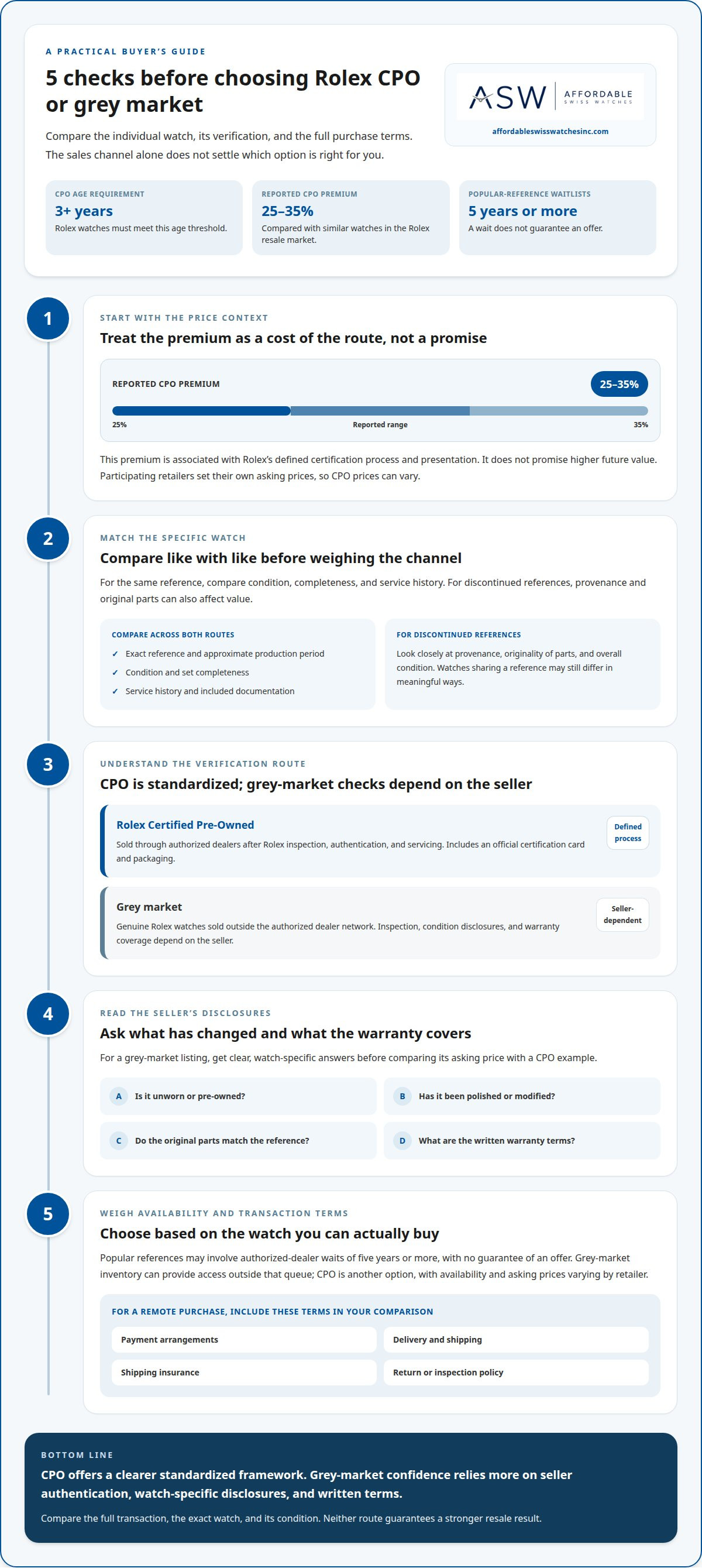
Certified Pre-Owned offers a more standardized route to buyer confidence. When buying from the grey market versus Certified Pre-Owned, you’re weighing that assurance against a wider range of seller-dependent inventory and terms. Rolex Certified Pre-Owned watches are sold through authorized dealers after inspection, authentication, and servicing by Rolex, and include an official certification card and packaging. Grey-market watches are genuine Rolex watches sold outside the authorized dealer network, so inspection, condition disclosures, and warranty coverage depend on the seller.
It’s reasonable to prioritize a clear authentication process and defined warranty, especially when a watch is a substantial purchase. But the CPO label doesn’t settle every question: price, availability, condition, and the specific reference still matter. This comparison explains how the two routes differ in buyer confidence, authentication, warranty coverage, pricing, and inventory. It also clarifies when CPO’s structure may suit you better and when an independent seller’s stated assurances and selection may be a more practical fit.
Key Takeaways
- Compare the total asking price with the watch’s condition and included documentation, not just its sales channel.
- For a grey market purchase, weigh the exact reference, originality of parts, condition, and warranty terms together.
- Rolex Certified Pre-Owned watches must be at least three years old, and participating retailers set their asking prices.
- Choose the route that fits your priorities: a standardized certification process, or a broader range of sellers and inventory.
- Before purchasing remotely, understand the seller’s disclosures about the watch, payment, delivery, and any return or inspection policy.
Is Buying A Rolex CPO Safer Than Grey Market?
Rolex Certified Pre-Owned can offer a more standardized route to confidence, but its higher price does not automatically make every purchase safer. The central price comparison is a reported 25-35% premium over similar watches in the Rolex resale market. Since grey-market watches are sold outside Rolex’s authorized dealer network, the premium may also put a CPO watch above a comparable grey-market example. The right comparison is between watches with matching references, condition, completeness, and service history.
That premium pays for Rolex’s defined certification process and presentation, not a promise of higher future value. Participating retailers set asking prices for their CPO inventory, so certification does not create a uniform price across retailers. Similar watches may be listed at different prices because condition, included items, and seller valuations vary. Compare those details before assuming the CPO label justifies a higher asking price.
Price differences can persist for high-demand Rolex models. The Daytona, GMT-Master II, and some Submariner configurations may be difficult to obtain through authorized dealers. Scarcity can keep secondary-market asking prices above retail, including for watches without CPO certification. CPO prices may be higher still when buyers value Rolex’s inspection and certification. The premium reflects the purchase channel and the individual watch, not a guarantee of appreciation.
Authorized-dealer waitlists are another factor. For popular Rolex references, waits can stretch five years or more, with no guarantee that an offer will follow. A grey-market purchase can provide access to inventory outside that queue, but the asking price may include a premium over retail. CPO also offers an alternative to waiting, though each retailer sets its own price. For buyers seeking a specific reference sooner, availability can matter as much as the sales channel.
So, is buying from the grey market versus Certified Pre-Owned safer? CPO has the clearer standardized framework; confidence in a grey-market purchase depends more on the seller’s authentication, disclosures, and written terms. The CPO premium may make sense when Rolex’s certification is central to your decision. A well-documented grey-market watch may better suit a buyer prioritizing a particular reference, condition, or price. Neither route guarantees a stronger resale result.
For discontinued Rolex references, scrutinize the premium carefully. Provenance, original parts, and overall condition can affect value, so watches with the same reference may not be equivalent. A CPO designation defines the certification route, while a grey-market listing calls for clear, watch-specific disclosures. Compare the actual watch and its full purchase terms, not just the channel name or headline premium.
Choosing between buyer confidence, price, and inventory
Choose a purchase route by weighing its verification process against the watch’s price and availability. The same Rolex reference may suit different buyers depending on its condition, documentation, and timing.
Matching Purchase Routes to Priorities
The decision comes down to choosing the seller and purchase channel that best fit your priorities. Certification, price, and available inventory do not always align. A buyer who values Rolex’s defined CPO process may accept its premium. Someone focused on a particular reference may prefer broader secondary-market inventory. Compare the specific watch and its terms instead of assuming one route wins on every measure.
Grey-Market Dealer Trust and Buyer Risk
Trust in a seller starts with clear, watch-specific disclosures and purchase terms. Grey-market inventory can come from collectors, secondary dealers, international channels, resales, or dealer-to-dealer trades. That variety makes the seller’s inspection and documentation especially relevant. Find out whether the watch is unworn or pre-owned, whether it has been polished or modified, and how its warranty works. Original parts should also match the reference.
Buyer Checklist
A purchase checklist brings the watch’s identity, condition, and transaction terms into one comparison. The same reference can differ in completeness and history, so consider its exact reference and approximate production period, then review the set’s completeness and condition disclosures. Include warranty expectations, paperwork, and any return or inspection policy. For remote purchases, also account for payment, delivery, shipping, and insurance arrangements.
Buyers Suited to CPO
CPO suits buyers who prioritize an authorized-dealer purchase and Rolex’s certification framework. Rolex CPO watches are inspected, authenticated, and serviced by Rolex before sale through authorized dealers. Buyers who value that defined process, along with its official certification card and packaging, may accept the retailer’s asking price. If you want a specific configuration, weigh available CPO inventory against your requirements rather than treating certification alone as decisive.
Consider two buyers seeking a popular Rolex reference. One values the CPO process and will choose among the available certified watches. The other has a specific condition or configuration in mind and may favor broader secondary-market inventory, provided the seller clearly explains the watch and its terms. In either case, compare the full transaction, not only the label or asking price. Buyers weighing an existing timepiece alongside a purchase can also explore watch appraisal options.
Independent dealer warranties and authentication
Authentication, servicing, and warranty terms vary by purchase route. Distinguish proof that a watch is genuine from a promise to cover future repairs.
Authentication and Servicing
Rolex Certified Pre-Owned watches are inspected, authenticated, and serviced by Rolex before sale through authorized dealers. The CPO designation is tied to Rolex’s own inspection and service. An independent seller’s authentication is a separate process, even when the watch is genuine. Condition still matters: polishing, modifications, and parts that do not match the reference can affect originality and value.
Authentication establishes whether a watch is genuine; servicing concerns its mechanical condition and the work performed. A service record can help explain a watch’s history, while condition disclosures describe its present state. Consider these as separate details rather than treating an authenticity statement as evidence of recent servicing.
Independent Dealer Warranties
An independent dealer’s warranty is the seller’s stated coverage, separate from Rolex CPO certification. Coverage varies by watch and seller, so the written terms determine what protection applies. They may specify covered faults, exclusions, duration, and the claims process. A general statement that a watch has a warranty does not explain which repairs qualify or how a claim is handled.
Keep the warranty with your purchase records, and distinguish seller coverage from manufacturer coverage. Authenticity alone does not establish repair coverage. Read the warranty terms separately, alongside the watch’s condition and service history.
Returns and Consumer Protections
Return policies for grey-market and CPO purchases depend on the seller’s stated terms; CPO status alone does not establish a uniform return period. Before buying, understand the policy’s deadline, condition requirements, and approval process. Those details determine how a return works for that transaction.
A return policy and warranty address different situations. The return policy sets the seller’s conditions for sending the watch back; the warranty describes coverage for specified issues after purchase. Keep the listing, invoice, and written terms together to clarify the watch’s represented condition and the transaction terms.
Seller Verification and Manufacturer Service
Assess a grey-market seller by reviewing watch-specific disclosures: reference, condition, parts, authentication, warranty, and return terms. For CPO, confirm the sale is through an authorized Rolex retailer and includes the official certification card. These details help establish whether the watch and sales channel match the description.
Grey-market status identifies the sales channel; it does not by itself establish eligibility for manufacturer repairs, recall work, or service in the United States. Manufacturer service eligibility and seller warranty coverage are separate matters. A seller’s warranty describes the seller’s stated coverage, not a manufacturer’s service decision.
Retail versus secondary-market pricing
Retail and secondary-market prices answer different questions. Retail pricing is the brand’s official price through its authorized network. A secondary-market asking price reflects a seller’s valuation of a particular watch. For a useful comparison, first match the exact reference and configuration. Then consider condition, included documentation, and the terms attached to each listing. Comparing “a Submariner” with another Submariner may overlook meaningful differences.
Condition can change the comparison even when two listings name the same reference. One watch may be unworn, while another has been worn, polished, or modified. Those distinctions affect what the listed price represents. Documentation and included accessories also shape how complete each purchase is. A price comparison that ignores these details can make a lower asking price seem more favorable than the watch warrants.
Pricing for a newly introduced Rolex calls for particular care. A new model can attract secondary-market demand before buyers have a long history of comparable transactions. The Land-Dweller is one example to assess by comparing its official retail position with current secondary-market listings, while noting each listing’s date. An early premium describes the market at that time; it does not establish lasting value or predict later pricing.
Prices also differ among sellers and sales channels. Rolex Certified Pre-Owned retailers set asking prices for their own CPO inventory, and independent secondary-market sellers set their own prices. The label alone does not establish that two watches offer equivalent value. Compare the same reference, condition, completeness, and disclosed service history before drawing conclusions about a price difference.
Don’t treat negotiation as a guaranteed part of the comparison. A listed price is the seller’s stated asking price, and there is no universal negotiation practice across retailers or dealers. Assess each offer on its published terms. If a seller says the listed price reflects current market value, evaluate it against the specific watch and comparable listings rather than assuming a discount will follow.
The practical decision is to identify what the asking price includes. Separate the watch’s stated condition from its documentation, accessories, service records, and warranty terms. Then decide which differences matter to your purchase. For a Rolex Submariner, for example, a matching reference alone does not make two listings equal. A careful, like-for-like comparison is more informative than choosing the lowest displayed figure or paying more solely for a channel label.
Rolex's Certified Pre-Owned program and authorized retailers
Rolex launched its Certified Pre-Owned program in late 2022. It created an official route for buying qualifying pre-owned Rolex watches through authorized retailers. The distinction matters: a watch sold by an independent dealer may be genuine, but that sale is not automatically part of Rolex CPO. Buyers should identify the sales channel before comparing certification, price, and included materials.
Eligibility sets a clear boundary. Rolex CPO watches must be at least three years old, so the program does not cover every pre-owned Rolex on the market. Each qualifying watch is inspected, authenticated, and serviced by Rolex before sale through an authorized dealer. This ties the CPO designation to Rolex’s process rather than solely to an independent seller’s inspection.
The official certification card and packaging are part of the program. They help identify a CPO purchase, but buyers should still match these materials to the specific watch and sales record. A card does not make different references or conditions equivalent. When comparing CPO watches, consider each watch’s reference, condition disclosure, completeness, and asking price.
Authorized retailers set asking prices for their CPO inventory. Rolex certification therefore does not mean every retailer charges the same price for a similar watch. Each retailer’s valuation applies to a specific piece, and the watch’s condition and included items remain relevant to the comparison. A CPO premium pays for access to Rolex’s certification and service process, not a guarantee of appreciation or a better long-term return.
CPO differs from authorized-dealer retail sales. A Rolex purchased at retail is a different transaction from a qualifying pre-owned watch sold under the CPO program. CPO’s value is its defined authentication and servicing route, while the participating retailer sets the price. Buyers prioritizing official Rolex inspection may value that structure; those focused on a particular reference should weigh actual CPO inventory and price against their requirements.
For a practical comparison, confirm that the seller is an authorized Rolex retailer, the watch meets the program’s age requirement, and the official certification card accompanies the purchase. Then compare its reference and condition with other examples. This keeps your decision focused on the individual watch, not simply the CPO label.
Review the Rolex purchase options alongside the CPO criteria to see which buying route fits your priorities.
Affordable Swiss Watches Inc.
Affordable Swiss Watches Inc. offers an independent-dealer option for buyers comparing Rolex watches outside the Certified Pre-Owned program. Its selection includes Rolex Submariner, Datejust, Land-Dweller, and Oyster Perpetual watches. Each pre-owned watch undergoes in-house, multi-step authentication and includes a two-year limited warranty. If a watch is found not genuine, the company provides a full money-back guarantee.
This route may suit buyers who value a seller’s authentication and warranty terms while considering inventory beyond Rolex CPO. Affordable Swiss Watches Inc. is an independent watch dealer, not an authorized Rolex retailer, so its purchases are separate from Rolex’s official certification program. Compare the specific watch, its condition, and the written terms with your priorities. Contact Affordable Swiss Watches Inc. with questions about its Rolex selection.
Choose the route that fits your next decision
Before choosing a watch, decide which trade-off matters most: an official certification route, a particular reference, or the terms attached to one specific listing. That priority gives you a practical way to assess a shortlist without assuming one purchase channel suits every buyer. Buying from the grey market versus Certified Pre-Owned comes down to the watch and its documented terms, not the label alone.
If you’re considering an independent-dealer purchase, Affordable Swiss Watches Inc. offers Rolex Submariner, Datejust, and Land-Dweller watches. Compare an available piece against your priorities for reference, condition, and purchase terms, then decide whether it belongs on your shortlist. A focused conversation can help you weigh the options and decide what you’d like to explore next.
Contact Affordable Swiss Watches Inc. about your Rolex shortlist to discuss the watches you’re considering. Take the next step when you’re ready, with your priorities in view.
Frequently Asked Questions
If retail is cheaper, why doesn't everyone just buy at the boutique?
Retail pricing helps buyers who can purchase their chosen reference through an authorized retailer. If you have a particular model or configuration in mind, a lower official price does not make that watch available to buy. Buyers open to different references, dials, or configurations may find retail more suitable. Those focused on one specific watch can weigh access and timing alongside the asking price.
Which Buyers Usually Benefit Most From Each Route?
CPO is a strong fit for buyers who want Rolex’s own certification and service process attached to their purchase. Grey-market options may suit buyers comfortable evaluating a seller’s documentation and terms for a specific watch. For example, someone choosing between two references may value inventory choice more than a single standardized program. Match the route to the priorities that matter most for the watch you intend to own.
Why do some Rolex watches sell for more than their retail price?
Some Rolex watches have secondary-market asking prices above retail because demand for a particular reference exceeds the supply available through retail channels. Discontinued references can also attract collector interest because they are no longer current production models. These factors explain why asking prices can differ from retail, but they do not establish what a buyer will later recover when reselling the watch.
What does grey market mean when buying a product?
For a Rolex, grey market describes a sale outside the brand’s authorized dealer network. It identifies the sales channel, not a condition grade or a particular level of documentation. A listing may describe a watch as unworn or pre-owned, and seller records may vary. Assess the channel description and the watch’s individual condition as separate details.
What does certified pre-owned mean, and how does certification work?
Rolex Certified Pre-Owned is Rolex’s program for qualifying pre-owned Rolex watches sold through authorized retailers. The designation applies to Rolex watches, not to pre-owned watches generally or every independent dealer’s authentication process. The certification card and packaging identify the program materials accompanying the purchase. Certification documents the CPO route, but does not predict the watch’s future market value.
How do grey-market and certified pre-owned prices compare in the United States?
There is no single asking price for either route across all Rolex references. A useful comparison uses listings for the same reference and similar condition, then considers whether each includes comparable documentation and accessories. Also note when each listing was priced: secondary-market asking prices can change, so listings priced at different times may not reflect the same market conditions.
What warranties come with grey-market purchases versus certified pre-owned products?
Warranty coverage depends on the terms attached to the individual purchase. Before choosing, identify who provides the coverage and whether it is a seller’s warranty or manufacturer coverage. Then read how the written terms define covered work, exclusions, and the claims process. These distinctions matter if a service issue arises later, because a seller’s warranty and a manufacturer warranty are separate forms of coverage.
What are the risks of buying grey-market versus certified pre-owned?
Grey-market purchases call for attention to whether the watch’s components and history fit its stated reference, especially for discontinued models where provenance can affect value. CPO offers Rolex’s defined inspection route, but buyers still need to assess the individual watch and its asking price. For either route, compare the watch’s identity, condition, documentation, and purchase terms as a complete transaction rather than relying on its label.