

The Seamaster's appeal comes from combining a long diving-watch history with models suited to different tastes and routines. The collection began in 1948, and its recreational-diving descendant followed in 1957; Omega began featuring the Seamaster as James Bond's watch in 1995. A useful Omega Seamaster buying guide weighs that heritage against practical details such as case size, water resistance, movement and how the watch compares with a Rolex Submariner.
The Omega Seamaster’s recognizable dive-watch design may draw you in, but the right choice depends on what you value on the wrist. A larger professional-style diver, a restrained everyday model and a vintage-inspired design each offer a different wearing experience.
This Omega Seamaster buying guide explains the collection’s appeal, how key features work and what distinguishes modern models. It also compares the Seamaster with the Submariner, helping you focus on fit, function and design rather than reputation alone.
Key Takeaways
- Vintage Seamaster 300 references can differ in movement and period details, so reference-level research matters when assessing a specific watch.
- The Diver 300M pairs a 300-meter water-resistance rating with a 42 mm case in its current generation; consider fit and everyday wear alongside its Bond association.
- Master Chronometer certification and the Co-Axial movement relate to performance, including resistance to magnetic fields. Learn what those specifications mean in daily use.
- Compare the Aqua Terra, Diver 300M and Planet Ocean by their intended use, water-resistance ratings and wrist presence to narrow the modern collection.
- When weighing a Seamaster against a Submariner, focus on design, fit and the features you value rather than choosing by name alone.
Why is the Omega Seamaster so popular?
The Seamaster combines a history that reaches back to 1948 with purpose-built dive-watch designs. Its vintage references, Bond connection and deep-sea models give buyers distinct reasons to explore the collection.
Seamaster Collection History
The Seamaster collection began in 1948, then gained a recreational-diving descendant in 1957. That history helps explain why vintage references can differ substantially in purpose and construction.
The original Seamaster 300 was advertised with 200-meter water resistance, despite "300" in its name and on its dial. Reference details matter: CK 14755 used calibre 550 or 552, while CK 165.014 used calibre 552 or 560. These distinctions help buyers assess a vintage watch against its stated reference.
Earlier history adds context. Omega introduced the Marine, described as its first real diver's watch, in 1932. In the United States, the Fordney-McCumber Tariff Act of 1922 applied different import taxes to Swiss watches based on adjustment and jewel count. That historical detail reflects how watch specifications could affect import treatment.
The Ploprof took a more specialized path. Its roots trace to experimental watches used by COMEX divers in the 1970s, with a design shaped around deep-sea work. Modern Ploprof models can withstand water pressure to a depth of 1,200 meters, a specification that sets them apart from everyday dive-style watches.
James Bond's Seamaster Connection
Omega began featuring the Seamaster as James Bond's watch in the 1995 film GoldenEye. The films kept the model visible across a span of 30 years, through 2021's No Time to Die.
The connection gave the Seamaster a recognizable place in popular culture, but it doesn't determine which reference suits a buyer. The Diver 300M is the collection's best-known Bond-linked line; compare its design and intended use with vintage models before deciding.
The Omega Seamaster Diver 300M has a five-year warranty. Servicing costs depend on the movement, the watch's condition, required parts and the work involved, such as case refinishing.
In the United States, an Omega boutique or authorized retailer is a direct route for a new Seamaster; a specialist dealer is an option for pre-owned examples. Choose based on the watch's condition, documentation and purchase terms.
For a used Seamaster, compare the reference and serial details with the dial, case and movement, and review available service records. Inspect the bezel, crown, bracelet and clasp for wear or damage; on a vintage CK 165.014, confirm that its movement corresponds to the reference.
Seamaster Diver 300M features and Bond connection
The Diver 300M combines a distinct dive-watch design with technical features that vary by reference. Case dimensions, movement and bracelet choice help separate standard models from chronographs and Bond-related editions.
Diver 300M Features and Specifications
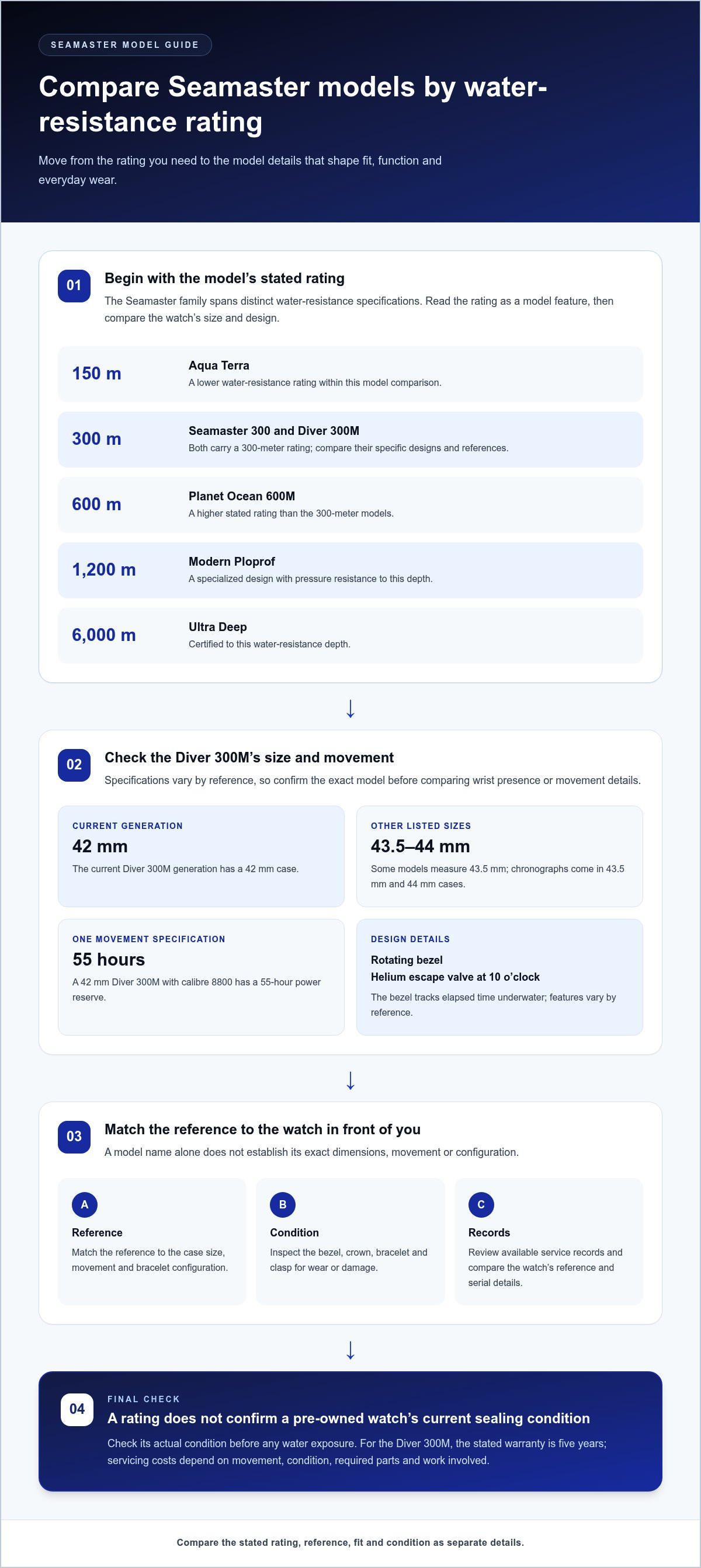
The Diver 300M is a modern diving watch with a 300-meter water-resistance rating. Its helium escape valve sits at 10 o’clock, while the rotating bezel helps track elapsed time underwater. These details matter when comparing practical dive functions with the look and feel of a particular model.
The current generation has a 42 mm case. Some listed Diver 300M models measure 43.5 mm, while chronographs come in 43.5 mm and 44 mm cases. A 42 mm model with calibre 8800 has a 55-hour power reserve. These variations make reference identification important before assessing dimensions or movement.
Water resistance differs across the wider Seamaster family: the Aqua Terra is rated to 150 meters, the Seamaster 300 to 300 meters, and the Planet Ocean 600M to 600 meters. The Ultra Deep is certified to 6,000 meters, while modern Ploprof models can withstand pressure to 1,200 meters. Ratings describe distinct model specifications, not interchangeable features.
Models and Special Editions
Diver 300M models differ by case material, dial, bracelet and movement. The 2018 revamp introduced a ceramic dial with laser-engraved waves. A chronograph adds timing functions and a larger case, while bracelet and strap configurations change the watch’s weight and wrist presence.
The James Bond association gives some editions added cultural significance, including the No Time to Die model. Treat that connection as a design and collecting consideration, not evidence that one reference suits every wearer. The Speedmaster is a separate Omega line, so its heritage should not be confused with the Diver 300M’s Bond identity.
Pre-owned value depends on the specific reference, production period, condition, service records and completeness of the set. A recent Diver 300M and an older example can differ substantially even when their designs look similar. Compare the actual reference and condition before judging two listings; year alone cannot establish equivalent value.
For a used Diver 300M, match the reference to its case size, movement and bracelet configuration. Check bezel action, clasp wear and service documentation. A water-resistance rating does not establish the present condition of a pre-owned watch, so its actual sealing condition matters before any water exposure.
Master Chronometer certification and Co-Axial movement
Master Chronometer certification describes tested performance, while Co-Axial refers to Omega’s escapement design. These terms help you compare movement specifications instead of relying on a model name alone.
METAS Certified Master Chronometer Seamasters resist magnetic fields up to 15,000 Gauss. That rating matters around devices and equipment that produce magnetic fields, which can affect a mechanical watch’s timekeeping. Omega Master Chronometer watches are also guaranteed accurate to within 5 seconds per day. Certification and accuracy are related performance measures, but they describe different aspects of a movement.
The Co-Axial escapement is designed to reduce friction between components. It is one part of the movement’s construction, not a measure of case size, water resistance or power reserve. Compare the complete calibre specifications, since Seamaster models may use different movements and offer different reserves.
For example, a listed Diver 300M uses Omega calibre 8800 and has a 55-hour power reserve. The 8806 movement in the Diver 300M also has a 55-hour reserve, resists magnetic fields reaching 15,000 gauss and operates at 25,200 vibrations per hour, or 3.5 Hz. These details identify movement performance; they don’t establish the exact specification of every reference.
The Seamaster 300 Heritage’s calibre 8400 has a 60-hour power reserve and is specified to run between -4 and +6 seconds per day. The Aqua Terra Worldtimer also has a 60-hour reserve. Its 43 mm case measures 14.12 mm thick, a useful fit consideration for buyers comparing sports watches with a chronograph or slimmer daily-wear model.
Calibre numbers help distinguish movement families, while serial numbers identify an individual watch. Omega calibre 552, introduced in 1958, has 24 jewels. Calibre 565 followed in 1965 with a rapid date corrector. Those historical examples show why a reference, calibre and production period should be considered together, especially for vintage watches.
Other modern examples include the 43.5 mm Planet Ocean with calibre 8900 and the 45.5 mm titanium Ultra Deep with calibre 8912. The Aqua Terra 150M is listed with calibre 8800 in a 38 mm case. Comparing these specifications clarifies how movement, material and case dimensions vary across the collection.
To assess a pre-owned Seamaster’s authenticity, compare its reference and serial details with the case, dial and movement, then review the available documentation. A serial number or card alone does not prove that every component matches the watch’s original specification.
For an Omega Seamaster buying guide, the key is to treat certification, calibre and serial details as separate pieces of evidence. Match each specification to the exact reference, then consider the watch’s intended use and fit.
The Modern Collection: Which Seamaster is Right for You?
Omega’s modern Seamaster collection includes everyday watches, dive models and heritage designs. Start with how you plan to wear the watch, then compare case size and water resistance.
Collection Families and Overview
The Seamaster is a broad collection with more than 150 models across Aqua Terra, Diver 300M, Planet Ocean and Heritage families. Those names indicate distinct designs and specifications, helping you narrow the selection before comparing individual pieces.
Aqua Terra models pair a versatile style with 150-meter water resistance. The Railmaster is another less overtly dive-focused option, with a listed 38 mm case. The Diver 300M and Planet Ocean families have more explicit diving-watch designs, while the Seamaster 300 Heritage draws on earlier Seamaster styling.
Collection labels are a useful first filter, not a substitute for checking reference details. Case sizes and specifications can vary within a family, so compare the exact model to see whether its proportions and functions suit your routine.
Comparing Seamaster Models
Choose the Aqua Terra if you want a more versatile design and don’t need the deeper water-resistance rating of a dedicated dive watch. Its 150-meter rating and range of case sizes give buyers several configurations to consider. A 38 mm Aqua Terra, for example, differs substantially in wrist presence from a 41 mm version.
The Planet Ocean 600M is rated to 600 meters, while the Diver 300M is rated to 300 meters. That difference is meaningful for comparing specifications, though many buyers will place greater weight on case dimensions and comfort than on depth ratings they won’t use.
The Seamaster 300 Heritage and Railmaster offer different ways to choose a less contemporary dive-watch profile. Compare their design, case size and movement details against the Aqua Terra and Diver 300M. Certification can also distinguish some specifications, but it doesn’t replace choosing a style that feels right on your wrist.
Case Size and Wrist Fit
Case diameter is a starting point; wrist circumference and lug-to-lug length also shape how a watch wears. Aqua Terra 150M models are listed in sizes from 28 mm to 41.5 mm, including 34 mm, 38 mm, 38.5 mm and 41 mm. Planet Ocean 600M options range from 37.5 mm to 45.5 mm.
For a wrist measuring around 6.0 to 6.5 inches, the 38 mm Aqua Terra or vintage Seamasters may feel more proportionate. For wrists between 6.75 and 7.25 inches, consider the 41 mm Aqua Terra, Seamaster 300 or 42 mm Diver 300M.
Above 7.25 inches, larger models such as the Planet Ocean and Ultra Deep may sit more naturally. These are starting points, not rules. Compare the watch’s thickness and how its lugs extend across your wrist, since diameter alone cannot predict comfort.
Seamaster versus Rolex Submariner
The Seamaster and Submariner are established luxury dive-watch lines, but the meaningful differences depend on specific references, movement standards and design. Compare the versions you are considering, not broad brand reputations. This matters because “Seamaster” covers several families, while the Submariner comparison usually involves a narrower dive-watch choice.
The Seamaster Diver 300M offers a 300-meter water-resistance rating and, in its current generation, a 42 mm case. Its helium escape valve sits at 10 o’clock. Those details make it a practical reference point for comparing dive-watch features, while other Seamaster models serve different preferences. The Aqua Terra, for example, has a different design and a 150-meter rating.
Magnetic resistance provides a measurable technical distinction. METAS Certified Master Chronometer Seamasters resist magnetic fields up to 15,000 Gauss. Most Rolex models are described as having magnetic resistance of roughly 1,000 Gauss. These figures apply to the stated groups, not every Seamaster or Rolex reference; check the exact model’s specification before treating them as a direct, model-to-model result.
Movement choice also separates particular versions. A listed Diver 300M uses the automatic Omega calibre 8800, with a 55-hour power reserve. Rolex Submariner references have their own movement specifications, so compare the exact reference and production version rather than assuming every model shares one calibre. Buyers who prioritize movement certification should assess the individual watch’s documentation alongside its stated specifications.
Wrist fit can decide the comparison more quickly than brand preference. The 42 mm Diver 300M gives you a clear case-size reference, but diameter alone doesn’t determine comfort. Consider thickness, lug span, bracelet fit and how the watch sits during ordinary wear. Compare both timepieces on the wrist where possible, especially if one has a broader profile or different bracelet construction.
Design and collecting preferences matter, too. The Seamaster Diver 300M has a ceramic, laser-engraved wave dial in models following its 2018 revamp. The Submariner’s appeal centers on its own recognizable design language and reference history. Special editions and changes between versions can affect which details attract a collector, so identify the exact edition before comparing condition or originality.
For a pre-owned example, assess condition, service records, reference consistency and whether components match the watch’s version. A Submariner reference such as 126610 and a Diver 300M should each be evaluated against their own specifications. A complete set can support provenance, but paperwork alone doesn’t establish the condition of the timepiece.
Choose the Seamaster if a specific design, certified magnetic resistance or broader collection options match your priorities. Choose the Submariner if its reference and wearing experience suit you better. Compare the exact watches side by side, using fit and documented specifications as your final criteria.
Affordable Swiss Watches Inc.: Rolex Submariner
If you are considering a Rolex Submariner after comparing it with the Seamaster, Affordable Swiss Watches Inc. sells pre-owned and unworn Submariner watches. Its design and wearing experience may make it a relevant alternative to explore.
Each pre-owned watch in the inventory undergoes in-house, multi-step authentication. Pre-owned watches include a 2-year limited warranty, and a full money-back guarantee applies if a watch is found not genuine. These terms provide concrete points to consider alongside a watch’s condition, provenance and documentation.
Affordable Swiss Watches Inc. is an independent dealer and is not affiliated with Rolex. Before choosing a Submariner, review the specific watch’s details and purchase terms. Contact Affordable Swiss Watches Inc. with questions about its Rolex Submariner selection or the buying considerations in this guide.
Make the Choice That Fits Your Wrist
The right Seamaster is the reference you’ll enjoy wearing, not simply the one with the longest specification list. Consider how its proportions feel over a full day and whether its design suits the occasions when you’ll wear it most. Choosing carefully leaves less room for regret than buying on reputation alone.
Use this Omega Seamaster buying guide as a framework, then narrow your choices to references that match your priorities. If the Submariner remains under consideration, compare the actual watches side by side, weighing condition, fit and documented details together. Affordable Swiss Watches Inc. also sells Rolex Datejust and Rolex Land-Dweller watches for buyers considering other designs.
Take time to review the available options and choose the direction that feels right for your collection. Explore the available watch selection as you continue your search. A confident purchase starts with knowing which details matter most to you.
Frequently Asked Questions
Conclusion: Which Seamaster Should You Choose?
Choose the Seamaster whose size, design and functions suit how you’ll wear it. For a versatile daily watch, compare Aqua Terra configurations; for a more pronounced dive-watch design, consider the Diver 300M or Planet Ocean. If you prefer vintage-inspired styling, assess the Seamaster 300. Try to compare exact references in person, since bracelet feel and case proportions can change your preference.
The Final Verdict: Is the Seamaster a Good Investment?
Approach the Seamaster as a watch to wear and enjoy, rather than as a dependable investment. Resale value can vary with reference, condition, completeness, service history and demand at the time of sale. A limited edition may attract collector interest, but that alone does not establish future value. Choose a specific Seamaster for its design and specifications, not on assumed resale performance.
What is a Master Chronometer?
A Master Chronometer is a tested watch-performance designation associated with METAS certification. It covers criteria including precision and resistance to magnetic fields, with certified Seamaster models resisting fields up to 15,000 Gauss. The designation applies to particular watches, not automatically to every Seamaster. When comparing two references, distinguish certification from the movement’s calibre, power reserve and other specifications.
What are the current Omega Seamaster models and their differences?
The main modern families include Aqua Terra, Diver 300M, Planet Ocean and Seamaster 300, alongside specialized models such as the Ploprof. They differ in design, intended use, case options and water-resistance ratings. Aqua Terra offers a less overtly dive-focused style; Planet Ocean emphasizes greater rated water resistance. Check the specific reference, since one family can contain different sizes, materials and movement configurations.
How much does a new Omega Seamaster cost in the US?
There is no single price for a new Seamaster. Cost depends on the family, reference, case material, complications and configuration. A steel Aqua Terra and a precious-metal or specialized model occupy different parts of the range. Identify the exact reference and consult its current US listing before budgeting, since retail pricing can change. An older price is not a current quote.
How do Seamaster Diver 300M, Planet Ocean, Aqua Terra, and Seamaster 300 compare?
The Diver 300M and Planet Ocean have distinct dive-watch designs, with ratings of 300 meters and 600 meters respectively. Aqua Terra is a more versatile-looking family rated to 150 meters. The Seamaster 300 draws on heritage styling and is rated to 300 meters. Choose by design and fit first, then consider which water-resistance specification and functions are relevant to your use.
What movement, power reserve, and accuracy specifications does each Seamaster offer?
Specifications vary by reference. Listed examples include the Diver 300M with calibre 8800 and a 55-hour power reserve, and the Planet Ocean with calibre 8900. The Seamaster 300 Heritage calibre 8400 has a 60-hour reserve; an Aqua Terra Worldtimer also has a 60-hour reserve. Master Chronometer watches are specified within 5 seconds per day. Confirm each exact reference before comparing.
Do Omega Seamaster prices hold their value, and which models are best for resale?
Seamaster resale values vary, so no family is a reliable resale choice in every market. Condition, originality, service documentation, box and papers, and buyer demand all affect a specific watch’s appeal. Keep purchase records and service documents together, and preserve original components where possible. Compare completed transactions for the exact reference and condition, rather than relying on list prices or brand reputation alone.