

The familiar 42mm Chronomat chronograph may catch your eye first, but it isn’t automatically the right fit. The collection also includes time-and-date models and a GMT configuration, so watches with a similar design can differ in size, function, and wearing experience.
Start with your priorities: how you want the watch to wear, which complication you’ll use, and what materials suit your daily routine. This guide compares the Automatic 36, Automatic GMT 40, B31 Automatic 40, and B01 Chronograph 42. It also explains how to assess an individual listing’s condition, documentation, and warranty terms.
Before you buy, confirm which protections apply to the specific watch. Affordable Swiss Watches Inc. is an independent dealer, and every watch sold comes with a 100% authenticity guarantee and a full money-back guarantee if it is ever found not to be genuine. Pre-owned watches carry a 2-year limited warranty from ASW Inc.; unworn watches carry the original manufacturer’s warranty. Compare each watch on its own details rather than assuming every listing has identical coverage.
Key Takeaways
- Think of the Chronomat as a broad collection. Its 1984 history and centenary connection offer context, but the exact reference is what matters when comparing watches.
- Compare configurations by function and listed size to narrow your shortlist to watches that suit how you plan to use and wear them.
- Use the individual listing to verify materials and dial details. Similar-looking watches do not necessarily share the same specifications.
- Read the condition description, included documentation, and warranty terms for each watch before comparing listings.
- Review ASW Inc.’s six-step authentication process and confirm which protections apply to the watch’s stated condition.
What makes the Breitling Chronomat distinct?
The Breitling Chronomat is a collection, not one fixed configuration. Its models differ in size, materials, and function, so compare the specific watch rather than relying on the collection name. The modern Chronomat’s sports-watch character draws on a design introduced in 1984. Today’s range extends beyond chronographs to include time-and-date and GMT configurations.
Some design details help identify the family resemblance. The modern design is associated with four rider tabs on the bezel, a Rouleaux bracelet with rounded links, and an onion-shaped crown. These features give the Chronomat a recognizable look, but they do not make every model identical. Case size, material, dial, and complications depend on the particular configuration.
A concise definition: The Chronomat is Breitling’s family of sports watches. A reference identifies one particular configuration within that family.
Why does the Chronomat have more than one identity?
The name first appeared in the early 1940s on a watch with a circular slide rule. The modern design arrived in 1984, when Breitling introduced a mechanical chronograph developed for the Italian Frecce Tricolori aerobatic team. That year also marked Breitling’s centenary. For an overview of these iterations, see the Breitling Chronomat Wikipedia page.
This history provides context, not a specification sheet. The 1984 origin does not tell you the movement, materials, or dimensions of a watch offered today. Those details belong to its exact reference and listing. Current examples include Automatic 36, Automatic GMT 40, B31 Automatic 40, and B01 Chronograph 42 configurations, illustrating the collection’s range of functions and sizes.
Who might prefer a Chronomat?
A Chronomat may suit a buyer looking for a luxury watch with a sports-watch character and a choice of functions. A chronograph offers a different experience from a time-and-date model, while a GMT configuration provides another kind of utility. The right choice depends on which complication you’ll use and which design details you want on your wrist.
Fit is personal, so do not assume one model will suit every routine. Consider the listed case size, how the bracelet looks to you, and whether the dial and bezel work with your usual wardrobe. Compare those details with your preferences rather than assuming that the largest or most technically complex option is the best one.
Before browsing, answer three questions: Do you want a chronograph, GMT, or simpler display? Which listed size feels proportionate to your wrist? Does the material and dial combination suit your taste? These answers can narrow a broad collection to a few relevant references.
Which Chronomat configurations should you compare?
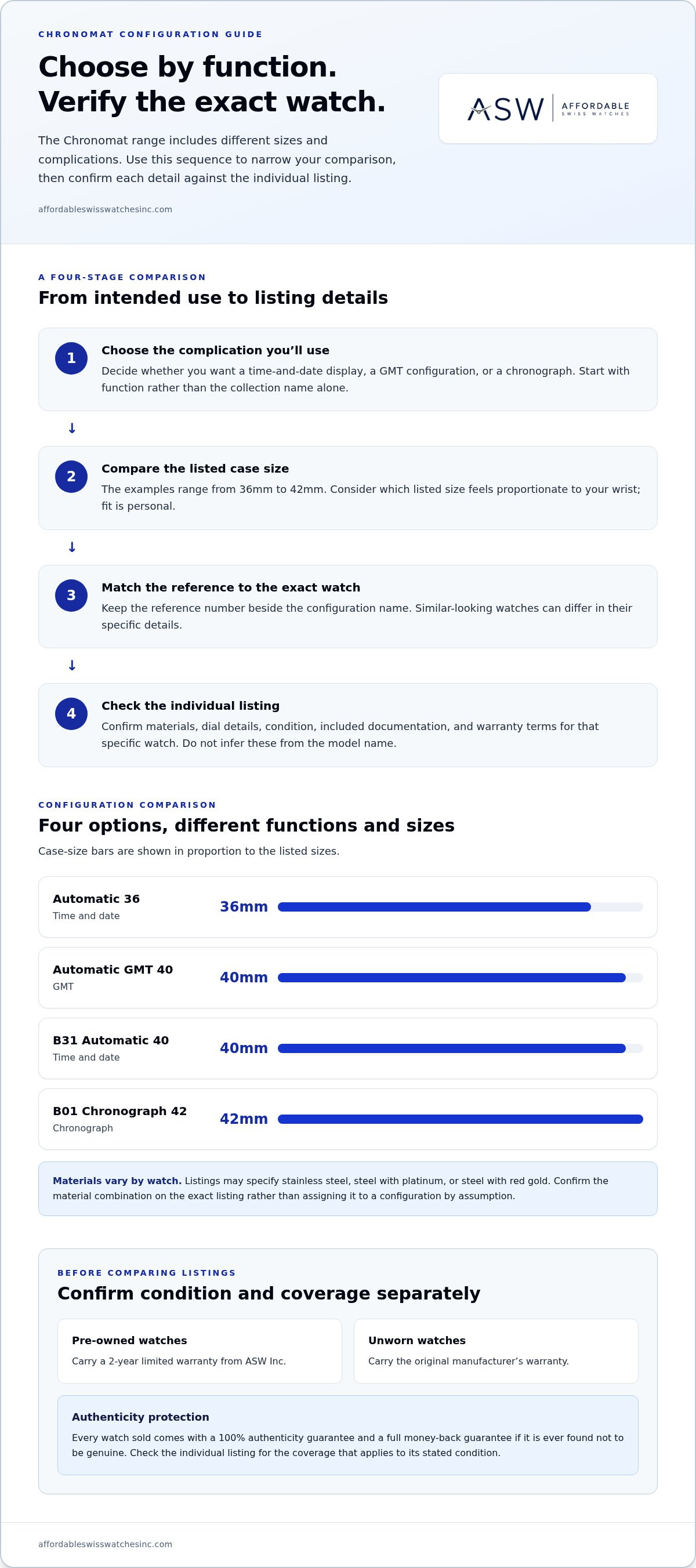
Start with function, then compare size, materials, and dial. Automatic 36, Automatic GMT 40, B31 Automatic 40, and B01 Chronograph 42 identify different configurations, but the model name alone does not establish every detail. Use the exact reference and individual listing to verify the watch’s specifications before deciding.
| Configuration | Listed size | Materials | Stated complication |
|---|---|---|---|
| Automatic 36 | 36mm | Check the individual listing; don’t infer materials from the model name. | Time and date |
| Automatic GMT 40 | 40mm | Check the individual listing; don’t infer materials from the model name. | GMT |
| B31 Automatic 40 | 40mm | Check the individual listing; don’t infer materials from the model name. | Time and date |
| B01 Chronograph 42 | 42mm | Check the individual listing; don’t infer materials from the model name. | Chronograph |
Use the table to build a shortlist, then verify the individual listing. Materials may be described as stainless steel, steel with platinum, or steel with red gold. Do not assign one of these combinations to a model unless the listing for that specific watch says so. Breitling’s official Chronomat collection provides the brand’s overview; use an individual product listing to confirm the exact watch’s details.
How do Automatic, GMT, B31, and B01 Chronograph differ?
The names point to useful distinctions. Automatic GMT 40 identifies the GMT-named option, while B01 Chronograph 42 identifies a chronograph configuration. Automatic 36 and B31 Automatic 40 are separate choices, even though both use the word “Automatic.” The names alone do not establish every specification, so compare the reference and listing instead of assuming the shared term means the watches have identical features.
Which listed Chronomat examples illustrate the range?
Reference A10380101L1A1 is an Automatic 36 example with a mint-green dial. Compare it with Automatic GMT 40 reference A32398101L1A1. Its reference and configuration name identify a different option, so use the listing to confirm its precise materials and features. A B31 Automatic 40 and a B01 Chronograph 42 can broaden the comparison, but their material details should come from each watch’s listing, not assumptions about the model family.
Reference numbers identify specific watches; they are not style names. Keep the reference beside the configuration name when comparing similar-looking models. This makes it easier to distinguish the exact option you’re considering and reduces the risk of mistaking a dial or material description for a model specification. If you’re also weighing a Chronomat against a Rolex Land-Dweller or another Breitling, compare the specific watches by function, size, and design rather than brand reputation alone.
Once you have a shortlist, browse the Chronomat listings and compare each reference with its stated configuration and materials.
How do size, materials, and dial affect your choice?
Use the listed case diameter as a starting point, not a verdict on fit. A 36 mm, 40 mm, or 42 mm case gives you a basis for comparison, but wrist presence also depends on the case’s proportions and how the bracelet looks on you. The reference and listing matter more than the collection name because they identify the specific configuration you’re assessing.
How should you choose between 36 mm, 40 mm, and 42 mm?
If possible, compare the diameter with watches you already wear. Decide whether you prefer a more restrained or more prominent look, then consider the case shape and bracelet appearance too. Diameter is one useful point of comparison, but proportions and design details also affect how a watch looks on the wrist.
A listing’s stated diameter cannot tell you exactly how a watch will fit. If you cannot assess it in person, use the available details and images to judge its visual scale, while treating that judgment as an estimate. Do not assume that a smaller diameter will feel comfortable or that a larger one will feel too substantial. Personal preference and wrist proportions both matter.
Which materials and dial details should you weigh?
Read material descriptions literally. A listing that specifies stainless steel gives you a different visual reference from one that specifies steel with platinum or steel with red gold. The combination affects the watch’s appearance, but do not infer the material of a particular model from its name or another listing. Compare only the metals named for the individual piece.
Dial colour can change the character of a familiar case. For example, the mint-green dial on Automatic 36 reference A10380101L1A1 offers a distinct look. Use the listing to verify the exact dial description for any watch you compare. Treat white or other dial options as details to verify for a specific listing, not as assumed variants. Check that the photos and written description refer to the same configuration.
Gem-set or diamond details are worth considering when they appear explicitly in the listing. Treat them as design preferences, not evidence of future value or investment performance. The same goes for a distinctive dial colour: choose it because you want to wear it, not because you expect it to appreciate.
Before choosing, note the listed diameter, material wording, dial colour, and any stated gem-set details for each candidate. This simple comparison helps separate actual differences from assumptions based on similar styling. If you’re comparing sports-watch designs across brands, a Rolex Submariner buyer’s guide can provide a separate point of reference.
How should you assess condition, documentation, and warranty?
Read each listing as a description of one specific watch. “Unworn” and “pre-owned” are distinct condition labels, but neither tells you whether original accessories or documentation are included. Check the item description for the stated condition, included contents, and warranty information. Do not infer these details from photographs or from another listing.
What does ASW Inc.'s authentication process involve?
ASW Inc. uses a six-step in-house authentication process:
- Initial visual inspection. The watch receives an initial visual examination.
- Internal component verification. The movement and serial number are verified.
- Provenance assessment. The watch’s history, certificates, and service records are assessed.
- Timekeeping testing. Its timekeeping is tested against brand tolerances.
- Restoration and servicing. Restoration and servicing take place at ASW Inc.’s dedicated service center.
- Final approval. The watch receives final approval after the preceding steps.
This process explains how ASW Inc. evaluates a watch. It is separate from the documentation that may accompany the item, so assess the listing’s included contents on their own merits. Every watch sold also comes with ASW Inc.’s 100% authenticity guarantee and a full money-back guarantee if it is ever found not to be genuine.
What do box, papers, and warranty terms tell you?
Original accessories and documentation are included where available. Box and papers are listing-specific details, not standard contents to assume for every watch. Check the item description for exactly what is included. If photos show accessories, use the written listing to determine whether they accompany that particular watch.
Some pre-owned pieces carry third-party Pre-Owned Certified status from WatchCSA. This status applies to select pieces only. Treat it as a detail of the individual listing, alongside the stated condition and included documentation.
Before comparing two watches, note each item’s condition description, included documents and accessories, and stated warranty. This helps distinguish listings that may look similar but differ in what accompanies the watch and what coverage applies. Base the comparison on the individual item descriptions, not assumptions drawn from the model name or another example.
How can you choose and buy the right Chronomat through ASW Inc.?
Make the decision in a consistent order: choose the function you want, narrow by case size, compare materials, select a dial, then consider condition. This keeps a striking colour or familiar collection name from outweighing practical preferences. Once you have a shortlist, compare each listing’s exact reference, condition description, included documentation, and applicable warranty.
ASW Inc. is an independent luxury watch dealer unaffiliated with any single watch brand. Assess each Chronomat listing on its own details. The model family helps identify the general configuration, but the reference number and item description are the more useful guides to the specific watch.
What should your final comparison checklist include?
Write down the details for each candidate before choosing. A side-by-side comparison makes it easier to see where similar-looking listings differ and which details matter most to you.
- Configuration and function: Record the preferred configuration and its stated complication.
- Case diameter: Note the listed size and how it aligns with your fit preference.
- Materials and dial: Capture the materials and dial description exactly as stated.
- Reference and condition: Match the reference number to the listing, then read its condition description rather than relying on a general label.
- Documentation and warranty: Note which accessories or documents are included and match the warranty to the watch’s stated unworn or pre-owned condition.
Use this record to remove candidates that miss a priority, not to rank every detail equally. If a particular function is essential, make it a deciding factor. If dial colour is a preference rather than a requirement, give condition or fit more weight. The right choice is the listing that best matches your priorities and has details you can verify.
Where can you browse current Chronomat listings?
ASW Inc.’s Chronomat listings give you a place to apply this checklist. Review each item description for the exact reference, stated condition, included documentation, and warranty information. Listings can change, so use the individual page for details about the specific watch rather than assuming another example has the same features or accessories.
Compare a short list before deciding. If one listing fits your preferred function and size but differs in condition or documentation, weigh that trade-off against your priorities. A clear comparison keeps the decision grounded in the watch itself rather than its name alone.
Browse the Chronomat collection to review current listings and apply your comparison checklist at your own pace.
Choose the Chronomat that fits your priorities
Before deciding, set one non-negotiable and identify one point where you can be flexible. You might prioritize a particular function while staying open to a different dial or material. This gives you a practical way to weigh trade-offs when two listings appeal to you, without letting a small visual difference distract from what matters most.
Then return to the exact listing and make sure its details match the watch you intend to buy. A considered choice does not require a model that leads in every category. It means selecting a configuration whose function, proportions, appearance, and stated condition align with how you plan to wear it.
ASW Inc. is an independent dealer, and its listings provide the specific details for each available piece. Compare the options that meet your priorities, then browse the Chronomat collection to explore current listings at your own pace.
Frequently Asked Questions
Is the Breitling Chronomat suitable for daily wear?
It may suit daily wear if its fit works with your routine. Compare the listed case diameter with a watch you already wear, and consider cuff clearance, desk contact, and bracelet comfort through a typical day. Think about whether you would remove a valuable watch for some activities. These habits can help you judge whether a particular Chronomat fits your everyday life.
What is the difference between a Chronomat GMT 40 and a B01 Chronograph 42?
Choose the GMT configuration if tracking another time zone is useful to you; choose a chronograph if elapsed-time timing is your priority. Let the complication guide your decision instead of choosing by model name alone. If neither function has a clear role in your routine, compare simpler configurations instead.
Do Chronomat watches come with a box and papers?
Check the listing to see what accompanies that specific watch. A box is an accessory, while papers are documentation; neither should be assumed to come with every piece. Use the item description rather than assuming pictured contents are included or that another listing has the same package. If completeness matters to you, include it in your comparison.
What warranty applies to an unworn or pre-owned Chronomat from ASW Inc.?
An unworn watch carries the original manufacturer’s warranty. A pre-owned watch carries a 2-year limited warranty from ASW Inc. Every watch sold also has a 100% authenticity guarantee and a full money-back guarantee if it is ever found not to be genuine. Review the individual listing’s condition and warranty details so you know which warranty applies to the watch.