

The most recognizable Day-Date isn’t automatically the right one for your wrist. A 36 mm and a 40 mm model can share defining features yet look and feel quite different when worn. To choose between them, compare proportions, material, dial, reference, and condition rather than relying on prestige alone.
If similar-looking listings make it difficult to tell what sets one watch apart, focus on the details that identify the individual piece. Condition, included documentation, and warranty coverage matter, especially when comparing unworn and pre-owned watches. This guide explains what to compare before you decide.
We’ll look at the 36 mm and 40 mm sizes, consider how material and dial choices affect the watch’s appearance, and review specific collection examples. You’ll also find a practical way to assess listing details and understand the safeguards offered by Affordable Swiss Watches Inc., including its authenticity guarantee and the separate warranty terms for unworn and pre-owned watches.
Key Takeaways
- “Day-Date” can describe a day-and-date display or refer to Rolex’s named model. Check the brand and full model name to understand which meaning applies.
- Compare case diameter, material, dial, condition, and reference side by side when assessing similar listings.
- The Rolex Day-Date 40 in yellow gold, reference 228238-0006, is one specific comparison point. It is listed as unworn with a 40 mm case.
- Choose a day-date watch by model family, size, material, dial, and condition, then check the exact reference and listing details.
- Warranty coverage depends on condition: unworn watches carry the original manufacturer warranty, while pre-owned watches carry ASW Inc.’s 2-year limited warranty. Every watch sold has a 100% authenticity guarantee and a full money-back guarantee if it is ever found not to be genuine.
What does "Day-Date" mean when comparing watches?
“Day-Date” can refer to Rolex’s named model family or describe a watch that displays both the day of the week and the date. The meanings overlap, but they are not interchangeable. When a listing uses the term, start by identifying the brand and full model name, then check the reference and specifications.
A product description may use “day-date” to describe a display function, while a listing for a Rolex Day-Date refers to a specific model family. The words alone don’t identify the watch’s brand, reference, case size, material, condition, or exact features. Treat them as a starting point, not a complete description.
How is a Rolex Day-Date different from a day-date description?
The Rolex Day-Date is a distinct model family. Day-Date wording may also appear as part of another watch’s full model name, which does not make it a version of the Rolex model. This distinction helps prevent a common comparison mistake: assuming that watches with similar wording share the same design, specifications, or model history.
For background on Rolex’s model, see Rolex Day-Date History. When comparing listings, use the brand, full model name, and reference together. The reference identifies a particular configuration more precisely than a broad label does. If two listings both say “Day-Date,” compare their individual specifications rather than assuming they describe equivalent watches.
What should a buyer decide before comparing listings?
First decide whether you’re looking specifically for a Rolex Day-Date or are open to other watches with a day-and-date display. Then set priorities for size, material, dial, and condition. Making these choices first narrows the options and keeps small differences between individual listings from becoming distracting.
Use this checklist to keep the comparison focused:
- Model family: Identify the brand and full model name.
- Size: Compare the listed case diameter and consider how you want the watch to sit on your wrist.
- Appearance: Note the material and dial details that suit your preferences.
- Condition: Distinguish unworn from pre-owned, since the condition label also relates to warranty coverage.
- Listing details: Match the reference to the stated specifications before drawing conclusions.
Prestige alone is a poor way to choose. Personal fit and accurate listing information provide a more useful basis for comparison. Once you’ve defined your preferences, assess each configuration on its own terms.
How should you compare Day-Date size, material, and dial?
Put the specifications side by side before deciding which configuration suits you. A simple table makes differences easier to spot and helps prevent a familiar dial or gold tone from distracting you from case size, condition, or reference.
| Model | Case diameter | Material | Dial | Condition | Reference |
|---|---|---|---|---|---|
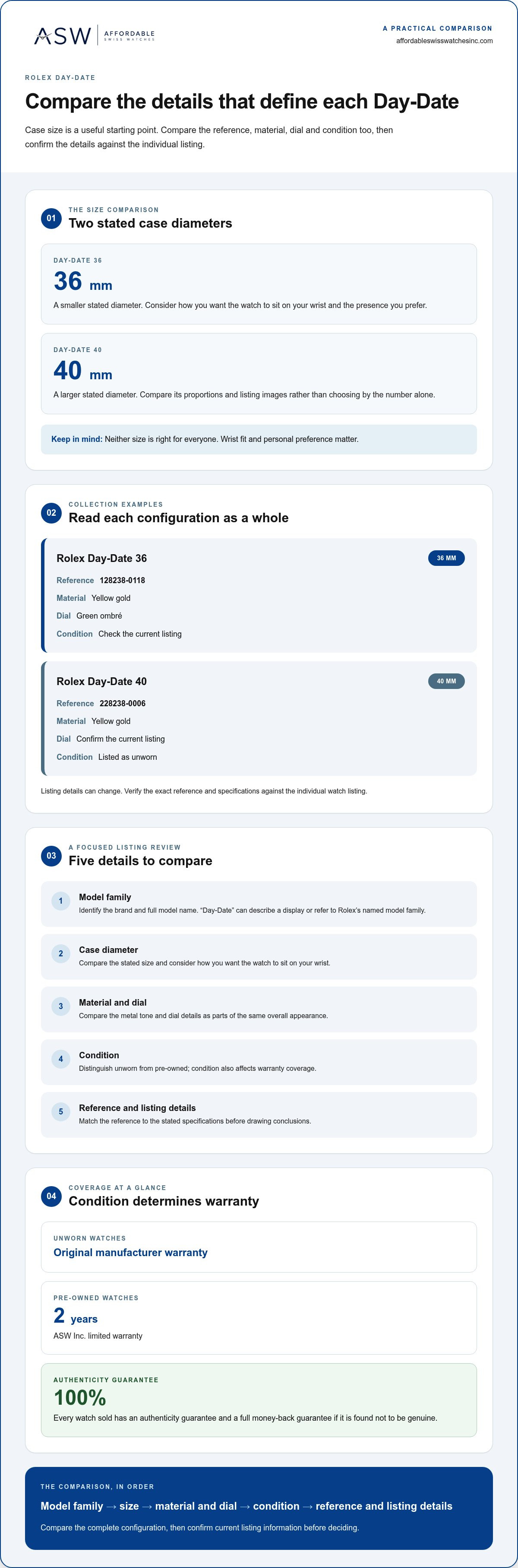
| Rolex Day-Date 36 | 36 mm | Yellow gold | Green ombré | Review current listing | 128238-0118 |
| Rolex Day-Date 40 | 40 mm | Yellow gold | Review current listing | Unworn | 228238-0006 |
Listing details can change. Use the table as a comparison framework, then confirm each specification against the individual watch listing before deciding.
Should you choose a 36 mm or 40 mm Day-Date?
Both sizes have a distinct wrist presence, and neither is right for everyone. The 36 mm example, reference 128238-0118, pairs a smaller stated case diameter with yellow gold and a green ombré dial. The 40 mm example, reference 228238-0006, is listed as unworn in yellow gold. These details show why size is one part of a configuration, not a complete description of the watch.
Consider how each diameter relates to your wrist, whether you prefer a more restrained or more noticeable presence, and how often you expect to wear the watch. Compare the stated diameter and listing images carefully. Avoid assuming that a larger or smaller case will suit you based on the number alone; proportions and personal preference matter too.
Which gold tone and dial details fit your preferences?
Yellow gold has a warm, distinctive appearance. White gold offers a cooler, less contrasting look, while Everose gold has a warmer pink tone. These are visual differences, not a ranking of quality. Compare how the metal finish works with the dial instead of choosing by material name alone.
The 36 mm yellow-gold reference 128238-0118, with its green ombré dial, is one example of how dial colour can change a watch’s overall character. Diamond-set details add another design element and may draw more attention to the dial or bezel. Treat these as matters of taste, not as evidence of condition or a substitute for reviewing the watch’s stated condition and listing details.
To compare available configurations, browse the Day-Date watch collection and assess each listing by its exact specifications.
Which Day-Date collection examples are worth comparing?
Specific listings make the differences between Day-Date watches easier to assess. Compare the brand and full model name first, then check the reference, case diameter, material, dial, and stated condition. The examples below illustrate different options in the collection. Since listing details can change, use the current product page for the specifications and condition of each watch.
How do the Rolex Day-Date examples differ?
The Rolex Day-Date 40, reference 228238-0006, is listed as unworn, with a 40 mm case and yellow-gold material. The Rolex Day-Date 36, reference 128238-0118, is listed in yellow gold with a green ombré dial. These examples let you compare case size and dial configuration. The condition detail supplied for the 40 mm listing gives you another factor to consider.
Use the reference to keep each configuration distinct. Both watches share the Rolex Day-Date name and yellow-gold material, but their case diameters differ, and the 36 mm example has a specified dial colour. Don’t assume the details of one listing apply to another reference. Confirm the dial and condition stated for the individual watch, along with its other specifications, before deciding.
When might a TAG Heuer Carrera Day-Date suit the buyer?
A TAG Heuer Carrera Day-Date is a separate model name, not a Rolex Day-Date variant. The useful point in this comparison is that “Day-Date” wording alone does not identify a single model or set of specifications. Compare the full brand and model name, then assess the reference and details for the specific watch you’re considering.
Decide which model family you prefer, then compare its stated dimensions, appearance, and condition against your priorities. Avoid inferring unlisted details from the reference or the name alone. The Rolex examples in this guide should be assessed as individual Rolex configurations, not as a template for other watches.
A practical comparison records each watch’s brand, full model name, reference, case size, material, dial, and condition. This makes similarities and differences visible without relying on prestige or a broad category label. Affordable Swiss Watches Inc. is an independent dealer. Every watch sold carries a 100% authenticity guarantee and a full money-back guarantee if it is ever found not to be genuine. Review the current listing details before deciding, since they describe the individual watch being offered.
How can you assess Day-Date condition and buying confidence?
Condition labels affect both what you’re buying and which warranty applies. Read the listing’s condition description alongside its reference and specifications, then distinguish clearly between unworn and pre-owned coverage. Affordable Swiss Watches Inc. is an independent dealer. Every watch sold has a 100% authenticity guarantee and a full money-back guarantee if it is ever found not to be genuine.
What does ASW Inc. check during authentication?
ASW Inc.’s authentication process follows six documented steps. Each addresses a different part of the assessment:
- Initial visual inspection: Examine the watch’s visible details.
- Internal component verification: Verify the movement and serial number.
- Provenance assessment: Assess the watch’s history, certificates, and service records.
- Timekeeping test: Test accuracy against brand tolerances.
- Restoration and servicing: Handle restoration and servicing at ASW Inc.’s dedicated service center.
- Final approval: Complete the process with a final approval.
This sequence gives buyers a concrete account of the checks behind ASW Inc.’s authenticity guarantee. The guarantee applies to every watch sold, with a full money-back guarantee if a watch is ever found not to be genuine.
What should you understand about condition and warranty?
Warranty coverage depends on condition, so don’t treat “unworn” and “pre-owned” as interchangeable labels. An unworn watch carries its original manufacturer warranty. A pre-owned watch carries an ASW Inc. 2-year limited warranty. These terms apply to their respective condition categories, so read them that way when comparing listings.
Original accessories and documentation are included where available. Some pre-owned pieces may also carry third-party WatchCSA Pre-Owned Certified status. Review the specific listing for the accessories, documentation, condition, and certification details that apply to that watch; don’t assume one listing’s contents carry over to another.
Listed prices reflect the current market value of each watch. Compare the stated condition, warranty, and listing details rather than assuming a price is negotiable or that two watches are equivalent because they share a model name.
Review the Day-Date watch listings to compare current condition details and warranty terms for individual pieces.
How do you choose and buy the right Day-Date watch?
A sound buying decision follows a clear order: choose the model family, case size, material, dial, and condition. This sequence narrows the field according to what you value, then leaves the exact reference and listing details as the final check. It also keeps a familiar name or prestigious reputation from outweighing practical fit.
What final checks help narrow the shortlist?
Before deciding, review each shortlisted watch against the same criteria. A simple checklist can catch differences that are easy to miss when listings look similar:
- Model identity: Match the brand and full model name to the reference.
- Configuration: Confirm case size, material, and dial against the specific listing.
- Condition: Check whether the watch is listed as unworn or pre-owned.
- Purchase details: Review the warranty terms and note which original accessories or documentation are included, where available.
Don’t assume two similar references have the same material, dial, or condition. Small differences can define the configuration. Compare the stated information for each individual watch rather than carrying details over from another listing.
Warranty coverage follows condition: unworn watches carry the original manufacturer warranty, while pre-owned watches carry an ASW Inc. 2-year limited warranty. ASW Inc. also provides a 100% authenticity guarantee on every watch sold and a full money-back guarantee if a watch is ever found not to be genuine. These safeguards are part of the purchase review, not substitutes for matching the listing to your preferences.
Where can you compare current Day-Date listings?
Once you know which model family, size, material, dial, and condition suit you, compare the current Day-Date collection listings. Read each product description closely and use its reference to distinguish similar configurations. Inventory and listing details can change, so rely on the current information for the individual watch.
Listed prices reflect each watch’s current market value. Consider the price alongside the specific configuration and condition rather than assuming that watches with similar names or appearances are equivalent.
With your priorities set, browse the current Day-Date collection and compare the details of each listing at your own pace.
Choose with confidence by focusing on the details
The right day-date watch is the one that fits your preferences and stands up to a careful listing review. Start with the model family, then compare case size, material, dial, and condition. Before deciding, match the reference and specifications to the exact watch rather than assuming similar models share the same configuration.
Condition also determines warranty coverage: unworn watches carry the original manufacturer warranty, while pre-owned watches have an ASW Inc. 2-year limited warranty. Affordable Swiss Watches Inc. backs every watch sold with a 100% authenticity guarantee and a full money-back guarantee if a watch is ever found not to be genuine. Its documented six-step authentication process provides a clear framework for verification.
Take time to compare the details that matter most to you. Browse the Day-Date collection to review current listings and find a configuration that fits your priorities.
Frequently Asked Questions
Is the Rolex Day-Date available in 36 mm and 40 mm?
Yes. The collection examples include Rolex Day-Date watches listed with 36 mm and 40 mm cases. Neither size is universally preferable; consider how each proportion relates to your wrist and whether you prefer a more restrained or more pronounced presence. Use the stated case diameter as a starting point, not the sole deciding factor. Check the exact reference and current listing details, since material, dial, and condition can differ.
What is the difference between a Rolex Day-Date and a TAG Heuer Carrera Day-Date?
They are distinct model names from different brands. “Day-Date” doesn’t identify one watch model across brands. Compare the brand and full model name, then review the reference, case size, material, dial, and condition for each watch. This helps distinguish specific configurations instead of assuming they share specifications.
How can I know whether a Day-Date watch is authentic?
ASW Inc. applies a documented six-step authentication process: visual inspection, movement and serial number verification, provenance assessment, timekeeping testing against brand tolerances, restoration and servicing at its dedicated service center, and final approval. Every watch sold has a 100% authenticity guarantee and a full money-back guarantee if it is ever found not to be genuine. Review the individual listing for details about the specific watch.
Does a pre-owned Day-Date have the same warranty as an unworn watch?
No. Warranty coverage depends on the listed condition. Pre-owned watches carry a 2-year limited warranty from ASW Inc. Unworn watches carry the original manufacturer warranty. Check whether the listing describes the watch as pre-owned or unworn before comparing warranty coverage. The terms are distinct and do not apply to both condition categories.
How should I compare Day-Date listing prices?
Listed prices reflect the current market value of each individual watch. To compare day-date listings, review the exact reference, condition, material, dial, and included documentation rather than treating similar-looking watches as equivalent. Each configuration and its stated details matter. Use the current product listing to assess what applies to that watch, and avoid drawing conclusions from the model name alone.
When you’re ready to compare current options, browse the Day-Date collection at your own pace.