

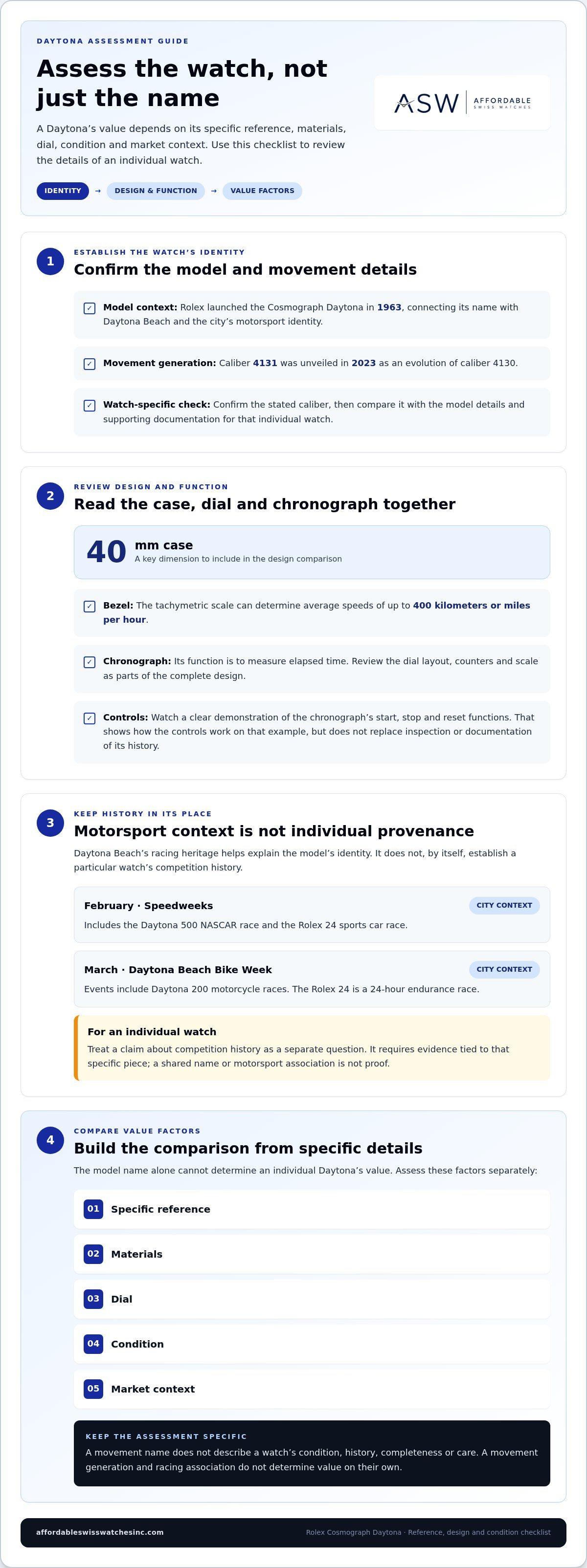
Daytona's motorsport identity predates the watch: Rolex launched the Cosmograph Daytona in 1963, giving the model its enduring name. Today, its price depends on the specific reference, materials, dial, condition and market context, so the name alone cannot determine an individual watch's value.
That distinction matters when comparing examples. The Daytona’s racing heritage helps explain its appeal, but each watch’s specific details shape its value and deserve careful assessment.
This guide explores the model's motorsport history, caliber 4131, dial design and materials. You'll learn how these details inform comparisons and help you understand the factors behind a Daytona's price.
Key Takeaways
- The model’s motorsport identity connects to Daytona Beach, while its launch in 1963 marks its place in Rolex history.
- Caliber 4131, unveiled in 2023, is an evolution of caliber 4130. Understanding the movement helps you assess the watch beyond its appearance.
- Compare the 40 mm case, dial layout and tachymetric scale to understand how the design supports the chronograph’s racing association.
- Material, dial, condition and market context all affect how individual examples compare. Use these details rather than the model name alone to assess value.
- When considering a different Rolex, compare its design and purpose with options such as the Submariner, Datejust, Land-Dweller and Oyster Perpetual.
Daytona history and motorsport connections
Daytona Beach's racing identity gives the Rolex Cosmograph Daytona a distinctive context. The model's 1963 launch connects its name with a Florida city known for motorsport.
Daytona History
Daytona Beach, Florida, was founded in 1870. The Town of Daytona was incorporated on July 26, 1876. These dates mark the city's early development, before the watch appeared decades later. The U.S. Census Bureau recorded 72,647 people in Daytona Beach in the 2020 census, placing the watch's namesake in a real community, not simply a racing venue.
That distinction helps buyers separate the city's history from the watch's own timeline. Rolex launched the Cosmograph Daytona in 1963, giving the model a direct association with the place. A careful account keeps these milestones separate: the town's founding and incorporation describe local history, while 1963 marks the watch's introduction.
The Daytona name carries more than a geographic reference: Daytona Beach’s motorsport history is part of the model’s identity. That heritage provides context, but does not determine the value of an individual watch. Assess the specific reference, condition, dial and materials separately.
Motorsport Connections
Daytona Beach's racing events reinforce the connection. Speedweeks is held in February and includes the Daytona 500 NASCAR race and the Rolex 24 sports car race. In March, Daytona Beach Bike Week events include Daytona 200 motorcycle races. These different events connect the city with stock-car, sports-car and motorcycle competition.
The Rolex 24 At DAYTONA is a 24-hour endurance race. Its format gives the event a clear link to sustained performance, a natural association for a chronograph designed to measure elapsed time. The race and watch share the Daytona name, but that association is historical and thematic. It should not be treated as evidence that a particular watch was used in a race.
When assessing a Daytona, use motorsport history to understand the model's identity, not as a substitute for examining the watch. A useful first step is to separate documented model facts, such as its 1963 launch, from personal assumptions about racing provenance. Reserve any claim about an individual watch's competition history for evidence tied to that specific piece. That distinction keeps the city's heritage meaningful without confusing it with a particular watch's documented record.
This adds another dimension to Daytona Beach’s history: the city’s identity includes both motorsport events and a trail focused on Black heritage. Grant-supported interpretive signage connects visitors with this part of the city’s past. Keeping that civic context distinct from the Daytona’s racing associations provides a broader view of the place behind the model’s name. Neither context establishes the provenance or history of an individual watch.
Caliber 4131 movement
The Rolex Cosmograph Daytona is equipped with caliber 4131, an evolution of caliber 4130 unveiled in 2023. That relationship gives buyers a clear starting point: identify which movement generation belongs to the watch under consideration. The caliber name is more useful than general claims about performance because it identifies a specific movement family and its place in the model's history.
A chronograph measures elapsed time, which connects the movement's function with the model's motorsport identity. NASCAR races such as the Daytona 500 help explain the wider cultural association between racing and precise timing. That connection does not establish that a particular watch was used in competition. Treat the movement's role and a watch's personal provenance as separate questions.
When comparing examples, begin with the stated caliber and the watch's documented identity. Then compare the movement information with the model details provided for that individual piece. A movement name alone cannot describe the watch's condition, history or completeness. It also cannot tell you whether a particular example has received appropriate care. Those points require evidence specific to the watch, rather than assumptions based on the caliber generation.
The 4131's 2023 unveiling marks a practical distinction for buyers comparing it with the earlier 4130. Focus on what the known lineage establishes: 4131 is an evolution, not an unrelated movement name. Avoid treating that relationship as proof that every component, performance measure or service history is identical. The relevant question is which movement is documented in the specific watch and whether its condition is supported by the watch's records.
Use the same review for each watch: confirm its stated movement designation, compare that with the model information and supporting documentation, then watch a clear demonstration of the chronograph’s start, stop and reset functions. A demonstration shows how the controls work on that example, but does not replace inspection or documentation of its history. Keep each check specific to the watch.
This measured approach helps separate technical facts from racing associations. The connection to NASCAR gives the chronograph context, while caliber 4131 identifies the movement generation. Neither point alone determines an individual watch's value. Compare its movement documentation with its dial, materials and condition before weighing the complete package. For a closer look at available examples, browse the Rolex Daytona collection and compare each watch's stated details.
Daytona design and dial
The Rolex Cosmograph Daytona’s design combines a 40 mm case with a chronograph layout shaped by racing use. Its scale, counters and dial should be assessed together, since each affects legibility and the watch’s overall appearance.
Design Features
Start with the 40 mm case, then examine how the bezel and dial form the watch’s visual frame. The tachymetric scale can determine average speeds of up to 400 kilometers or miles per hour. That racing function gives the bezel a role beyond decoration, while its position around the dial makes it a defining design element.
The characteristic five-circle design brings together the bezel, minute track and three counters. Consider how these circular elements relate before deciding whether the layout suits you. Their repeated shapes give the dial structure, while the outer scale emphasizes the chronograph’s timing function.
Dial Details
The three counters are central to the dial’s appearance and chronograph layout. When reviewing the watch in person or in clear images, check that each counter stands apart from the main dial. Consider whether the hands, markers and counter positions are easy to read, including when the chronograph is running.
Dial preference is personal, but comparisons are clearer when other variables stay consistent. Compare examples with the same case material, then consider differences in dial color and contrast. This helps you judge the dial itself without confusing its visual effect with differences in material or condition.
For a focused inspection, check the case proportions, trace the tachymetric scale around the bezel, inspect the minute track and three counters, then assess legibility across the dial. Photos help with broad comparisons, but reflections and viewing angles can hide details. Compare images under similar lighting and at a consistent viewing distance.
Design also affects how the watch feels in daily use. The 40 mm case provides a fixed reference point, while the dial’s contrast and counter arrangement determine how quickly its information stands out. A buyer who values a restrained appearance may weigh dial balance differently from someone drawn to the visible racing cues. Neither preference changes the underlying specifications.
Before choosing, compare the proportions and dial details on the specific watch you are considering. The tachymetric scale’s stated capability and the five-circle layout provide useful reference points, but condition and materials remain separate considerations. To compare individual examples, browse the Rolex Daytona collection with these design details in mind.
Daytona materials and prices
Material is a key point of comparison among Rolex Cosmograph Daytona versions. Consider the case, bezel and bracelet together, then assess how the configuration affects the watch’s current market value.
Material Options
Oystersteel, yellow gold, white gold, Everose gold and platinum appear among Daytona material options. The platinum version has a 950 platinum case. Certain versions with a Cerachrom bezel and Oysterflex bracelet are made in 18 kt gold. Check the complete configuration, since a material description may refer to the case, bracelet or both.
For a practical comparison, note the case metal first, then identify the bezel and bracelet. An Oystersteel configuration and an 18 kt gold version present different material choices and visual profiles. Platinum brings another distinct case material. These differences can help narrow a shortlist before you assess dial preference, condition and the specific watch’s market value.
Price Considerations
Price comparisons are useful only when the configurations are clear. Start with the material, then compare the dial, bracelet or strap, condition and reference details. For example, Oystersteel and gold configurations are different watches, not directly interchangeable listings. Compare each configuration within its own market context rather than treating one price as representative of every Daytona.
A watch’s current market value also depends on its condition and completeness. Compare like with like, matching materials and dials where possible, then account for differences between the individual examples. A listed price applies to that particular watch at that time, not every Daytona or future sale.
When reviewing listings, write down the stated material, dial, bracelet or strap, and condition for each watch. That simple comparison prevents a gold version from being judged against an Oystersteel model as though their configurations were identical. Note whether a listing identifies 950 platinum or 18 kt gold, and whether it names a Cerachrom bezel or Oysterflex bracelet.
Materials give the watch distinct visual character. Oystersteel looks different from yellow gold, white gold or Everose gold, while platinum is another precious-metal option. Choose according to the configuration you prefer and how you intend to wear the watch. Lifestyle settings may influence that choice, but a direct comparison of material and condition remains essential.
Separate the watch’s metal and configuration from its condition and current market context. Compare examples with the same key details instead of relying on a broad model name or an old price reference. This makes differences easier to understand and keeps your assessment focused on the individual watch.
Shopping and retail
A considered purchase starts with a clear comparison, not a quick look at one listing. For a Rolex Cosmograph Daytona, assess the specific watch, its documentation and the sale terms. Keep notes as you compare examples so you can track differences and judge which option fits your priorities.
Record the details supplied for each watch: its reference, stated condition, included documentation and warranty terms. Compare similar configurations, and distinguish differences in the watches from differences in how the listings are presented. A written record is more reliable than memory after reviewing several examples.
Use a consistent review process for every candidate:
- Match the listing to the watch. Compare the stated reference and visible details with the accompanying records. Note any discrepancy for clarification before making a decision.
- Review condition carefully. Inspect clear images of the case, bracelet, bezel, dial and clasp. For an in-person viewing, examine the same areas under steady lighting.
- Read the sale terms. Understand the written warranty, return conditions and any authentication documentation. Terms can differ, so assess the exact offer rather than relying on general expectations.
- Keep a comparison record. Save each listing’s details and note what is included. This helps distinguish a difference in the watch from a difference in the package.
Photos can help narrow your shortlist, but reflections may hide marks or alter how dial colors appear. Compare images taken from similar angles and in similar lighting. If inspecting in person, view the watch from multiple angles and compare it with the listing description. A chronograph demonstration can also show how that example’s controls operate.
Review documentation separately. Match any included papers or service records with the watch details in the listing. Read the warranty terms rather than assuming the word “warranty” explains the coverage. For a pre-owned watch, understand the coverage, exclusions and process for raising a concern.
Finally, assess the asking price against current examples with comparable details. Listings can change, so note when you made each comparison and avoid using an old figure as a fixed benchmark. A strong purchase decision comes from weighing the individual watch, its records and the written sale terms together. Browse available Daytona watches through Affordable Swiss Watches Inc. and use this checklist to compare each example.
Retail exploration can provide a practical change of pace when a watch search forms part of a wider shopping day. Premium outlets and lifestyle centers offer diverse shopping and dining options that can complement a day out. These destinations can be included in a personal itinerary alongside the careful comparison of a luxury timepiece, with the purchase decision still based on the individual listing, its documentation, and its explicit terms.
Affordable Swiss Watches Inc.: Rolex Submariner
Affordable Swiss Watches Inc. offers the Rolex Submariner for buyers comparing the daytona with another Rolex model. The Submariner provides a different direction for someone whose priorities have shifted from chronograph design toward another established Rolex option. Comparing both models can help clarify which watch better fits your preferences and intended use.
You can also consider the Rolex Datejust, Rolex Land-Dweller or Rolex Oyster Perpetual. Focus on the model details that matter to you, then review the condition and documentation for each specific watch. Careful comparison applies whether you prefer a chronograph or another style.
Contact Affordable Swiss Watches Inc. to discuss the Rolex Submariner or other available models.
Choose the watch that fits your priorities
Start by deciding which qualities matter most for everyday wear. A Daytona may suit you if you want a chronograph with a motorsport identity. Affordable Swiss Watches Inc. also offers the Submariner, Datejust and Land-Dweller. Compare each model’s purpose and design with your preferences, then assess the details of the specific watch before choosing.
Keep your comparison focused on the individual watch and the details that matter to you. Review the listing carefully, note any questions, and take the time you need to make a considered decision. For a practical next step, browse the available Daytona watches. You can also contact Affordable Swiss Watches Inc. with questions as you compare your options.
Frequently Asked Questions
What does Daytona refer to?
Daytona can refer to Daytona Beach, Florida, its motorsport events, or the Rolex Cosmograph Daytona watch. Context clarifies the meaning: a listing describing a dial or movement refers to the watch, while a reference to the Daytona 500 names a NASCAR race. The Rolex 24 At DAYTONA is another race associated with the city. In a watch-buying discussion, the model is usually intended.