

A watch can contain genuine components and still be a 'Frankenwatch' if those parts don't belong together in its original factory configuration. Understanding what a 'Frankenwatch' is and how to avoid one starts with distinguishing an incompatible combination from a normal service replacement. For example, replacing a crystal or crown doesn't automatically make a watch a Frankenwatch.
It's reasonable to be cautious: undisclosed changes can affect a watch's originality, collector appeal, and value. But age and replacement parts alone don't prove a problem, and an original vintage watch may show wear rather than look new. This guide explains how opportunistic part-swapping differs from service work, which details can reveal mismatched components, and what to examine before buying. You'll also learn why clear disclosure matters when a watch has been modified, so you can judge it on its actual configuration rather than assumptions about its condition.
Key Takeaways
- Separate ordinary service replacements, such as a new crystal or crown, from parts that don’t fit the watch’s original configuration.
- Use the reference and documented specifications to assess whether the dial, hands, case, and movement belong together.
- Look for consistency across the movement, caseback markings, lume, and visible signs of age rather than judging originality by appearance alone.
- Ask whether modifications or replacement parts have been disclosed; originality and condition can affect how a watch should be valued.
- Read the article’s checks before buying to make a more informed decision about a watch’s authenticity and history.
Distinguishing service replacements from opportunistic part-swapping
The term describes a parts mismatch, not a legal verdict. For buyers, the key distinction is whether the seller discloses mismatched components or presents the watch as fully original.
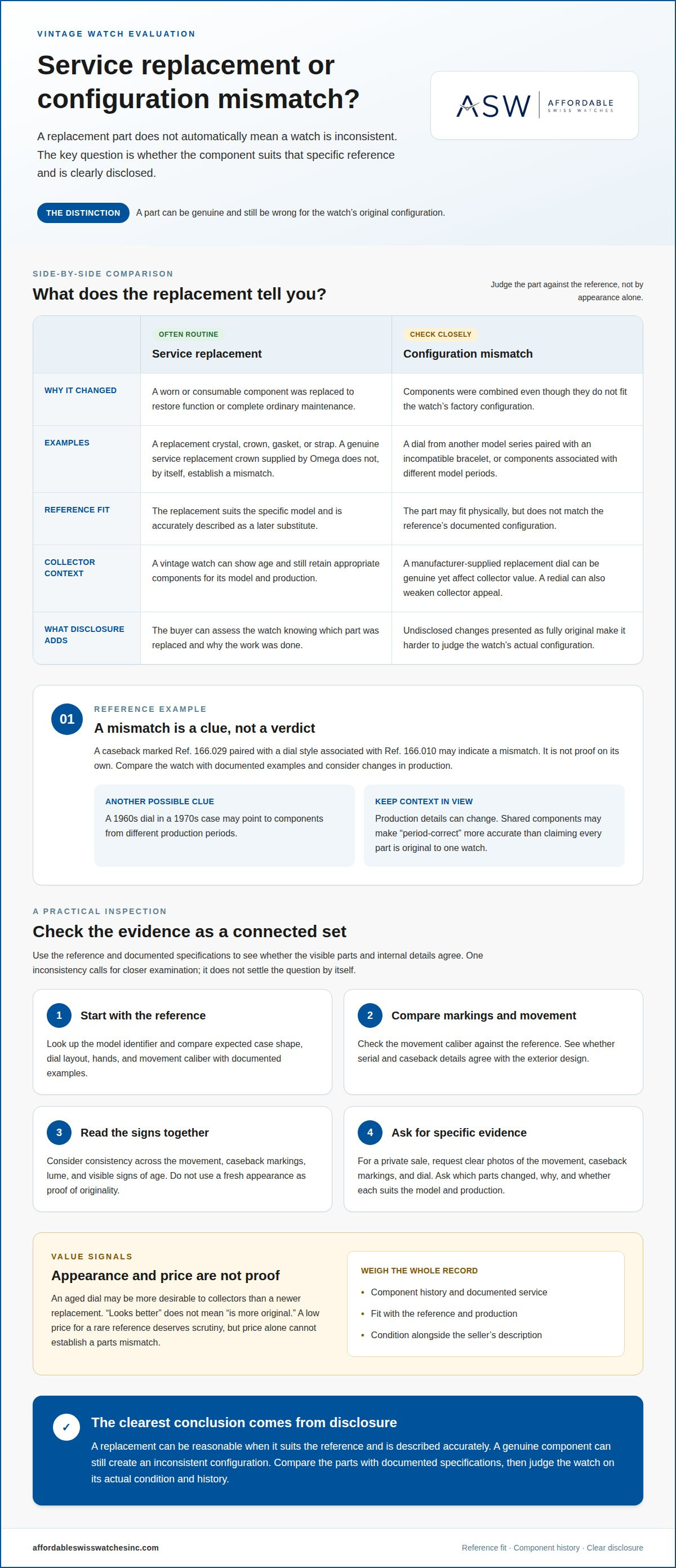
A service replacement restores function or replaces a worn component; opportunistic part-swapping combines components that don't fit the watch's factory configuration. A crystal, crown, gasket, or strap may be replaced during ordinary maintenance. By contrast, pairing a dial from another model series with an incompatible bracelet can change the watch's identity as a collector's piece. The part's origin matters, but so does whether it suits that specific reference.
Original Condition and Replacements
Original condition means the watch retains components appropriate to its model and production, while a replaced part is a later substitute. That distinction matters because a vintage watch can show age and still be original; a fresh appearance alone doesn't establish originality. A replacement crystal may be routine, while a dial from another series can make the configuration inconsistent.
Brand and model matter when assessing a service part. A genuine service replacement crown supplied by Omega doesn't, by itself, make a watch a Frankenwatch. The same applies to consumable parts such as crystals: replacement is servicing when accurately disclosed, not proof of opportunistic assembly. Buyers should distinguish a part that suits the reference from one that merely fits the case.
Effects on Value and Authenticity
Authenticity and originality are related but distinct: genuine parts can still form a configuration that was never correct for that reference. A manufacturer-supplied replacement dial may be authentic, yet still reduce a vintage watch's collector value. A redial can also substantially weaken collector appeal, even when the watch remains wearable.
Disclosure helps buyers assess the piece accurately. A seller who identifies a replaced dial, crown, or bracelet lets the buyer judge the watch as modified rather than assume every component is original. Ask which parts were replaced, why the work was done, and whether each replacement suits the model and production. Those details help distinguish documented servicing from a parts combination presented as untouched.
Consider two vintage watches with replacement dials. One has a documented manufacturer service dial that suits its reference; the other has a dial from a different model series and is advertised as all original. Both contain replaced parts, but only the second presents a clear mismatch alongside an undisclosed originality claim. An aged dial may be more desirable to collectors than a newer replacement, so "looks better" isn't the same as "is more original." Before buying, weigh the watch's condition against its component history and the seller's description.
What exactly is a frankenwatch?
A Frankenwatch describes a watch assembled from parts that may be genuine but don't match its factory configuration. The term describes the watch's components, not a legal status; whether a sale is misrepresented depends on the seller's description and disclosure.
Start with the reference, the model identifier that helps establish which dial, case, and movement belong together. A caseback marked Ref. 166.029 paired with a dial style associated with Ref. 166.010 is a possible mismatch, not proof on its own. Compare each visible marking with documented examples of that reference. A 1960s dial in a 1970s case is another clue that parts may come from different production periods.
Watch reference books can reduce risk by documenting model details and expected components. Use them to compare the case shape, dial layout, hands, and movement caliber with the watch being offered. Then compare more than one example when production details changed over time. Soviet factories, for example, shared components across production runs, and specifications could change. In such cases, "period-correct" may be more accurate than claiming every screw is original to one watch.
For a private-sale watch, ask for clear photographs of the movement, caseback markings, and dial. Compare the movement caliber with documentation for the reference, then check whether the serial and caseback details agree with the exterior design. A seller's account of service or ownership history can help explain replaced components. If photos omit the movement or markings, request those specific views before deciding. A useful answer explains what changed and why; a vague claim that everything is original doesn't resolve a mismatch.
A low price for a rare reference deserves closer scrutiny, but price alone cannot establish that a watch has mismatched parts. Compare its stated condition and originality with the evidence in the photographs and description. A customized or modified watch can still suit a buyer who understands its configuration. The key is clear disclosure, not presenting modifications as factory-original details.
If you discover after purchase that parts don't match, save the listing, photographs, messages, and any service records. Document the specific discrepancy, such as a movement caliber that conflicts with the reference, then raise it with the seller using that evidence. Until the history is clear, describe the watch accurately rather than repeating an unsupported claim of originality. This record can also help clarify whether the issue is an undisclosed mismatch, a documented modification, or a detail requiring closer examination.
A personal definition of a Frankenwatch
You can spot a possible Frankenwatch by checking whether its movement, dial, hands, and case form a coherent configuration for its reference. In practical terms, it is a watch whose components don't fit the model's documented design or history.
Parts Combined in a Frankenwatch
A Frankenwatch often combines a case, dial, hands, or movement from different models or production periods. Omega’s 500-series movements appeared in many watches, and compatible hands could fit models across a 30-year period. That overlap means one seemingly plausible component doesn’t settle the question. The relationship between the parts matters more than whether each part looks genuine on its own.
Some combinations are deliberate. Soviet pocket-watch movements were sometimes fitted into new, oversized wristwatch cases, creating what collectors call “marriage” watches. Watches assembled from New Old Stock parts can also be described as NOS Frankenwatches, even when those parts remained unworn. These examples show why the label describes a configuration, not necessarily a dishonest seller or a fake component.
A personal definition should account for purpose and disclosure. A clearly described custom watch may be an acceptable choice for someone who values its appearance or function over factory originality. The same assembly becomes misleading if a seller presents it as untouched. For a collector seeking an original reference, that difference affects whether the watch meets their priorities.
Recognizing a Frankenwatch
Recognizing a Frankenwatch means finding mismatches across several details, rather than treating one unusual feature as proof. Compare the reference with the movement caliber, then examine whether the dial and hands suit the case. Check that lume color and aging appear consistent between the hands and dial. A mismatch can justify closer scrutiny, but aging alone doesn't establish that parts were swapped.
Look inside the case as well as at the dial. Movement spacer rings and case clamps should fit correctly; poor fit can signal that the movement and case weren't designed to work together. Caseback reference and serial markings, logos, and exterior design should also make sense alongside the movement. These checks build a more useful picture than appearance alone.
No single detail defines every Frankenwatch. Shared components, production changes, and service work can complicate a comparison, while multiple mismatches give stronger grounds for concern. For example, an unexpected movement caliber combined with incompatible hands and a poorly fitted spacer ring tells a different story from one replaced component. Judge the complete configuration against the watch's reference and stated history.
Checking authenticity before buying
Before buying a vintage watch, assess its configuration, condition, and sales description together. A matching serial or convincing dial alone cannot establish that every component belongs to the same original watch. Treat each detail as evidence, then look for consistency across the complete piece.
Begin with the model reference and the expected movement, dial, and case details. Request clear photographs of the dial, caseback, movement, and any visible markings. Compare them with documented examples of that reference, noting whether the hands, logo, and case design agree. If an important view is missing, ask for it before deciding.
Check the lume as a group, not as an isolated feature. On a watch with 1960s tritium lume, aging may create a warm cream-to-brown patina. The dial and hands should show compatible color and aging; sharply different tones can justify closer examination. However, a mismatch is a clue, not proof by itself, because service work or different exposure can affect appearance.
Consider age realistically. A vintage watch that is 40 or 50 years old need not look as though it just left the factory. Wear can be consistent with an original watch, while a pristine replacement dial may indicate that something changed. Compare the visible condition with the seller’s description and any available service history. Ask which parts were replaced and whether the seller represents them as original, service replacements, or later modifications.
- Compare the movement. Match the visible caliber to the model reference. A different caliber deserves an explanation tied to the watch’s documented history.
- Check the exterior details. Compare the caseback markings, logo, and case design with the reference. Look for combinations that point to different models or production periods.
- Assess the lume. Compare the dial and hands for compatible color and aging, rather than expecting every aged surface to look identical.
- Read the description closely. Distinguish disclosed service work from claims that the entire watch is original. Ask for clarification on any changed component.
A New Old Stock description also deserves careful scrutiny. The term implies an unworn, untouched watch, so visible wear or replaced components would conflict with that claim. Photographs can support an assessment, but they cannot always reveal the full history. For a private sale, preserve the listing and seller messages alongside the images; those records help compare what was promised with the watch received.
Make the decision based on evidence, not urgency or appearance alone. If the movement, markings, lume, and written history tell a consistent story, you have a stronger basis for buying. If they conflict, treat the unresolved discrepancy as material to your decision.
What parts are commonly combined in a Frankenwatch?
A Frankenwatch can combine genuine components that belong to different watches, references, or production periods. The mismatch may involve the dial, hands, movement, case, bezel, or bracelet. Looking at each part separately can miss the problem: a component may be authentic yet still be wrong for the watch's specific configuration.
The dial is often central to the assessment because its design, markings, and finish identify a particular model. A dial from one series fitted to another case can create a combination that never matched the factory configuration. Hands can also come from another model. Even compatible hands may have different shapes or lume from those expected on the watch.
The movement and case must also make sense together. A movement from another reference may fit inside a case without being correct for it. Check the caliber against the model documentation, then consider whether the caseback markings, movement, and exterior design support the same identification. A movement swap is more consequential than a replacement strap because it changes the watch's mechanical identity.
- Dial and hands: Compare their design, markings, and lume. A cream dial paired with visibly different hand patina can merit closer examination.
- Movement and case: Compare the caliber with the reference and inspect whether the movement fits securely. Spacer rings and case clamps should fit correctly.
- Bezel and bracelet: Check whether their style and construction suit the reference and production period, rather than assuming a brand name makes them correct.
- Caseback and markings: Compare the reference, serial markings, and logo with the case design and movement.
Bracelets and bezels can be replaced during a watch's life, so their presence alone doesn't define a Frankenwatch. The key questions are whether the parts suit the stated reference and whether the replacement has been disclosed. A correct replacement bracelet may preserve a coherent configuration; an incompatible bracelet may signal that parts were gathered from different models.
Production history can complicate the comparison. Omega used 500-series movements in many watches, and compatible hands could fit across models over a 30-year period. That overlap means compatibility alone does not prove originality. A fitting hand may still differ from the hand specified for the watch’s reference, so check the full combination rather than one component.
For a watch you're considering, request clear photographs of the movement, dial, caseback, and bracelet, then compare those parts with the stated reference. Ask the seller to identify each changed component and explain its history. That component-by-component account gives you a clearer basis for judging the watch.
Affordable Swiss Watches
Affordable Swiss Watches Inc. offers a next step if you prefer to consider a watch with documented authentication rather than assess an uncertain listing alone. Its pre-owned watches undergo in-house, multi-step authentication and include a 2-year limited warranty. A full money-back guarantee applies if a watch is found not genuine.
Affordable Swiss Watches Inc. offers the Rolex Submariner, Rolex Datejust, and Rolex Land-Dweller. It is an independent dealer, not an authorized dealer or brand-affiliated representative. Buyers considering a purchase can review the watch's stated condition and the dealer's authentication information.
Contact Affordable Swiss Watches Inc. with questions about its watches.
Set Your Standard Before the Next Purchase
Before your next purchase, decide what originality means for your intended use. A collector may require period-correct components, while someone choosing a watch to wear may accept disclosed service parts. Neither standard is right for every buyer. The important point is matching the watch's documented condition to your own priorities.
Understanding what a Frankenwatch is and how to avoid one gives you a basis for setting that threshold. Write down which changes you would accept and what evidence would help you assess them. Then judge each listing against those criteria, rather than adjusting your expectations to fit a particular watch. A clear standard makes the decision more deliberate.
If you’d like to discuss your next watch purchase, contact Affordable Swiss Watches Inc. A considered choice begins with knowing what matters to you.
Frequently Asked Questions
Frankenwatches: Are they as bad as they seem?
Not necessarily. A disclosed, modified watch may suit someone who values its design or wants a watch to wear, while an undisclosed mismatch can disappoint a collector seeking factory originality. The concern is the combination of components and the claims made about them. Consider your purpose first: the same replaced part may matter greatly to a collector and less to a buyer prioritizing everyday use.
What is a Frankenwatch?
A Frankenwatch is assembled from parts that may be genuine but don't belong together in the model's original configuration. Understanding what a 'Frankenwatch' is and how to avoid one starts with assessing the watch as a complete piece, rather than judging each component alone. The term describes the assembly, not automatically the seller's intent. Clear disclosure helps you decide whether the watch's configuration suits your priorities.
How do you verify a watch’s reference and serial numbers?
Read the markings on the watch and compare them with documentation for the stated model. Reference numbers identify a configuration; serial numbers help place a watch within its production history. Check that the case markings make sense alongside the watch's design and movement. A number that appears plausible on its own doesn't establish that the complete watch is correctly assembled, so consider the surrounding evidence.
How can you authenticate a watch’s dial, hands, case, and movement?
Assess each component against the stated model, then look for agreement across the set. For instance, compare the dial layout and hand design with documented examples, and check whether the movement caliber suits that reference. Examine whether the case markings support the same identification. Photograph details in consistent light; this makes differences in finish, markings, or lume easier to review side by side.
What are the risks of buying a Frankenwatch?
You may pay for originality the watch doesn't have, or discover that its configuration is difficult to restore. A mismatched movement can complicate future servicing, while a replaced dial may reduce collector appeal. Parts can also be hard to source when the watch combines different references. These risks depend on the specific components, their condition, and whether the seller described the modifications accurately.
How much less is a Frankenwatch worth than an original watch?
There's no fixed reduction that applies to every Frankenwatch. Value depends on the reference, which components changed, their condition, the quality of the work, and how clearly the modifications are disclosed. A replacement dial can affect collector demand differently from a replaced crystal. Compare the watch's configuration and condition with comparable examples, rather than applying a standard percentage to every modified piece.
How can you avoid buying a Frankenwatch when shopping online or from a dealer?
To understand what a 'Frankenwatch' is and how to avoid one, compare the listing with clear photographs of the dial, caseback, and movement. Ask for images showing details omitted from the listing, and request a written account of known replacements or modifications. Save the listing and seller's replies. For a dealer purchase, read the invoice description carefully so the written record reflects the watch's stated condition and originality.
What should you ask a seller before buying a used luxury watch?
Ask whether the dial, hands, case, movement, bezel, or bracelet have been replaced, and why. Request the service history and ask whether the seller considers the watch original to its reference or modified. If the seller says a part is a manufacturer service replacement, ask for supporting documentation. Also ask which accessories and records accompany the watch, then make sure the written description matches the answers.