

Photos can reveal inconsistencies, but they cannot definitively authenticate a luxury watch. Knowing how to get a luxury watch authenticated means treating a photo review as an initial assessment, not as proof of what is inside the case.
It is reasonable to want clear evidence before buying a pre-owned watch online. Detailed images can help you assess the dial, case, bracelet, clasp, and included paperwork, and flag questions about the reference or condition. But photographs cannot establish the identity of every internal component or replace a physical inspection when one is needed.
This guide explains how to review a watch’s details, what to look for in seller photos, and which records can help assess its history. You’ll also learn when a remote review is useful, when an in-person examination matters, and how to reduce uncertainty before deciding whether to buy.
Key Takeaways
- Compare visible details with the watch’s specific model and year; small inconsistencies can be clues, but no single detail proves authenticity.
- Treat serial numbers and accompanying papers as supporting evidence, not a complete authentication.
- Use clear photos to assess exterior details and identify questions, while recognizing that images cannot verify every internal component.
- Review repair records, purchase documents, warranty terms, and the seller’s authentication process before buying online.
- Separate an authenticity assessment from an appraisal: confirming what a watch is and estimating its market value are different tasks.
Inspecting dials, hands, bezels, crystals, bracelets, and cases
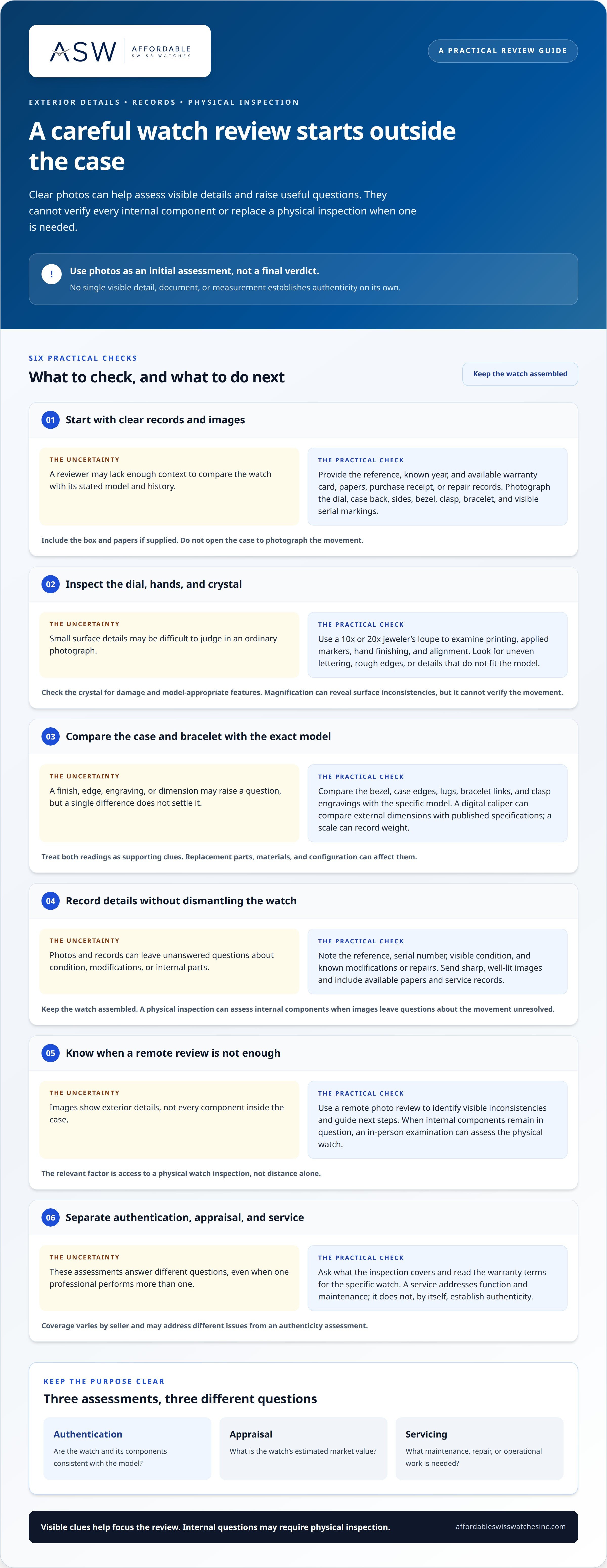
Authentication determines whether a watch and its components are consistent with its model. An appraisal estimates market value, while servicing addresses operation, maintenance, or repair. These are distinct assessments, even when one professional performs more than one.
Authentication costs depend on the inspection’s scope and whether the watch needs a physical examination. Turnaround also depends on the review required and, for mail-in services, shipping and handling. There is no single timeline for every watch.
- Start with clear records and images. Provide the watch’s reference, known year, and any available warranty card, papers, purchase receipt, or repair records. Photograph the dial straight on, then capture the case back, both sides, bezel, clasp, bracelet, and any visible serial markings. Include the box and papers if supplied, since the reviewer can compare them with the stated reference. Never open the case yourself to take movement photographs.
- Inspect the dial, hands, and crystal under magnification. Use a 10x or 20x jeweler’s loupe to examine printing, applied markers, hand finishing, and the alignment of details. Look for uneven lettering, rough edges, or marks that do not fit the model. A loupe can reveal surface inconsistencies, but it cannot verify the movement. Check the crystal for damage and model-appropriate features.
- Compare the case and bracelet with the exact model. Examine the bezel’s finish, case edges, lugs, bracelet links, and clasp engravings. A digital caliper can help compare external dimensions with published specifications, while a scale can record the watch’s weight. Treat both readings as supporting clues: replacement parts, materials, and configuration can affect them. Do not use one measurement as a verdict.
- Record details without dismantling the watch. Note the reference and serial number, visible condition, and any known modifications or repairs. Send sharp, well-lit images of the dial, case back, sides, clasp, and bracelet. Include available papers and service records. Keep the watch assembled; a physical inspection can assess internal components when photographs leave questions about the movement unresolved.
- Use an in-person review when evidence is incomplete. In the United States, an authentication assessment can be conducted by a watch professional through an in-person examination. A remote photo review can identify visible inconsistencies and guide next steps, but it cannot establish every internal component. For nearby options, the relevant factor is access to a physical watch inspection, not distance alone.
- Separate authentication from service and coverage. Servicing concerns the watch’s function and maintenance; it does not, by itself, establish authenticity. Ask what the inspection covers and read warranty terms for the specific watch. Coverage varies by seller and may address different issues from an authenticity guarantee. A physical movement inspection may be necessary when originality or internal condition remains unresolved.
Does a fake watch always have a wrong serial number?
No. A counterfeit may carry a copied serial number from a genuine watch, so a match with papers cannot authenticate the watch by itself. Treat the serial, reference, documents, exterior details, and movement as evidence that must agree.
- Match the reference to the watch’s configuration. Record the reference and serial number, then compare the stated model with the dial, case, bezel, bracelet, and movement. A serial number can identify a particular watch, while the reference describes a model or configuration. Check that supplied papers name details consistent with the physical piece. A correct-looking serial cannot resolve a mismatch elsewhere.
- Consider the Rolex serial location by production period. On Rolex models made before 2005, the serial number is between the lugs at 6 o’clock. From the mid 2000s onward, it is also engraved on the inner bezel ring at six o’clock. Modern Rolex serial numbers are laser-etched at the 6 o’clock position on the rehaut. The correct location depends on the watch’s period.
- Inspect the crystal and rehaut together. Modern Rolex crystals have a laser-etched coronet at the 6 o’clock position. Use magnification and angled light to examine the etching and the rehaut engraving, then compare their placement and finish with the model. A visible coronet or crisp serial is only one clue. Genuine serial details can be copied, so neither feature proves authenticity alone.
- Compare papers without treating them as proof. Check whether the serial number on a warranty card or papers matches the watch, and whether the reference and model details correspond. Some Rolex watches from the 1980s and 1990s no longer have their papers, so their absence alone does not settle the question. A box or card can also be assessed for consistency with the stated reference.
- Have a professional assess mechanical and sensory details. An in-person inspection can assess winding, operation, sound, and movement condition alongside visible finishing. Most Swiss watch movements beat at 28,800 beats per hour, or 8 beats per second, but that figure is not a universal test for authenticity. A professional compares the movement with the expected specification for that model.
- Keep the case closed until a specialist examines it. Opening a case can damage components or compromise its condition. A physical movement inspection may be needed when the serial and exterior appear consistent but questions about internal parts remain. Authentic brand replacement parts can still be genuine; however, parts incompatible with the particular model affect whether the watch is considered totally authentic. ASW Inc.'s inventory consists only of genuine watches and is unrelated to counterfeit watches. For a reference point, review certified-authentic watch listings alongside the specific watch details.
Can you authenticate a watch from photos?
Photos support an initial review, but they cannot definitively authenticate a watch. They show visible details and may reveal inconsistencies, but cannot establish whether the movement or every internal component is original.
- Send identifying details with the images. Include the brand, model, reference, serial number, and known year when available. State any known repairs or modifications. These details help a reviewer compare the pictured configuration with the stated timepiece. If a seller’s description names a different reference than the paperwork, provide both versions rather than choosing one.
- Photograph the whole watch before close-ups. Take a clear, straight-on image of the dial, then capture the case back, each side, clasp, and bracelet. Keep the complete watch in frame for context. Add close-ups of markings or areas that raise questions. Sharp focus and even lighting help distinguish surface details from reflections or blur.
- Use consistent angles to show exterior details. Photograph the bezel and dial from directly above, then capture the case profile and bracelet from the side. A straight-on dial image can show marker alignment, while a side view reveals case shape and visible finishing. Images can help compare these features with the reference, though perspective may distort proportions.
- Include supplied documents in the image set. Photograph the box, card, and papers clearly, including identifying details, and state which items belong to the watch. A reviewer can assess whether the paperwork appears consistent with the stated reference and serial number. Matching details support the assessment, but cannot prove the watch is genuine because serial numbers can be copied.
- Understand what a photo assessment can establish. It can flag visible inconsistencies, describe which details appear consistent, and identify questions for further examination. Magnified images may reveal printing, engraving, or finishing issues when focus is sharp. They cannot reproduce every physical inspection condition or verify parts hidden inside the case. Knowing how to get a luxury watch authenticated means understanding that boundary.
- Arrange physical inspection when internal originality matters. A remote review cannot establish whether the movement is original or whether internal components match the specific model. Don’t open the case to take pictures. A watch professional can examine the movement in person when images leave that question unresolved.
- Use remote review to decide what evidence comes next. For buyers considering how to get a luxury watch authenticated before an online purchase, treat a photo assessment as a first step, not a complete verdict. If images show inconsistent reference details or omit a key view, identify that specific gap before proceeding. The written findings should distinguish what the photographs support from what requires physical examination.
Is it safe to buy pre-owned luxury watches online?
Online purchases can be less risky when the seller explains the authentication process, documents the watch’s condition, and provides clear written warranty terms. Assess the watch, the seller’s process, and the protections available before paying.
-
Check authenticator credentials and reputation
Review the authenticator’s stated qualifications, watch-specific experience, and written description of the inspection process. Look for a clear report that says what was examined, including whether the movement was physically inspected or only exterior details were reviewed. Check who performed the assessment and how concerns are handled. Avoid relying on unsupported claims such as “fully verified” without a defined scope.
-
Seek professional verification and warranty
Choose a seller that describes the checks performed before sale, rather than relying only on a serial number or photographs. Read the warranty terms, including coverage, exclusions, and how to raise a concern. A warranty and an authenticity guarantee address different risks, so confirm which protection applies to the specific watch. Keep copies of the listing, invoice, condition description, and warranty.
- Assess the seller’s responses before committing. Compare the listing’s reference and condition description with the photos and supplied records. A seller who refuses reasonable questions, avoids documenting known repairs, or changes important details between messages leaves material uncertainty. Walk away if the seller pressures you to pay outside the stated process or will not provide clear transaction terms.
- Account for the risks of mailing a watch. Shipping can expose a valuable timepiece to loss, damage, or delay, and a photo review cannot resolve every internal question. Before sending a watch, document its condition with dated photographs, keep the shipment record, and follow the carrier’s packaging and coverage requirements. Understand who is responsible during transit and how the watch will be returned.
- Respond carefully if an assessment finds a problem. If the watch is identified as counterfeit or has replaced parts, pause the purchase and preserve the written findings, listing, messages, and payment records. Do not dismiss incompatible components without considering their effect on authenticity and value. Follow the seller’s written return or refund process, and keep the watch and its documents together while the issue is resolved.
- Compare the complete record, not one assurance. The seller’s reputation, inspection scope, warranty language, photographs, and paperwork should tell a consistent story. For example, a listing that describes an original configuration deserves closer scrutiny if the service record notes a replacement component. A clear process helps you understand what was checked and what the written protection covers.
Tips for buying pre-owned luxury watches
Use a consistent review process before paying for a pre-owned luxury watch. A sound decision depends on matching the watch, its history, and the seller’s written terms.
- Define the exact watch you want. Record the brand, model, reference, and configuration before comparing listings. For a Rolex Datejust, for example, distinguish the reference and dial details rather than relying on the collection name alone. The reference narrows which case, dial, and bracelet should be present. A broad model label is not enough to assess a specific piece.
- Compare the listing with the watch’s visible details. Check that the seller’s photos show the actual watch, not only catalogue images. Compare the dial, hands, bezel, case, and bracelet with the stated reference. Note mismatches in writing and request clear images of the relevant area. A different bracelet or replacement component can affect condition and originality, even when the watch itself is genuine.
- Review the available ownership records. Ask for purchase receipts, repair paperwork, warranty cards, and manufacturer papers when they exist. These documents can help establish a watch’s history and support a resale assessment. Their absence does not automatically determine authenticity or value. Many watches change hands without a complete paper trail, so weigh records alongside the physical watch and the seller’s account.
- Read the condition description line by line. Separate wear, damage, and servicing from claims about originality. For example, a polished case, replacement crystal, or documented service may explain differences from an untouched example. Ask the seller to identify known repairs or modifications in writing. Clear disclosure gives you a basis for comparing condition, records, and the listing before deciding.
- Assess price in relation to the specific model. Compare the asking price with current market information for the same reference, condition, and configuration. A price far below comparable market levels is a warning sign, not proof by itself. Differences in papers, service history, condition, and included components can affect value. Treat a discount without a clear explanation as a reason to pause.
- Keep appraisal separate from authentication. A watch can be appraised without original manufacturer papers by researching its model number, collection, case size, and current market. An appraisal estimates value; it does not establish that every component is original. If value matters to your purchase decision, keep the valuation and authenticity findings distinct.
- Choose a documented purchase process. Before payment, retain the listing, seller messages, condition details, and written warranty or return terms. Confirm what the warranty covers and how an authenticity concern is handled. Then browse certified-authentic watch listings as a reference for the details presented with pre-owned timepieces.
Affordable Swiss Watches Inc.
Affordable Swiss Watches Inc. can help buyers considering pre-owned or unworn luxury timepieces. It uses an in-house, multi-step authentication process. Pre-owned watches include a two-year limited warranty.
The selection includes Rolex Submariner, Rolex Datejust, and Rolex Land-Dweller watches. Affordable Swiss Watches Inc. is an independent dealer, not affiliated with any watch brand. Contact Affordable Swiss Watches Inc. with questions about its watches and authentication process.
Make the next purchase decision with confidence
Set your decision threshold before committing: the evidence should support the specific watch, its stated condition, and the purchase terms. If a detail remains unresolved, pause the transaction until you understand what it means for your decision. Knowing how to get a luxury watch authenticated helps separate useful evidence from assumptions, especially when a purchase begins with an online listing.
Affordable Swiss Watches Inc. offers Rolex Submariner, Rolex Datejust, and Rolex Land-Dweller watches for buyers considering these models. Review the available listings and their details as you consider what suits your preferences and collecting goals.
Explore certified-authentic watch listings and take the next step at your own pace.
Frequently Asked Questions
How do I know if my Rolex is real?
Look for consistency across the reference, case, dial, bracelet, serial details, and movement. A serial number that matches a card is useful, but cannot establish authenticity on its own because genuine serial numbers can be copied. Check whether the watch’s features fit its stated model and production period. A professional physical examination can assess internal details that photographs and paperwork cannot establish.
Does a pre-owned Rolex need box and papers?
No. A pre-owned Rolex can be genuine without its original box or papers. Many Rolex watches from the 1980s and 1990s no longer have their papers, so their absence is not proof of a problem. Documents can help establish provenance and compare the watch’s reference and serial details, but they are supporting evidence. Assess the watch itself and its history rather than treating a full set as decisive.
How do you authenticate a Rolex?
Assess a Rolex as a complete watch rather than relying on one hallmark. Compare its reference, serial details, dial, case, bracelet, and model-appropriate features, then examine the movement when needed. A professional can also consider known service history and replacement components. When buying online, a photo review can identify questions, but cannot verify the movement or every internal part.
How can you tell if all parts are original to the watch?
Compare each component with the watch’s reference and production period, then review service records for documented replacements. A genuine manufacturer replacement part may be authentic without being the part originally fitted to that individual watch. The key question is whether each component is appropriate for the model. If the movement or a hidden component raises concerns, photographs alone cannot establish its identity; a physical inspection may be needed.
Want to know if your timepiece is authentic?
Start with the watch’s brand, reference, serial details, known service history, and clear exterior photographs. Keep receipts, warranty cards, and service paperwork together so the details can be assessed as one record. A photo review can help identify visible questions, while a physical examination is needed to assess internal components. An appraisal estimates value, which is separate from authentication.
What steps do professional watch authenticators follow?
A professional assessment can include an initial visual inspection, internal component verification, provenance review, timekeeping tests, servicing or restoration, and final approval. These checks examine different evidence: the watch’s appearance, movement and serial number, history and records, and operation. The findings should make clear what was examined. A remote photo review cannot perform internal verification or timekeeping tests that require access to the watch.
Do luxury watch brands authenticate watches at their boutiques or service centers?
A service evaluation is not automatically the same as pre-purchase authentication; the assessment scope depends on the watch and the reason for the evaluation. Affordable Swiss Watches Inc. is an independent dealer and is not affiliated with any watch brand. Its authentication process is used for watches in its inventory, not as a representation of a brand boutique or a manufacturer’s service policies.
Can a watch be authenticated from photos or online?
Photos can support an initial review, but they cannot definitively authenticate a watch. Clear views of the dial, case back, sides, clasp, and bracelet help assess visible details. Include the reference and images of any supplied documents. A photo review can identify inconsistencies and guide next steps, but cannot establish whether the movement or every internal component is original.