

A watch’s asking price is not the same as its resale value. When selling a watch for the first time, gather the watch, its original box, warranty card, and service records, then compare dealer purchase, consignment, auction, and private-sale terms. A complete set can help buyers assess its history and completeness, but condition, model, and market demand also affect value.
It’s reasonable to seek a fair price while avoiding overlooked details and unnecessary risks. This guide to selling a watch for the first time explains what to gather, how to compare selling options, and which factors can influence an offer.
You’ll also learn why a listed price may differ from the eventual sale price, and how a specialist luxury watch dealer can support the process with inspection, authentication, and valuation. The goal is a clear, measured sale based on your watch and terms you understand before proceeding.
Key Takeaways
- Gather the watch’s box, warranty card, and service records, then clean it carefully before presenting it for sale.
- Compare the reach and trade-offs of in-person, online, auction, and private-sale options before choosing how to sell.
- Judge an offer against recent sales of comparable watches, not just the asking prices you see online.
- Account for the watch’s brand, model, rarity, condition, and completeness when assessing its resale value.
- Understand how a specialist’s inspection, authentication, and sale terms fit your priorities before proceeding.
Cleaning and preparing a watch for sale
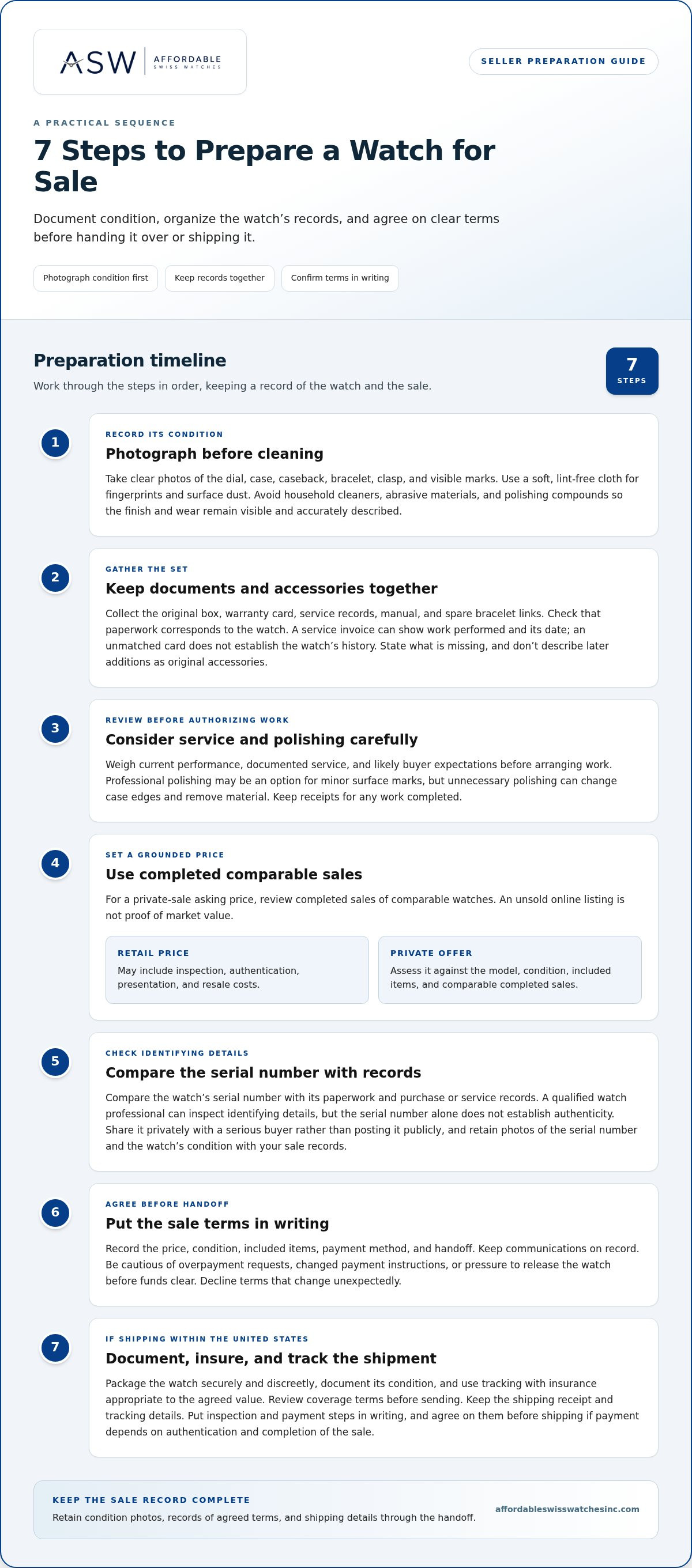
- Document the watch’s condition before cleaning it. Photograph the dial, case, caseback, bracelet, clasp, and any marks in clear light. Use a soft, lint-free cloth to remove fingerprints and surface dust. Avoid household cleaners, abrasive materials, and polishing compounds, which can alter the finish or conceal wear. Keep the original condition visible so your description reflects the watch accurately.
- Gather the original box, warranty card, service records, manual, and spare bracelet links. Check that the paperwork corresponds to the watch, then keep the documents together. A service invoice can identify work performed and its date, while an unmatched card does not establish the watch’s history. Describe missing items plainly, and don’t present later additions as original accessories.
- Review the service history before arranging any work. Weigh the watch’s current performance, documented service, and likely buyer expectations before authorizing work. Professional polishing may be an option for minor surface marks, but unnecessary polishing can change case edges and remove material. Keep receipts for any work completed.
- Set a private-sale asking price by reviewing completed sales of comparable watches. A retail price may include inspection, authentication, presentation, and resale costs, so it is not the same as a private buyer’s offer. A private seller can negotiate directly, but should support the asking price with the model, condition, and included items. Don’t treat an unsold online listing as proof of market value.
- Compare the serial number on the watch with its paperwork and purchase or service records. A qualified watch professional can inspect the serial number and other identifying details, but the number alone does not establish authenticity. Share identifying information privately with a serious buyer, and avoid posting the full serial number publicly. Keep photographs of the serial number and the watch’s condition with your sale records.
- Agree in writing on the price, condition, included items, payment method, and handoff before completing the transaction. Watch for overpayment requests, changed payment instructions, or pressure to release the watch before funds clear. Keep communications on record, and decline terms that change unexpectedly. A clear written agreement gives both parties the same description of the watch and payment process.
- For shipping within the United States, package the watch securely and discreetly, document its condition, and use tracking with insurance appropriate to the agreed value. Review coverage terms before sending, then retain the shipping receipt and tracking details. Put the inspection and payment steps in writing. If payment depends on authentication and completion of the sale, agree on those steps before shipping.
Comparing physical stores and online platforms
Choose a sales channel by weighing direct contact, audience reach, and how much of the process you want to manage. Each option affects how buyers discover and evaluate your watch.
- Consider a physical watch store if you value an in-person conversation with a buyer or dealer. You can discuss the watch directly and clarify details during the meeting. The trade-off is reach: a store connects you with its own clientele, not every potential buyer. Before visiting, prepare the reference, condition details, and records to keep the discussion focused on your watch.
- Consider an online platform if you want to reach buyers beyond a physical store’s clientele. Online watch-selling platforms can reach a broad audience, but transactions carry fraud risks. Choose a reputable platform and understand its listing process, payment steps, and seller terms before posting. Audience reach matters, as does choosing a selling process that suits your comfort level.
-
Get an initial online quote
Submit the watch’s brand, model, reference, condition, and available documentation through an online quote form. Include distinguishing details, such as a visible mark or missing accessory. Review how the quote relates to inspection and authentication, since an initial estimate is not necessarily the final offer. Compare the stated next steps before deciding whether to proceed.
-
Choose an online selling format
Choose an established marketplace to reach its existing buyers, or create a standalone online store to control how the watch is presented. A custom store requires you to organize the product page, explain the purchase process, and attract buyers yourself. A marketplace provides a selling framework, but its rules shape the listing and transaction. Read the terms before choosing either format.
- Photograph the watch so buyers can judge its details without relying on broad claims. Use sharp, well-lit images of the dial, case sides, clasp, and any marks. In the listing, identify the brand, model, reference, condition, and included items. For example, distinguish a light surface mark from a deeper case dent. Clear descriptions can reduce basic follow-up questions and help buyers assess whether the watch meets their needs.
- Before publishing, review the listing from a buyer’s perspective. Confirm that the title identifies the correct model and each photograph matches the written description. Check that the sale terms explain how an interested buyer can proceed. If the marketplace offers a preview, use it to catch unclear details before the listing goes live.
Selling through auctions or private sales
Set a defensible asking price before choosing a sales channel. The right route depends on your market knowledge and how directly you want to manage the transaction.
-
Identify the watch and assess its condition
Record the brand, model, reference number, and visible condition before approaching buyers. Check the case, dial, bracelet, and clasp for wear, then note the service history and any replaced parts. Use the reference on the watch or its paperwork rather than relying on appearance alone. Accurate identification makes comparisons meaningful and helps prevent disagreements about what the buyer is purchasing.
-
Research comparable watch sales
Compare completed sales for the same reference, condition, and included accessories. An advertised price is only an asking price: a watch listed at £9,500 may remain unsold for two years. These examples show why sellers should weigh realized prices more heavily than listings that show no completed transaction.
-
Choose an auction or private-sale channel
Choose among a dealer, jeweler, auction, marketplace, or consignment based on the sale process you want. The right sale channel depends on how much control you want over the process and how confident you feel assessing the watch’s value. A marketplace connects listings with online buyers, while a jeweler or dealer offers a direct sales route. For U.S. tax and reporting questions, keep purchase cost, sale proceeds, and transaction records together. Applicable treatment depends on the sale and your circumstances.
-
Review dealer assistance and commission
Ask for the dealer-assisted terms in writing, including commission, expenses, asking price, and payment timing. A dealer-assisted sale may involve a commission of around 20-25%, depending on the watch, its value, and the work involved. Many dealers charge a standard 10% consignment fee, with sliding scales for higher-value watches. Compare expected net proceeds, not just the advertised sale price.
- Decide whether an offer is worth accepting by comparing its net amount and conditions with your other options. An auction can attract competing bidders, but the result depends on demand and whether the watch reaches buyers. A private sale gives you direct control over negotiation, yet you must support your price with evidence. A dealer offer may simplify the handoff. Keep tax records whichever route you choose.
Before committing to a route, use recent sales of similar watches as a reality check, and consult an expert if the comparisons leave uncertainty. Researching recent sales of similar watches or consulting experts can help a seller estimate a watch’s value. A watch listed online for £9,500 may have been advertised for two years without selling. Treat that listing as an asking figure, not proof of a completed sale. Use the evidence to frame a reserve or private-sale negotiating position, then weigh likely net proceeds against the effort involved.
For any selling route, keep the basis for your estimate clear: compare similar watches, explain differences in condition, and distinguish asking prices from completed-sale evidence. This gives you a grounded way to discuss your watch with buyers and judge whether an offer fits your assessment.
Factors that affect a luxury watch’s resale value
Assess the watch by its specific reference and condition, not simply as part of a luxury collection. These steps help identify details that may strengthen or reduce its resale value.
- Record the brand, model, reference, and condition before estimating value. Brand, model, rarity, and condition all affect market value. Compare completed sales of the same reference, noting differences in wear, originality, and included accessories. Don’t judge a rare model in strong condition against a more common model or a watch with a different service history.
- Inventory the original box, warranty card or papers, instruction manual, serial number tags, and extra bracelet links.
- Assess completeness by brand, since missing items can affect value differently.
- Inspect the crystal, case, and bracelet closely, then describe each defect accurately. These factors are not automatic deductions: the reference, overall condition, and buyer’s assessment also matter. Photograph visible damage so a prospective buyer can understand the watch’s condition.
- Separate cosmetic marks from evidence that may affect originality or condition. A scratched case, replacement component, or altered finish can change how buyers assess the watch. Don’t polish a case just to improve photographs; polishing may change its edges and surface. Keep service records with the watch, since documented work gives buyers context about its history.
- Build your estimate from comparable completed sales, then account for the exact set and condition. For example, compare two watches of the same model while noting that one includes its papers and bracelet links and the other does not. Treat accessory-value estimates as context, not guaranteed additions. An offer reflects the whole watch, current demand, and the evidence you provide.
Using specialized luxury watch retailers
A specialist retailer can combine valuation and authentication with access to watch enthusiasts and collectors. Consider this route if you want a structured sale process, professional inspection, or help presenting the watch to prospective buyers. A guide to selling a watch for the first time should explain each stage, from initial valuation through payment, so you can decide whether that support suits your priorities.
- Prepare the watch’s identifying details, condition notes, and available records before approaching a specialist. Include the reference number if you know it, along with service history and any replaced components. A precise description gives the retailer useful context for an initial valuation and helps distinguish a preliminary estimate from a final offer based on physical inspection.
- Choose between an outright dealer purchase and consignment. An outright purchase transfers ownership after you accept the terms. With consignment, the retailer holds the watch for sale to a buyer. The first option offers a more direct transaction; the second depends on a later retail sale and the agreed consignment terms.
- Ask how the retailer’s valuation accounts for the reference, condition, completeness, and current buyer interest. Compare its proposed terms with completed sales of genuinely similar watches. A listed retail asking price alone does not show what a seller will receive. When selling a watch for the first time, separating the estimate from the final offer makes each stage easier to evaluate.
- Once you agree to proceed, let the specialist inspect and authenticate the watch. Physical inspection can compare its condition and identifying details with your description. Keep service records and agreed sale terms available. If the inspection identifies a difference, review the specific finding and its effect on the offer before deciding how to proceed.
- For consignment, clarify when payment is due and what must happen before it is released. Payment follows the inspection process and the watch clearing inspection. Review the written terms for the sale price, commission, expenses, and payment timing. This option suits sellers who prefer retailer-assisted selling and accept that proceeds depend on a completed retail sale.
- For an outright dealer purchase, expect a shipping label and quick payment after delivery and inspection. Email the dealer first, then speak by phone to help complete the transaction. Keep correspondence, shipping details, and agreed terms together. A specialist route is useful when valuation, authentication, and a defined handoff matter more than managing a private listing.
To explore a specialist route, review watch selling options and consider which process fits your priorities.
Affordable Swiss Watches Inc.: Rolex Submariner
Affordable Swiss Watches Inc. is a practical next step if your sale is part of a decision to buy another luxury watch. Its selection includes the Rolex Submariner, alongside the Rolex Datejust, Rolex Land-Dweller, and Rolex oyster Perpetual. As an independent dealer, Affordable Swiss Watches Inc. is not authorized by or affiliated with Rolex.
Use the details in this guide to compare a prospective purchase with your sale proceeds and priorities. Consider the specific model, condition, included documentation, and how each watch fits your collection. A clear comparison keeps the next decision grounded in the watch itself, rather than an asking price alone.
For information about the Rolex Submariner or other available watches, contact Affordable Swiss Watches Inc. or visit affordableswisswatchesinc.com.
Make your next move with a clear plan
Your sale can be a decision on its own or part of a larger change in your collection. If you plan to put the proceeds toward another watch, compare that goal with the models you’re considering, including a Rolex Submariner, Rolex Datejust, or Rolex Land-Dweller. Keep the purchase decision separate from your sale estimate, so the appeal of a new watch doesn’t distort what you consider fair value for the one you own.
A guide to selling a watch for the first time gives you a practical starting point, but the next step is deciding how much support you want with valuation and sale. Affordable Swiss Watches Inc. offers watch consignment and appraisals to help you consider the process with your specific timepiece in view. Bring its identifying details, condition notes, and records into that discussion.
Contact Affordable Swiss Watches Inc. to discuss watch consignment or an appraisal. Take the next step when you’re ready, with a clear view of your priorities.
Frequently Asked Questions
What’s Included in a Full Set?
A full set generally means the watch’s original box, warranty card or papers, manuals, and accessories supplied with that specific watch. Exact contents can differ by model and original sale. Match the card or papers to the watch’s identifying details, and separate original accessories from later additions. If an item is absent, describe the set as incomplete rather than implying that every original component is present.
Which Route Is Best?
The best route depends on whether you prioritize a direct transaction, broad buyer reach, or help with the sale. Choose a dealer purchase for a more direct handoff, consignment for dealer-assisted selling, an auction for competitive bidding, or a private listing for direct negotiation. For example, a seller who wants to avoid managing buyer messages may prefer dealer-assisted selling to a private marketplace listing.
What fees and commissions do watch-selling platforms charge in the United States?
Fees depend on the channel and the services included. A dealer-assisted sale may involve a commission of around 20-25%, depending on the watch, its value, and the work involved. Many watch dealers charge a standard 10% consignment fee, with sliding scales for higher-value watches. Marketplace charges vary by platform and transaction terms, so compare the seller’s net proceeds after applicable charges.
Which documents, box, papers, service records, and accessories increase a watch's resale value?
Keep the warranty card or papers, original box, service records, manuals, serial number tags, and extra bracelet links with the watch. Service records document maintenance and help explain its history; paperwork should correspond to the specific timepiece. Original accessories help establish completeness, while later additions should be identified separately. Present each item clearly so a buyer can distinguish documented provenance from accessories alone.