

What if a watch that looks flawless in photographs has a condition or history you can’t see? Learning how to spot a high-quality pre-owned watch means weighing observable evidence rather than relying on polished images or confident claims. Wear, incomplete records, and unclear verification can all affect your decision.
Start with the case, dial, crystal, and bracelet, then compare the watch’s provenance, service history, and available documents with its description. A box and papers can add context, but they do not replace technical verification or clear seller terms. This guide provides a step-by-step checklist for assessing each factor and deciding what to make of missing information.
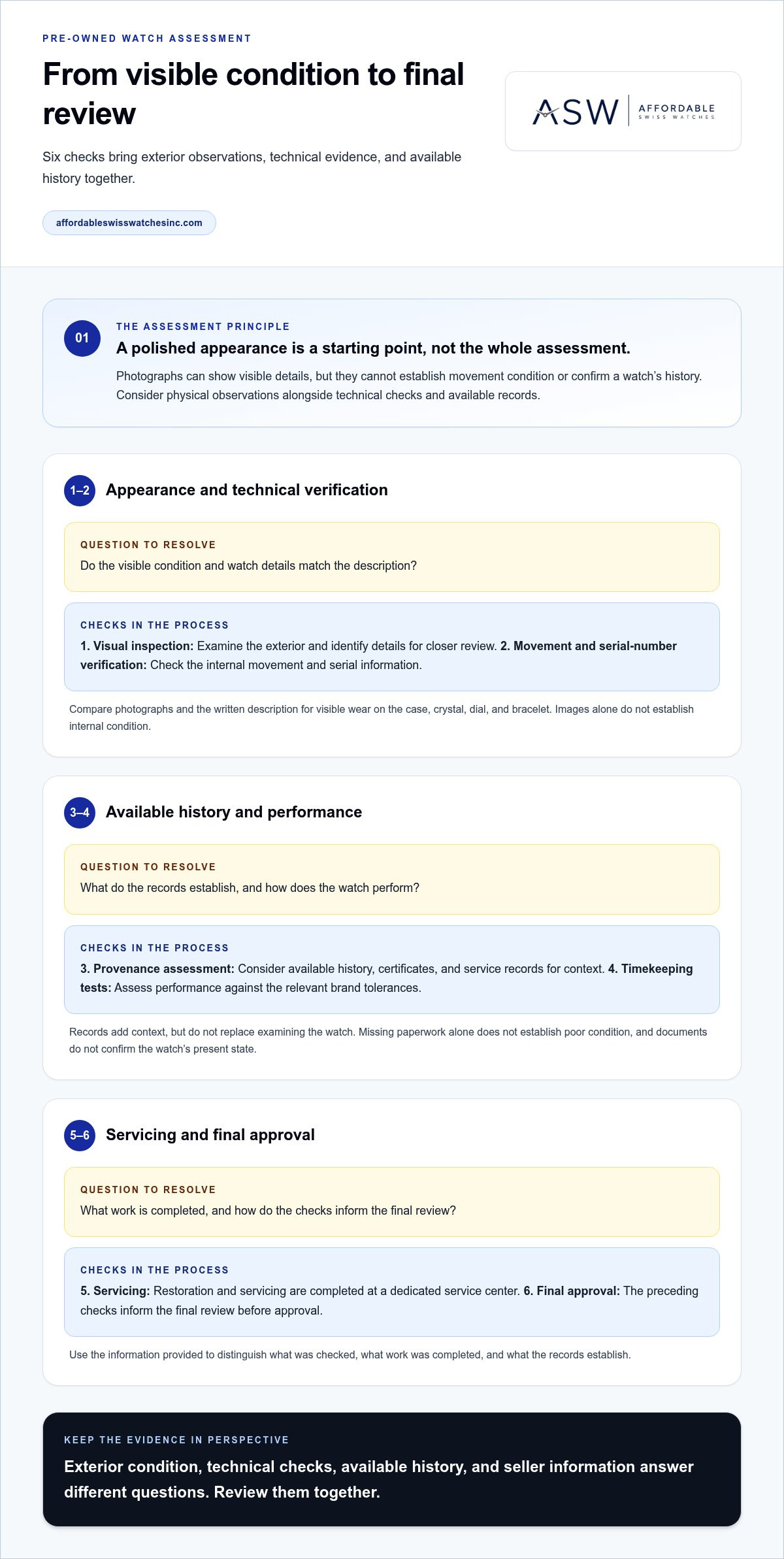
Affordable Swiss Watches Inc. assesses pre-owned watches through a six-step authentication process: visual inspection, movement and serial-number verification, provenance assessment, timekeeping tests, servicing, and final approval. Every watch sold has a 100% authenticity guarantee, with a full money-back guarantee if it is ever found not to be genuine. These standards offer a useful point of comparison as you review a watch’s condition, records, and protections.
Key Takeaways
- Assess condition, provenance, function, and seller safeguards together. A polished appearance alone is not enough to establish quality.
- Compare the condition description with clear photographs, noting visible wear or details that need explanation.
- Review available provenance and service records. Original accessories and documentation are included where available, not with every watch.
- Understand what the seller’s verification evidence and stated protections cover before deciding whether the purchase meets your standards.
- WatchCSA Pre-Owned Certified status applies to select pieces. Treat it as a specific verification detail, not an assumption about every watch.
What makes a pre-owned watch high quality?
Quality depends on four factors: condition, provenance, function, and verifiable seller safeguards. A high-quality pre-owned watch is one whose physical state and operation are understood, whose available history has been assessed, and whose description is supported by meaningful checks. That is a more useful standard than a glossy appearance or a broad condition label.
“Pre-owned” describes ownership history, not a uniform condition grade. Two watches of the same model may have different wear, service histories, or documentation. Assess the individual watch and the evidence available for it.
Which signs matter beyond appearance?
Photographs help you examine visible details, but they cannot establish the movement’s condition or confirm the watch’s history. Lighting and camera angles may also make marks less apparent. Look closely at the case, crystal, dial, and bracelet for scratches, dents, uneven wear, or details that do not match the written description. These are visible clues, not a complete assessment.
Other questions require inspection or records. A photograph cannot show whether the movement has been checked, how the watch performs during testing, or whether its serial information aligns with the stated history. Watchmakers develop specialized skills to inspect, maintain, and repair watches; the Watchmaker overview provides background on that craft. A useful assessment combines physical observations with technical and documentary checks.
- Visible evidence: Compare wear on the case, crystal, dial, and bracelet with the listing description.
- Inspection evidence: Look for information about movement checks and timekeeping tests.
- Historical evidence: Review available service records, certificates, and provenance details for consistency.
Why does provenance matter when assessing a watch?
Provenance is the available information about a watch’s history, supported where possible by records. A service receipt may help establish that work was performed, while a certificate may provide details about the watch or a prior assessment. Each document adds context, but its value depends on what it actually verifies. A certificate is not a substitute for examining the watch itself.
Missing paperwork alone does not establish poor quality. Records may be incomplete even when a watch is in sound condition, and a full set of documents does not prove the present state of the movement or exterior. Compare the records with the watch and the seller’s description, then note what remains unverified. This helps you distinguish a gap in documentation from a concern about condition without assuming that one proves the other.
How is a pre-owned watch's condition and authenticity verified?
Reliable verification follows a sequence: assess the exterior, examine the movement and serial information, review the watch’s history, test its timekeeping, complete servicing, and make a final approval. Affordable Swiss Watches Inc. uses these six steps to evaluate pre-owned watches. Each stage addresses a different question, so a polished appearance is only a starting point.
What does the six-step authentication process examine?
The process begins with what can be observed, then moves to the movement, serial number, and available history. Timekeeping tests and servicing address function and condition before final approval. The sequence brings physical observations together with technical and documentary checks rather than treating a photograph or a single record as conclusive.
- Visual inspection: The watch is examined externally to assess its visible condition and identify details for closer review.
- Movement and serial-number verification: The internal movement and serial information are checked as part of the watch’s verification.
- Provenance assessment: Available history, certificates, and service records are considered for context.
- Timekeeping tests: Performance is assessed against the relevant brand tolerances.
- Servicing: Restoration and servicing are completed at Affordable Swiss Watches Inc.’s dedicated service center.
- Final approval: The preceding checks inform the final review before the watch is approved.
This sequence clarifies what the process covers. Visual inspection can identify an exterior concern, while movement verification and timekeeping tests address questions photographs cannot answer. Provenance records add historical context, but do not replace physical and functional checks. The evidence is more useful when these separate checks are considered together.
What can servicing and timekeeping checks tell a buyer?
A timekeeping test assesses how the watch performs against its relevant brand tolerances. It provides functional evidence, but should be considered alongside other inspection findings; it does not give a complete account of the watch’s history. Affordable Swiss Watches Inc. completes restoration and servicing at its dedicated service center. Do not assume a test reading or service date unless it is stated in the watch’s documentation.
Servicing is one step in the process, not a substitute for inspection or final review. Use the information provided to distinguish what has been checked, what work has been completed, and what the records establish. Compare the listing’s condition description with its stated checks and available service information. In practice, learning how to spot a high-quality pre-owned watch means tracing the evidence through the process, not judging the result by appearance alone.
For a practical comparison, review the pre-owned watches from Affordable Swiss Watches Inc. alongside their stated condition and verification details.
How should you compare condition, provenance, and completeness?
Compare each watch across separate evidence categories instead of forming an overall impression from one strong feature. Visible condition describes what you can observe; provenance describes what records say about its history; completeness covers included accessories; and verification evidence shows what checks have been performed. This approach makes strengths and unanswered questions easier to identify without inventing a condition grade.
| Factor | What to compare | How to interpret it |
|---|---|---|
| Condition | Visible wear and the listing’s written description | Check whether photographs and wording agree. Appearance alone does not establish function or service history. |
| Provenance | Available certificates, service records, and history | Records add context when their details correspond with the watch. |
| Accessories | Box and other included original items, where available | Completeness can be useful, but accessories do not prove the watch’s condition or authenticity. |
| Verification | Documented inspection and technical checks | Look at what was checked, not simply whether a listing uses a broad assurance. |
Use the table to build a balanced picture, not to rank watches mechanically. A listing with detailed records but visible wear calls for a different assessment from one with a clean exterior and little history. Neither detail settles the question by itself. For a specific maker, such as Audemars Piguet, a brand-focused buying guide can help you apply the same evidence categories to your research.
How should you weigh wear against documented history?
Assess the exterior and records in parallel. Note scratches, dents, or other visible marks, then review the service history separately and check whether it describes work relevant to the watch. Minor wear does not by itself establish poor quality, just as a polished appearance does not confirm sound function or a well-documented past. Consider physical observations and available provenance together.
If the description calls attention to a particular condition detail, compare it with the photographs rather than assuming the wording covers every surface. A service record may clarify past work, but it cannot tell you everything about the watch’s current exterior. Photographs, in turn, cannot establish what service was performed. Keep those evidence types distinct.
What do accessories and records add to the assessment?
A box or other original accessories can show what accompanies the watch; certificates and service records may help document its history. Original accessories and documentation are included where available, but are not guaranteed for every watch. Their presence adds context, not automatic proof. Completeness and authenticity are separate: a complete set still needs verification, while missing accessories alone do not establish a problem with the watch.
Give records weight according to what they identify or document. Compare their details with the listing and the watch itself. Affordable Swiss Watches Inc.’s listed prices reflect current market value. Use the other evidence to assess condition, history, and included items rather than inferring quality from price alone.
What should you check before choosing a pre-owned watch?
Use a consistent sequence: read the listing, assess the condition details, examine available records, and understand the stated protections. Compare the written description with the photographs and documentation. If an important detail is unclear or inconsistent, treat it as an unanswered question rather than filling the gap with assumptions.
How to spot a high-quality pre-owned watch in a listing
Start with what the listing says is included and how it describes the watch’s condition. Then compare those statements with the photographs. If the description identifies a mark, see whether you can locate it in the images. If a photograph shows a detail the text does not address, note the discrepancy. Review available provenance documents and service records, without assuming that every watch comes with a complete file.
- Read the condition description: Identify stated wear and details about the watch’s present condition.
- Check included items: Note whether the listing specifies a box or other accessories, and compare that list with what is shown.
- Review available records: Look at certificates, service records, and other provenance details without treating any one document as a complete assessment.
- Compare evidence: Check that photographs, written details, and stated verification information tell a consistent story.
Read certification language carefully. A general claim that a watch is “certified” does not explain who performed the assessment or what it covered. WatchCSA Pre-Owned Certified status is a specific third-party designation that applies to select pieces at Affordable Swiss Watches Inc., not every pre-owned watch. Consider a named status alongside the listing details and other verification information.
How do warranty and authenticity terms affect the decision?
Read protections as separate terms with distinct purposes. Affordable Swiss Watches Inc.’s 2-year limited warranty applies to pre-owned watches. Unworn watches carry the original manufacturer warranty. Every watch sold also has a 100% authenticity guarantee, with a full money-back guarantee if it is ever found not to be genuine. The warranty and authenticity guarantee address different concerns. Review the terms as written, and do not assume the warranty covers matters that are not specified.
Apply the same checklist to a specific model. For example, a guide to buying a Rolex Submariner can help frame model-focused research, while the individual watch still needs to be assessed through its own condition, records, included items, and stated protections. A model’s reputation cannot establish the quality of a particular example.
Once you have compared the evidence and terms, browse pre-owned watches with those criteria in mind.
How does Affordable Swiss Watches Inc. support a confident purchase?
Affordable Swiss Watches Inc. is an independent luxury watch dealer. Its six-step authentication process addresses the watch’s exterior, movement, identifying information, history, timekeeping, and servicing before final approval. The process gives buyers specific evidence to consider; it does not assign or promise a particular condition grade. Review the individual watch’s stated condition and details as well.
Each stage addresses a different question:
- Visual inspection: What does the watch’s visible condition show?
- Movement and serial-number verification: Have its movement and serial information been checked?
- Provenance assessment: What available history and records provide context?
- Timekeeping tests: How does its performance compare with relevant brand tolerances?
- Servicing: What service work takes place as part of the process?
- Final approval: Have the preceding checks been reviewed before approval?
This sequence does not replace reading the details of a specific listing. Use it to understand the kinds of evidence available, then compare that evidence with the watch’s photographs, condition description, and records. Authentication findings and condition answer different questions: verification supports confidence in genuineness, while condition describes the watch’s physical state.
What protections apply to pre-owned watches from ASW Inc.?
Pre-owned watches from ASW Inc. carry a 2-year limited warranty. Unworn watches carry the original manufacturer warranty instead, so identify which status applies to the watch you are considering. Every watch sold has a 100% authenticity guarantee, with a full money-back guarantee if it is ever found not to be genuine. These protections are distinct from a condition grade and should be considered alongside the specific listing.
Some pre-owned pieces carry third-party Pre-Owned Certified status from WatchCSA. This status applies to select watches, not the entire pre-owned selection. Treat it as a specific verification detail when it appears, rather than assuming every listing carries the designation.
What is the next step if you have a particular watch in mind?
Review the current pre-owned listings and consider each watch on its own terms. Check its condition description, available records, included items, stated verification details, and applicable protections. A particular model may catch your interest, but the evidence for the individual watch is what supports an informed decision.
If you have questions about a specific watch, reach out for further information before deciding. You can also browse current pre-owned watches and use the checklist in this guide to assess each listing.
Choose with evidence and confidence
The right choice is a watch whose condition and available history align with your priorities, and whose unanswered questions you understand before committing. A complete set of records may matter to one buyer; another may focus more on visible condition or the specific watch. Decide which factors matter most to you, then use the same criteria for every listing. That makes how to spot a high-quality pre-owned watch a practical judgment, not a reaction to appearance or presentation.
Affordable Swiss Watches Inc. is an independent luxury watch dealer. Its stated protections can help frame your decision, but your assessment should still rest on the details for the individual piece. Review those details and choose when the evidence meets your expectations.
For a specific next step, browse pre-owned luxury watches and compare the available information for each watch.
Frequently Asked Questions
Can a pre-owned watch be high quality if it shows signs of wear?
Yes. Wear alone does not determine whether a pre-owned watch is high quality. A surface mark may be consistent with prior use, while the significance of more substantial wear depends on its location, the overall condition, and inspection findings. To assess a watch, separate cosmetic observations from evidence about function and history. Compare visible marks with the listing description, then weigh them alongside the watch’s verification details.
Does every pre-owned watch come with its original box and papers?
No. Original accessories and documentation are included where available, so a pre-owned watch may be offered without its original box or papers. Read the specific listing to see what accompanies that watch rather than treating a box shown in a photograph as included. Missing accessories do not by themselves establish a problem; assess condition and verification information separately from the completeness of the set.
Is every pre-owned ASW Inc. watch WatchCSA Pre-Owned Certified?
No. WatchCSA Pre-Owned Certified status applies to select pieces, not every pre-owned watch from ASW Inc. Treat this third-party status as a detail that applies when it is stated for an individual piece. Its absence does not replace the watch’s other verification information, and a general use of the word “certified” does not necessarily mean WatchCSA certification. Review the listing’s specific wording.
Does the 2-year limited warranty apply to unworn watches?
No. The 2-year limited warranty from ASW Inc. applies to pre-owned watches. Unworn watches carry the original manufacturer warranty instead. Check the watch’s stated status to understand which warranty applies. These are separate protections, so do not assume the ASW Inc. limited warranty applies to an unworn watch or that the manufacturer warranty applies to a pre-owned one.
Can Affordable Swiss Watches Inc. verify a watch’s timekeeping?
Yes. Timekeeping testing is part of Affordable Swiss Watches Inc.’s authentication process, with performance assessed against relevant brand tolerances. This check provides evidence about performance during testing; it does not predict indefinite future performance or replace consideration of condition and service history. Use the stated verification information for a specific piece to understand what was assessed rather than assuming an unstated reading or result.