

A pre-owned Rolex Daytona can be worth the price when the specific watch’s condition, service history, and completeness justify its market value. This pre-owned Rolex Daytona buying guide begins with the key comparison: the premium you may pay for immediate access versus the wait for a new watch through an authorized dealer. The Daytona was launched in 1963, but its long history alone doesn’t determine whether a particular example is a sound purchase.
It’s sensible to look beyond the dial and ask what the asking price includes. Warranty coverage, box and papers, and documented service all affect how confidently you can buy and compare watches. This guide explains how to assess those details, what pre-owned availability offers compared with dealer waitlists, and which condition and authenticity checks matter before you decide. The goal is a practical way to judge value, not a promise that every Daytona suits every buyer.
Key Takeaways
- Assess the watch’s condition and service history together; appearance alone won’t tell you what maintenance it may need.
- Use a professional authentication process that examines the watch itself, not paperwork alone.
- Compare warranty terms carefully, since coverage depends on who provides it and what it includes.
- Weigh box and papers against the watch’s condition and provenance when judging whether the asking price is justified.
- Review current market listings by reference, material, and condition before deciding what represents fair value.
1. Does a used Rolex come with a warranty?
A used Rolex may come with a seller’s warranty, but coverage depends on the seller and the written terms. Don’t assume a pre-owned watch has the same protection as a newly purchased one. Before buying, read the warranty document for its duration, covered components, exclusions, and service process. If you’ll own the watch internationally, clarify where the warranty applies and how service requests are handled.
The Daytona’s history explains its close connection to motorsports. Rolex launched the Cosmograph Daytona in 1963 for professional racing drivers, and the name refers to Daytona Beach, Florida, a historic center of American motorsports. Rolex adopted the Daytona name in 1964. Its chronograph and tachymetric scale support timing laps and calculating average speed, though buyers should judge a particular watch by its condition and documentation.
Movement history also helps place a reference in context. Rolex introduced its first in-house chronograph movement, Calibre 4130, in 2000. The Daytona reference 116520, produced from 2000 through 2016, uses this movement. Calibre 4130 is self-winding and has a 72-hour power reserve. Those details identify the reference’s technical generation, but they don’t prove that an individual watch is genuine or well maintained.
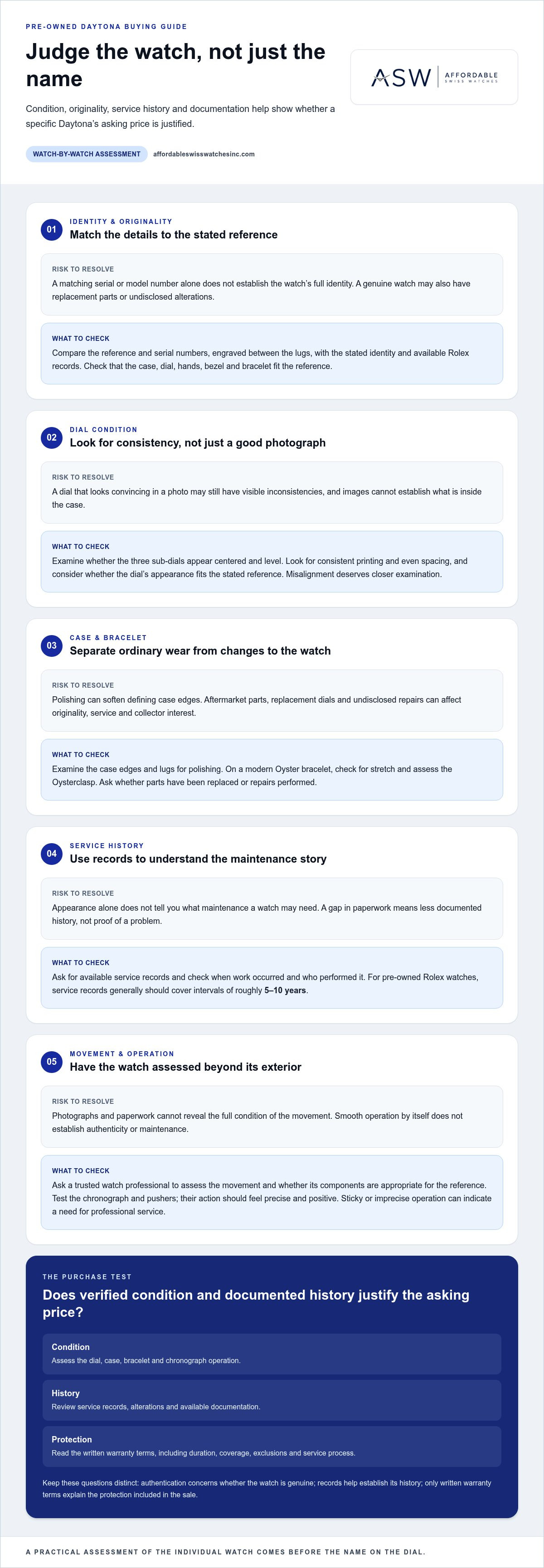
Start authentication with the reference and the watch’s physical details. Compare the stated reference with the case, dial, bracelet, and movement. Ask for a clear condition report and any available service records. Records should help establish when work occurred and who performed it; a gap in paperwork means less documented history, not proof of a problem. For pre-owned Rolex watches, service records generally should cover intervals of roughly 5 to 10 years.
A movement inspection provides evidence that photographs and papers can’t. Have a trusted watch professional examine the movement and assess whether its components are appropriate for the reference. Test the chronograph functions, including the pushers. Their action should feel precise and positive; sticky or imprecise operation can indicate a need for professional service. Smooth operation alone does not prove authenticity.
Separate three questions when weighing a purchase: Is the watch genuine? What is its documented history? What protection comes with this specific sale? Authentication addresses the first question, while service documents help answer the second. Only written warranty terms answer the third. Those distinctions make the Daytona’s heritage and movement evolution useful context, not substitutes for inspection.
2. Is a Pre-Owned Rolex Worth It?
A pre-owned Daytona can be a strong choice when its condition, originality, and documentation meet your priorities. A useful pre-owned Rolex Daytona buying guide starts with the individual watch, not the Rolex name alone. A collector may value a particular reference or dial, while another buyer may prioritize everyday wear. Treat investment potential as secondary to authenticity, condition, and the price of the specific watch.
Begin with the reference and serial numbers. Rolex serial and model numbers are engraved between the lugs; compare them with the watch’s stated identity and available Rolex records. Matching numbers are one part of the assessment, not proof by themselves. Also compare the dial, hands, bezel, and bracelet with the details expected for that reference. A genuine watch can still have replacement parts or undisclosed alterations.
Inspect the Daytona dial closely. Its three sub-dials should appear centered and level. Misalignment can indicate a replaced or tampered dial and deserves closer examination. Look for consistent printing and even spacing, then consider whether the dial’s appearance fits the stated reference. Photographs can reveal visible inconsistencies, but they can’t establish what is inside the case.
Case and bracelet condition affect both ownership and collector appeal. Examine the case edges and lugs for polishing; an unpolished case with original sharp edges is worth more than a polished example. On a modern Oyster bracelet, check for stretch and assess the Oysterclasp. These observations help distinguish ordinary wear from changes that can affect originality or value.
Aftermarket parts, replacement dials, polishing, and undisclosed repairs can reduce originality, complicate service, and weaken collector interest. A replacement part may make the watch inconsistent with its reference, while polishing can soften defining case edges.
For an online or in-person purchase, first compare the stated reference and serial details with clear photographs and accompanying records. Next, inspect the dial, case, bracelet, and chronograph operation, then have a qualified watch professional assess the movement and originality before completing the purchase. A pre-owned Rolex Daytona buying guide should apply the same sequence to remote purchases, using detailed images and a written condition report.
Vintage examples require particular care. A genuine vintage Rolex Daytona Paul Newman dial needs expert authentication; appearance alone cannot establish originality. For any reference, assess the dial and case alongside service history, since restoration can change what a watch represents to a collector.
The practical question is whether the watch’s verified condition and documented history justify its asking price for your intended use. A Daytona chosen primarily as a luxury watch should suit your preferences and ownership plans; a purchase made solely for investment requires a separate assessment of market risk and resale assumptions.
3. Secondary-market access and dealer waitlists
The secondary market changes the timing of a Daytona purchase. Instead of waiting for a new watch through an authorized dealer, buyers can compare pre-owned examples already offered for sale. As of October 2026, the reported Daytona dealer waitlist is ten years. That figure makes pre-owned availability relevant for buyers who value access sooner, but it doesn’t make every available watch a good value.
Availability varies by reference, material, dial, and condition. Stainless-steel models attract strong demand, while gold versions and other configurations appeal to different buyers. The mechanical chronograph is central to the Daytona’s appeal, but popularity alone doesn’t explain a specific asking price. Compare like with like: the same reference, similar condition, matching accessories, and comparable service history.
Market premiums can be substantial. Some Daytona models trade at double their retail price after leaving the showroom. That premium reflects the gap between demand and access, but it doesn’t guarantee future resale value. A watch bought above retail can still lose value if market conditions change, buyer preferences shift, or its condition proves weaker than expected.
A market snapshot collected on October 28, 2026, puts typical pre-owned Daytona offers between $22,000 and $39,000, with a median of about $31,000. That snapshot is valid through November 27, 2026, so treat it as time-sensitive rather than a permanent price guide. Individual offers vary with reference, material, dial, condition, service history, and completeness. A median is a comparison point, not a valuation for every watch.
To assess value, start with the exact reference, then compare current offers for that model. Separate condition differences from accessories: a full set may command a premium, while visible wear or limited service history may warrant a lower valuation. Don’t use a single low listing as proof that the broader market has shifted. Confirm that the examples are genuinely comparable before drawing conclusions.
For buyers reconsidering the Daytona because a dealer wait feels impractical, pre-owned availability offers a different trade-off: more immediate choice, but a market-driven price. Decide whether timing, specification, and documented condition justify that premium for you. If resale matters, treat appreciation as uncertain. Demand can support prices, yet market volatility and economic conditions can change the calculation.
The secondary market is most useful when you know which reference and configuration you want. Compare watches using those details, then judge each against its condition and documentation. That keeps the waitlist comparison grounded in the Daytona you’re considering, rather than a general claim about Rolex demand.
4. Box, papers, and warranty considerations
A Daytona’s box and papers add context, but they don’t establish authenticity on their own. Original paperwork can help connect a watch to its sale history, while a box mainly completes the presentation. Rolex watches with original boxes and papers and minimal restoration tend to command premium prices in the collector’s market. Compare the set with the specific reference and condition rather than paying extra for accessories without considering the watch itself.
Check the papers for consistency with the watch’s reference and serial details. The documents should relate to the same piece, not merely accompany it. A mismatch can complicate provenance and resale, even if the watch passes inspection. Missing papers don’t automatically make a watch unsuitable, but they mean there’s less documentary evidence. Consider completeness alongside condition and service history.
Warranty coverage depends on who issued it and what the written terms include. A Rolex warranty and a seller’s warranty are not interchangeable. Read the document for its start and end dates, covered work, exclusions, and service process. Check whether coverage applies to the movement, the caliber, or other components, and whether shipping for warranty work is addressed. A verbal assurance is not a substitute for clear written terms.
Returns matter because you may discover a condition issue after handling the watch. Before payment, read the return policy and note its deadline, required condition, and any limits on refunds. A reputable pre-owned Rolex dealer should provide authentication documentation, a detailed condition report, and a clear return policy. These documents let you compare what was promised with the Daytona you receive.
In the United States, sales tax treatment depends on the transaction and applicable state or local rules. Shipping insurance affects financial protection in transit, while payment methods can affect processing costs and dispute options. Compare the complete written terms before paying, including the amount due, delivery arrangements, and how a return would be handled.
For a shipped Daytona, confirm who arranges shipment, whether insurance covers the full agreed value, and what steps apply if the package arrives damaged or doesn’t arrive. Keep the order confirmation, condition report, warranty, and shipping records together. For an in-person purchase, review the same paperwork before leaving, then make sure the watch and listed accessories match the sale documents.
Choose based on documented terms, not the box alone or a broad promise of protection. A complete set can appeal to enthusiasts and support the watch’s provenance, while a well-documented watch without its original box may still suit your priorities. The caliber and production reference describe the watch; the warranty and return terms describe your recourse as a buyer. Assess both before committing.
5. Retail and pre-owned Daytona prices
Pre-owned Daytona prices can exceed retail because buyers pay for an available watch rather than wait for an authorized-dealer allocation. Some Rolex Daytona models trade at double their retail price after leaving the showroom. That premium doesn’t apply equally to every reference or condition. It reflects current demand, supply, configuration, and the individual watch’s documented state. Other luxury chronographs may cost less or more, but a useful comparison requires matching materials, complications, condition, and warranty terms.
A current US benchmark comes from a market snapshot collected on October 28, 2026. It places typical pre-owned Daytona offers between $22,000 and $39,000, with a median of about $31,000. The range is valid through November 27, 2026, so treat it as time-sensitive. This aggregate isn’t a reference-by-reference price list. Reference, material, dial, condition, service history, and accessories affect individual offers.
Reference matters. The stainless-steel 116500LN belongs to the ceramic-bezel era introduced in 2016, while the 126500LN was released in 2023. The 116520, produced from 2000 through 2016, represents another generation. Because these references differ in production period and design, compare each only with the same reference and a similar configuration. A broad Daytona average can conceal those distinctions.
Condition also changes the comparison within one reference. A sharp case with minimal polishing may attract more collector interest than one with softened edges. A complete set of original box and papers can support a premium, while missing documentation or substantial wear may affect value. Service records add context to the watch’s history. These factors matter more than calling a timepiece “classic” or assuming every Daytona sets a record.
Vintage references require a separate lens. Early examples such as the 6239 and 6263 have different histories and collector considerations from modern ceramic models. Rarity, originality, dial condition, and restoration history can shape their value. Don’t judge a vintage Daytona against the current aggregate for pre-owned offers. Compare its exact reference with similar examples, and weigh condition and provenance carefully.
A useful pre-owned Rolex Daytona buying guide starts with a record of each comparable watch’s reference, material, dial, condition, service documentation, and accessories. Compare those details with the current market band, then account for meaningful differences. The takeaway is clear: a premium may make sense when access and the specific watch justify it, but the Rolex name alone doesn’t. To apply these criteria to available watches, browse pre-owned Daytona watches.
The current US benchmark is $22,000–$39,000 for pre-owned Daytonas, with a median of about $31,000, but it is an aggregate rather than a reference-by-reference range. Within each reference, material, dial, condition, service history, and accessories affect offers; sharp cases, complete original sets, and service records can support value, while wear or missing documentation may weigh on it.
Affordable Swiss Watches Inc.: Rolex Submariner
Affordable Swiss Watches Inc. offers the Rolex Submariner for buyers whose priorities have shifted from a chronograph to another Rolex model. After weighing a Daytona’s price, condition, and documentation, you may decide that comparing another model better fits your preferences. The Rolex Datejust, Rolex Land-Dweller, and Rolex Oyster Perpetual are also available to consider.
Turn to ASW Inc. when you’re ready to compare these models using the criteria in this guide. Focus on each watch’s condition, provenance, and written warranty terms rather than assuming one model is automatically the better value. The right choice depends on which features and ownership experience matter most to you.
Contact Affordable Swiss Watches Inc. to discuss the Rolex Submariner or another listed model.
Choose the watch that fits your priorities
Before choosing a specific Daytona, decide what you want your next watch to do for you. A chronograph may be the right fit, or your priorities may point toward another Rolex model. Use this pre-owned Rolex Daytona buying guide to compare condition, provenance, warranty terms, and value, then let your preferences shape the final decision.
Affordable Swiss Watches Inc. offers the Rolex Submariner, Rolex Datejust, and Rolex Land-Dweller for buyers considering other options. Comparing different models can clarify which design and ownership experience suit you best. Take time to assess the individual watch, not just its name or reputation.
When you’re ready to review available watches or discuss which direction fits your priorities, browse the collection and reach out to Affordable Swiss Watches Inc. A considered choice starts with the details that matter to you.
Frequently Asked Questions
Is a Pre-Owned Rolex Worth It?
Yes, if the individual watch suits your budget, intended use, and condition expectations. A pre-owned Daytona can provide access to a reference or configuration you want without waiting for a new allocation. Before deciding, compare the watch’s documented history and physical condition with its asking price. Consider investment potential separately from enjoyment: future resale value depends on market demand and the specific watch, not the Rolex name alone.
Do box and papers actually matter, or am I just paying extra for cardboard?
They can matter, but the box and papers don’t carry equal evidentiary value. Papers can help support a watch’s provenance when their details match its reference and serial information. The box mainly adds completeness and collector appeal. For example, a complete set may justify a premium to one buyer, while another may prefer a better-preserved watch with less packaging. Judge the accessories against the watch’s condition and price.
Does a used Rolex come with a warranty?
Sometimes. Warranty coverage depends on the watch’s status and the seller’s written terms, so don’t assume every used Rolex has active manufacturer coverage. Affordable Swiss Watches Inc. provides a 2-year limited warranty on pre-owned watches; unworn watches carry the balance of the original manufacturer’s warranty. Read the terms for coverage and exclusions before purchase, and keep the warranty document with the receipt and watch records.
How do I know the Daytona I buy is authentic?
Use a professional inspection that evaluates the complete watch, not paperwork or serial details alone. Affordable Swiss Watches Inc. uses a multi-step authentication process that includes visual inspection, internal component and serial verification, provenance assessment, timekeeping tests, and final approval. The company gives a 100% authenticity guarantee and a full money-back guarantee if a watch is ever found not genuine. Ask for the written condition report alongside the authentication information.
Is Buying a Used Rolex a Good Idea?
It can be a sensible choice if you prioritize a specific model and assess its condition before purchase. A used Rolex may have wear, replacement components, or service needs that affect ownership. Compare the watch in person or through detailed photographs, and review its return and warranty terms before paying. Buying pre-owned may not suit you if you expect a pristine, unworn piece but haven’t accounted for the difference in condition.
What Determines a Daytona's Value?
A Daytona’s value depends on its reference, material, dial, condition, originality, service documentation, and current buyer demand. For example, two watches from the same reference can differ in value if one has a polished case or less complete records. Original accessories may also affect collector interest. Evaluate these factors together; strength in one area, such as completeness, doesn’t erase concerns about condition or provenance.
What Makes the Rolex Daytona So Special?
The Daytona combines a mechanical chronograph with a tachymetric scale designed for timing laps and calculating average speed. That function connects the watch to its motorsports origins, while its reference history gives collectors distinct eras to compare. For an owner, the appeal may be practical, aesthetic, or historical. Consider whether you’ll use the chronograph and enjoy its design, rather than relying only on its reputation or resale prospects.
What is the difference between a Zenith Daytona and a modern Daytona?
The Zenith-era Daytona refers to models produced from 1988 through 2000, including reference 16520, which used a Zenith El Primero movement modified by Rolex to run at 28,800 beats per hour. Modern Daytonas use Rolex movements, including Calibre 4130 and Calibre 4131. The generations differ in movement and reference details, so identify the exact model before comparing condition, service history, or market value.