

The familiar 43 mm model is only one option. The collection also includes 32 mm, 36 mm, 41 mm, and 46 mm versions, from automatic and GMT watches to chronographs.
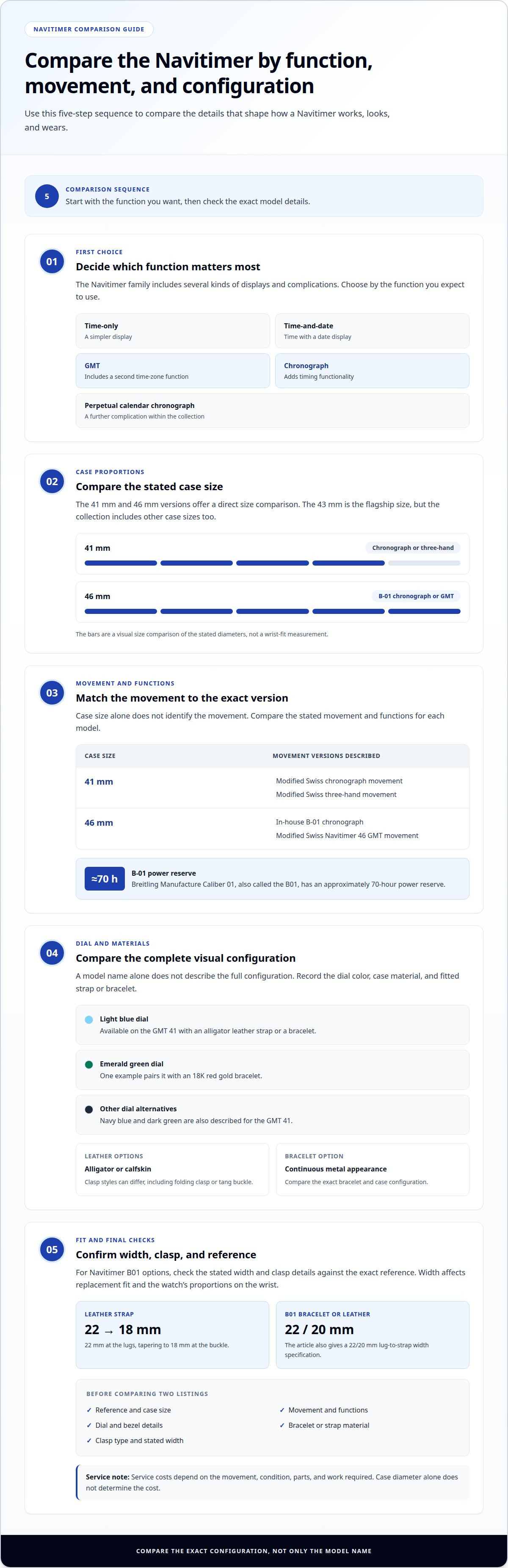
Case size is only one part of choosing a Navitimer. The movement, dial color, bezel details, and choice of bracelet or leather strap all affect how it looks and wears. Start with the functions and proportions that matter most to you.
This guide compares Navitimer collections, movement versions, and dial, bezel, bracelet, and strap options. Use these differences to narrow your shortlist, whether you prefer a classic chronograph layout or a simpler design.
Key Takeaways
- Start by deciding whether you want a time-only watch, GMT function, or chronograph, then narrow your choice by case size.
- For a 41 mm model, compare the chronograph and three-hand movement versions by the functions you’ll use most.
- Dial color, bezel details, and bracelet or leather strap can change the watch’s look and feel; compare the full configuration, not just the case.
- Assess authenticity through a thorough examination rather than relying on appearance alone.
- If you’re considering a Rolex instead, Affordable Swiss Watches Inc. offers the Submariner alongside select Datejust, Land-Dweller, and Oyster Perpetual models.
Dial, bracelet, and strap variations
Dial and strap choices change a Breitling Navitimer’s character while preserving its aviation-inspired layout. A dark blue dial looks different from silver, black, or light blue, while a metal bracelet creates a more integrated appearance. If legibility and visual balance matter most, compare the dials first, then weigh the bracelet or leather strap against how you plan to wear the watch.
The Navitimer Automatic GMT 41 appears in several dial and material combinations. Examples include a light blue dial on an alligator leather strap, a light blue dial on a bracelet, and an emerald green dial paired with an 18K red gold bracelet. A navy blue dial and a dark green dial offer additional alternatives. These examples show why a model name alone doesn’t describe the full configuration. Record the dial color, case material, and fitted strap or bracelet when comparing listings.
- A light blue dial with an alligator strap gives the GMT 41 a more traditional leather presentation.
- A light blue dial with a bracelet keeps the same dial color but changes the watch’s overall finish.
- An emerald green dial with an 18K red gold bracelet combines a distinct dial with a precious-metal band.
For the Navitimer B01, bracelet and leather options are available. A leather strap is 22 mm wide at the lugs and tapers to 18 mm at the buckle. The B01 bracelet or leather strap also has a 22/20 mm lug-to-strap width specification. Check the exact configuration and measurements for the reference you’re considering, since width affects replacement fit and the watch’s proportions on the wrist.
Leather options include alligator and calfskin, with different clasp styles. A black alligator strap, for example, may have a folding clasp, while another configuration may use a tang buckle. These details affect how the strap fastens and sits on the wrist. A bracelet avoids leather and gives the case a continuous metal appearance. Choose based on preferred feel, upkeep, and whether you want a more formal or casual look.
Compare the complete configuration, not only the dial color. First, note the reference and case size. Next, identify the exact dial, bezel, bracelet, or strap, then check clasp type and stated width. For example, two 41 mm GMT models can look notably different when one has an alligator strap and the other an 18K red gold bracelet. Matching these details makes comparisons more precise and helps you choose a combination that suits your wardrobe and daily use.
Navitimer 41 case size and movement versions
Routine care includes cleaning the case and bracelet, monitoring timekeeping, and arranging movement service when an inspection or the watch’s performance indicates a need. Service costs depend on the movement, condition, parts, and work required.
Case Size Versions
The 41 mm and 46 mm versions offer a direct size comparison within the collection. The 41 mm Navitimer comes with either a modified Swiss chronograph movement or a modified Swiss three-hand movement. The 46 mm version pairs with the in-house B-01 chronograph or a modified Swiss Navitimer 46 GMT movement.
Start with the case diameter, then consider which movement functions you want. A chronograph adds timing functionality, while the three-hand 41 mm version presents a simpler display. The 46 mm GMT option adds a second time-zone function. Since the collection spans 35 mm to 46 mm, compare the stated case size with the specific model rather than assuming every version shares the same proportions.
Movement Features and Power Reserve
The movement determines the functions you use and how the watch operates. The 41 mm modified Swiss chronograph and three-hand versions serve different preferences. At 46 mm, buyers can compare the B-01 chronograph with the modified Swiss GMT movement. Match the movement name to the exact model configuration before comparing two watches.
Breitling Manufacture Caliber 01, also referred to as the B01, has an approximately 70-hour power reserve. That figure helps you understand how long the movement can run when fully wound and unworn. Compare it with the movement in the other model under consideration, rather than treating all 41 mm or 46 mm watches as mechanically identical.
Service requirements depend on the movement and the watch’s condition. A chronograph’s timing mechanism, a GMT function, and service history can all affect the work involved. Inspection helps determine whether the movement or another component needs attention. Any resulting cost reflects the required work and parts, not case diameter alone.
For a careful comparison, note the case size, movement name, complications, and power reserve for each reference. Then compare the same details across the 41 mm and 46 mm models. You can browse Navitimer models with those specifications in mind.
Historical context provides another way to distinguish movement versions, but it should sit alongside the specific model details. The first automatic version of the Navitimer went into production Seven years after Scott Carpenter’s 1962 spaceflight. Breitling movements have been COSC-certified chronometers since 1999. Breitling began developing the B01 movement in 2004 and began rolling it out throughout its chronographs in 2009. Breitling and Tudor partnered to exchange movements in 2017.
These milestones provide context for the B01’s development and use, while the certification date offers a separate point of reference for Breitling movements. For a case-size comparison, use this history as background rather than as a substitute for checking the exact movement fitted to a particular 41 mm or 46 mm version. The movement name and stated functions remain practical details to consider when choosing a configuration.
Breitling Navitimer collections and models
The Navitimer family spans compact watches and complicated chronographs, so start by choosing the function you need. The collection includes time-only, time-and-date, GMT, chronograph, and perpetual calendar chronograph models. Case sizes range from 35 mm to 46 mm, while 43 mm is the flagship size. These distinctions help narrow the range before comparing individual references.
For a compact fit, the collection includes 32 mm and 36 mm models. The 41 mm size offers several distinct approaches, including the automatic GMT and chronograph versions. At the larger end, the B01 Chronograph is available in 43 mm and 46 mm versions. Choose by function first, then compare dimensions and dial layout within that group.
- Automatic and GMT: The Automatic GMT 41 combines automatic timekeeping with a second time-zone display.
- B01 Chronograph: Available in 43 mm and 46 mm formats, this model centers on chronograph timing.
- B09 Chronograph 41: This 41 mm model is a hand-wound chronograph option.
- B02 Cosmonaute: The B02 Chronograph 41 Cosmonaute adds a distinct model identity within the chronograph range.
- B19 Perpetual Calendar: The B19 Chronograph 43 Perpetual Calendar combines chronograph and calendar complications.
These names indicate meaningful differences, not merely dial variations. A GMT model serves travelers tracking another time zone, while a chronograph is suited to elapsed-time measurement. The B19 adds a perpetual calendar complication to its chronograph format. Compare the functions you will use against the case size and dial complexity before deciding which branch merits a closer look.
Historical editions add another route. The Navitimer 1959 Re-Edition draws on an earlier design, while the Old Navitimer reference 806 represents a vintage model family. These are different buying considerations from current-production models. Reference number, production year, condition, and originality matter when assessing an older watch, so identify the exact piece rather than relying on a broad collection name.
A practical shortlist can begin with three choices: the case size, the main complication, and the movement family. For example, compare a 41 mm GMT with a 43 mm B01 chronograph only if both functions suit your priorities. If a perpetual calendar is central, focus on the B19 Chronograph 43. That method keeps comparisons tied to specific models and avoids treating the entire collection as one uniform design.
Once you know which model and functions you want, listed prices offer another point of comparison. These examples span automatic and chronograph options, but you’ll still need to compare each watch’s features and fit.
When narrowing your shortlist, consider listed prices alongside the complications, case sizes, and designs that matter to you.
Dial, bezel, and slide rule
The Navitimer’s dial combines chronograph information with a circular slide rule around its perimeter. On a 43 mm Navitimer B01, the bezel diameter is also 43 mm. This layout gives the watch its dense, instrument-like appearance. It also means dial color is only one part of the visual comparison. Scale contrast, hand visibility, and subdial arrangement affect how quickly you can read the display.
The slide rule is a mechanical calculator built into the rotating bezel. Its paired scales can be used for multiplication, division, and conversions relevant to aviation calculations, such as fuel consumption or distance. Align the values on the scales and read the result at the corresponding marker. Rotating the bezel changes the relationship between the scales, making its movement part of the calculation, not just decoration.
For multiplication, align one value on the movable scale with the reference mark on the fixed scale. Find the second value, then read the result across the aligned scales. Division works on the same principle in reverse: align the values being compared and read the quotient. Read the printed scales carefully, especially when a value falls between marked intervals.
Dial contrast affects how clearly the scales and hands stand out. Dark blue, silver, black, and light blue dials each create a different effect. Some configurations also have contrasting subdials that separate chronograph readings from the main time display. Compare the dial in ordinary light and from different angles. A color that looks clear in a product photo may contrast differently with the bezel’s fine markings when viewed directly.
Use this sequence to compare two dial and bezel configurations:
- Check that the hands and scale markings remain distinct against the dial color.
- Study the subdial positions and confirm they suit your preferred chronograph layout.
- Rotate the bezel and see whether its markings move smoothly and remain readable.
- Compare the full dial, bezel, and case combination, not color alone.
The slide rule rewards practice, but it isn’t essential for every buyer. If you expect to use its calculations, practise aligning the scales before relying on a result. If you mainly want a chronograph, prioritize the legibility of the hands and subdials. The Navitimer’s bezel is functional, so its condition matters too. On a pre-owned watch, inspect the scale for wear and check that the bezel rotates evenly throughout its range.
How can you tell if a Breitling Navitimer is authentic?
Use the exact reference as your starting point. A Breitling Navitimer B01 Chronograph 43 reference AB0121 and reference AB0138 identify different watches, so compare each with its own specifications. Check the reference, case size, movement type, dial layout, and functions together. A match across several details is more meaningful than a logo or one convincing feature.
Ask for the reference and inspect the watch closely in good light. Compare the dial printing, hands, subdials, bezel scale, and case finishing with documented images of that exact model. The slide rule should be legible, and the bezel should rotate evenly. Look for inconsistent fonts, uneven markings, or details that don’t match the stated reference. No single visual clue can establish authenticity on its own.
Confirm that the movement fits the model’s identity. A B01 chronograph should be assessed as a chronograph with the specified movement, not as a time-only watch. Compare the stated functions with the dial and the documentation provided. If the caseback is open, examine the movement markings and construction. Don’t open the case yourself; it can risk damage and compromise the watch’s condition.
Documentation can help establish a watch’s history, but the paperwork should match the watch itself. Compare any reference and serial information on the documents with the watch. Check whether the box, warranty card, and service records correspond to that specific piece rather than relying on their presence alone. A complete set can support provenance, but packaging doesn’t replace inspecting the watch.
Use this practical sequence before making a decision:
- Record the reference and compare it with the exact model description.
- Check the case size, movement, dial arrangement, and functions as one set.
- Inspect printing, hands, bezel markings, and case finishing for consistency.
- Compare the watch’s identifiers with its accompanying paperwork.
- Request professional, multi-step authentication when visual checks leave questions.
Assess condition separately from authenticity. A genuine watch may show wear or have replacement service parts, so authenticity and originality are related but distinct considerations. Ask which components have been replaced and whether the service history records the work. On a pre-owned watch, examine the case, bracelet, and clasp as well as the dial and movement. These checks help distinguish ordinary wear from details that warrant closer scrutiny.
For a focused comparison, browse Breitling Navitimer watches and review each model’s stated reference and configuration.
Affordable Swiss Watches Inc.: Rolex Submariner
If your comparison leads you from Breitling to Rolex, Affordable Swiss Watches Inc. offers the Rolex Submariner, a sports watch alternative to an aviation chronograph. You can also compare the Rolex Datejust, Rolex Land-Dweller, and Rolex Oyster Perpetual.
As an independent watch dealer, Affordable Swiss Watches Inc. offers pre-owned and unworn luxury watches. Pre-owned watches include a two-year limited warranty. Compare the Submariner with the other Rolex models based on the design and functions you prefer.
Contact Affordable Swiss Watches Inc. with questions about the Rolex Submariner.
Make your shortlist before choosing
Before deciding, consider how the watch will fit into your collection and when you expect to wear it. A focused shortlist helps you weigh each Navitimer configuration against your priorities instead of comparing specifications without a purpose. Affordable Swiss Watches Inc. offers pre-owned and unworn Breitling watches for buyers considering a Navitimer.
Review the available configurations at your own pace, then focus on the references that best match your preferences. Browse Navitimer models to take the next step in your search.
Frequently Asked Questions
What is the Breitling Navitimer and what is it known for?
The Breitling Navitimer is a pilot’s chronograph known for its rotating slide rule bezel. The scale lets the wearer calculate multiplication, division, and conversions without a separate calculator. Its busy dial reflects the watch’s instrument-focused design. The combination of chronograph functions and a circular calculator distinguishes the Navitimer from simpler pilot-style watches, whose bezels primarily track elapsed time.
What are the current Breitling Navitimer models and specifications?
As of October 2026, the collection includes models with 32 mm, 36 mm, 41 mm, 43 mm, and 46 mm cases. Available formats include time-only, time-and-date, GMT, chronograph, and perpetual calendar chronograph versions. For example, the 41 mm range includes an Automatic GMT, while the B01 Chronograph comes in 43 mm and 46 mm sizes. Compare each model’s reference and functions before treating it as equivalent to another size.
How does the Navitimer slide rule bezel work?
The slide rule has two circular scales: one fixed, the other moved by rotating the bezel. Align values on the scales to calculate multiplication, division, or conversions, then read the result at the matching index. To try it, choose a calculation, identify the two values, and turn the bezel to align them. Read the answer from the paired scale, taking care to interpret the marked intervals.
What is the history of the Breitling Navitimer?
Breitling launched the Navitimer in 1952 after the Aircraft Owners and Pilots Association commissioned a chronograph for its members. The watch became the association’s official timepiece. In 1962, astronaut Scott Carpenter wore one during three Earth orbits, making it the first Swiss wristwatch in space. These milestones explain the collection’s aviation identity and why its slide rule remains central to the design today.
What is the typical resale price of a pre-owned Navitimer?
What are the pros and cons of owning a Breitling Navitimer?
Advantages include a broad choice of sizes and functions, dial and strap options, and the B01’s approximately 70-hour power reserve. The detailed dial can be dense to read, servicing depends on movement and condition, and the watch is not designed for swimming, snorkeling, or submersion.