

A single drop onto a hard surface is the recurring nightmare of many ceramic watch owners, yet the Omega Dark Side of the Moon remains one of the most resilient and technically impressive chronographs in modern horology. For most collectors, the premium is justified by the virtually scratch-proof ZrO2 ceramic case and the advanced Calibre 9300 or 9900 movements that standard Moonwatches lack. You likely admire this striking aesthetic but feel hesitant about the perceived fragility of a non-metal case. It is a reasonable concern for anyone who values longevity as much as design.
This guide provides a detailed analysis of the Omega Dark Side of the Moon, moving past the marketing gloss to examine the actual engineering of its ceramic construction. We will clarify the differences between popular variations like the Apollo 8 and the Pitch Black while addressing the specific challenges of verifying ceramic components on the secondary market. You will learn how to evaluate these timepieces based on their technical specifications and market value. Our goal is to provide the technical context and security protocols necessary for you to select a verified pre-owned piece that meets the high standards of a serious collection.
Key Takeaways
- Learn the material science of ZrO2 ceramic. This knowledge helps you balance extreme scratch resistance with the necessary care to prevent impact damage.
- Compare the Calibre 9300 movement with the METAS-certified Calibre 9900. Knowing the difference ensures you get the level of precision you expect.
- Differentiate between models in the omega dark side of the moon series. You'll understand the specific value of editions like the Apollo 8 and Pitch Black.
- Follow a professional 6-step authentication process. This method identifies micro-cracks and verifies that every ceramic component is genuine.
- Access a secure purchasing path through the Affordable Swiss Watches Inc. 2-year limited warranty. It provides peace of mind for the long-term durability of your luxury watch.
What makes the Omega Dark Side of the Moon unique?
The transition from the 1957 steel heritage to a 21st-century ceramic masterpiece represents a significant pivot in the history of the Speedmaster. While the original Professional was built for the rigors of NASA qualification using 316L stainless steel, the omega dark side of the moon is a material science triumph. It maintains the iconic "Moonwatch" silhouette but replaces traditional metals with high-tech Zirconium Dioxide. This shift appeals to collectors who value the heritage of the Apollo missions but demand the scratch resistance and aesthetic depth of modern engineering.
The "Dark Side of the Moon" moniker is more than a marketing label; it is a direct tribute to the Apollo 8 astronauts. They were the first humans to see the lunar far side with their own eyes. Omega captures this lunar mystery by using a polished and brushed black ceramic case that absorbs and reflects light differently than any metal alloy. For the serious collector, choosing this model over a standard steel Speedmaster is a statement of appreciation for both space history and technical progression.
The evolution of the Speedmaster case
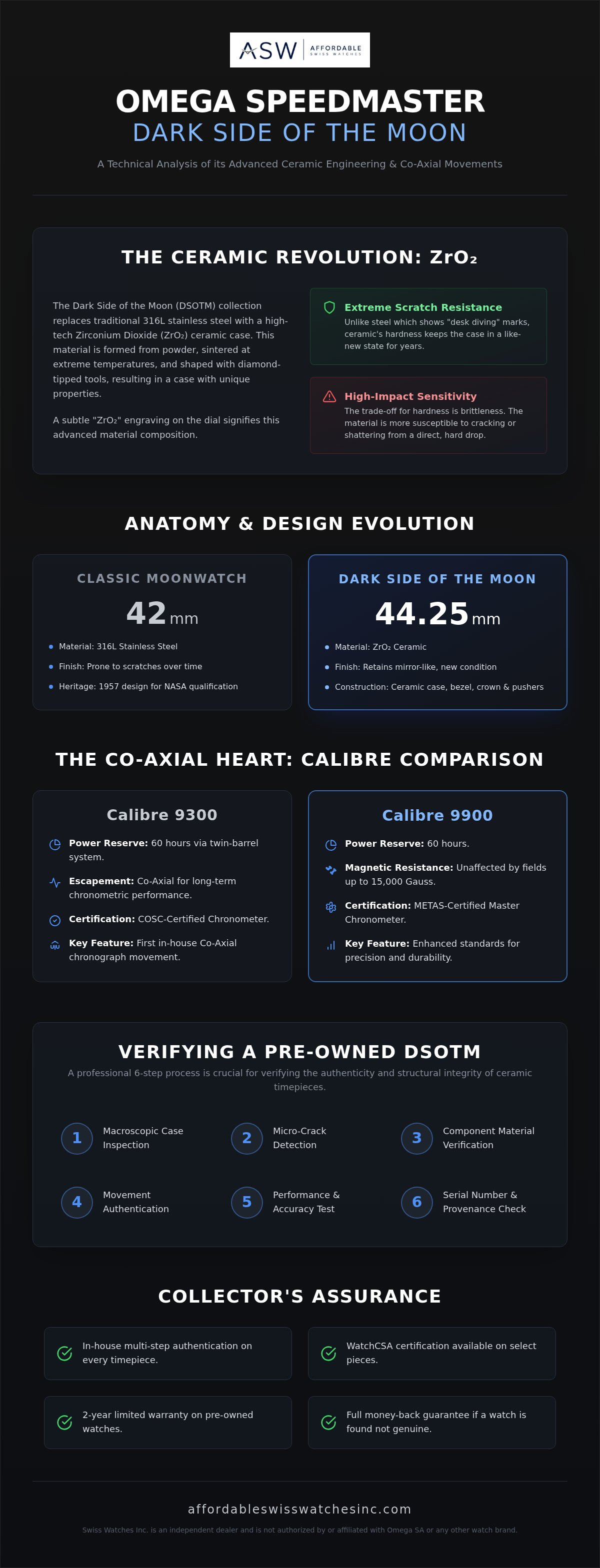
The case of the omega dark side of the moon measures 44.25mm, which is slightly larger than the classic 42mm Moonwatch. Despite the increased diameter, the watch wears remarkably well due to the lightweight nature of ceramic. The manufacturing process is intensive. It begins as a Zirconium Dioxide powder that is pressed into a solid block, sintered at extreme temperatures, and then shaped using diamond-tipped tools. This process results in a case that is virtually scratch-proof. Unlike steel, which accumulates "desk diving" marks and scratches over time, ceramic remains in a like-new state for years. However, this hardness comes with a trade-off in brittleness, meaning the material is sensitive to high-impact drops on hard surfaces.
Aesthetic hallmarks of the DSOTM
Consistency is a defining trait of this collection. Many ceramic watches from other brands use metal inner frames or steel pushers, but Omega utilizes ceramic for almost every exterior component. This includes the following:
- Integrated ceramic bezel: The tachymeter scale is often engraved using chromium nitride or liquidmetal, ensuring the markings never fade.
- Ceramic pushers and crown: These components match the case perfectly in both color and texture, creating a unified look.
- ZrO2 dial engraving: A subtle "ZrO2" is engraved just above the center of the dial, serving as a technical signifier of the watch's ceramic composition.
The polished finish on the case provides a mirror-like depth that stainless steel cannot replicate. It creates a high-contrast backdrop for the luminescent markers and hands, enhancing legibility in low-light conditions. This combination of durability and visual distinction is why the collection remains a staple for those who want a Speedmaster that feels distinctly contemporary.
Technical specifications: ceramic engineering and movements
The movement technology inside the omega dark side of the moon is as advanced as its exterior. When the collection launched, it featured the Calibre 9300, which was the first in-house Co-Axial chronograph movement from the brand. It utilized a unique two-register dial layout that combined the 12-hour and 60-minute counters into a single sub-dial at the 3 o'clock position. This design provides a cleaner aesthetic while maintaining full chronograph functionality. The 9300 relies on a twin-barrel system to deliver a consistent 60-hour power reserve, allowing the watch to maintain accuracy even when not worn for a full weekend.
Recent iterations have moved to the Calibre 9900, marking a significant upgrade to Master Chronometer status. While the 9300 was a COSC-certified chronometer, the 9900 undergoes additional testing by METAS. This certification ensures the entire watch, not just the movement, meets strict standards for precision, water resistance, and magnetic resistance. Protection against 15,000 Gauss is a critical feature for modern owners. Most daily environments contain magnets in tablets, smartphones, and magnetic clasps that can easily disrupt a standard mechanical watch. The Calibre 9900 remains unaffected by these common fields.
The Co-Axial difference
At the heart of these movements is the Co-Axial escapement. This mechanism reduces sliding friction between components, which directly translates to better long-term chronometric performance and longer intervals between required maintenance. The inclusion of a silicon (Si14) balance spring further enhances this stability because silicon is entirely non-magnetic and highly resistant to temperature fluctuations. The Co-Axial escapement is the primary reason these timepieces maintain such high levels of accuracy over years of continuous use.
Case and crystal architecture
Protecting the movement is a box-style sapphire crystal that is scratch-resistant and features anti-reflective treatment on both sides. This ensures the dial remains legible even under direct glare. The ceramic case is rated for 50 meters of water resistance, which is sufficient for daily wear and light exposure to water. Achieving this rating with ceramic requires specialized gaskets and high-precision machining, as ceramic does not flex or compress like stainless steel. The exhibition caseback allows for a clear view of the movement, finished with the distinctive Cotes de Geneve in Arabesque pattern. If you are looking for a piece that combines this level of finishing with modern durability, you can browse our verified Omega collection to find your next timepiece.
Comparing the Dark Side of the Moon collection models
The omega dark side of the moon collection has expanded significantly since the original 2013 release. While the first model featured a high-gloss black finish that defined the aesthetic, subsequent versions introduced matte textures and precious metal fusions. Choosing the right reference depends on whether you value the classic "Moonwatch" heritage or a more modern, tactical appearance. The original model remains a staple for its mirror-polished finish, but it is the variations that allow collectors to find a piece that matches their specific style.
For those who prefer a matte aesthetic, the Pitch Black and Vintage Black offer two distinct directions. The Pitch Black utilizes a matte ceramic case and bezel, with green Super-LumiNova applied to every element of the dial and tachymeter scale. The Vintage Black takes a heritage-inspired approach, using "fauxtina" luminescent material and a brown leather strap to evoke the look of a mid-century timepiece. The Sedna Black represents the most luxurious iteration, combining the durability of black ceramic with the warmth of 18K Sedna gold on the bezel ring, hands, and indices.
The Apollo 8 skeletonized masterpiece
The Apollo 8 is arguably the most visually distinct reference in the lineup. It deviates from the automatic movements of its siblings by using the hand-wound Calibre 1869. The movement bridges are laser-ablated to create a realistic lunar surface texture, visible through both the skeletonized dial and the exhibition caseback. With its bold yellow accents and perforated strap, it is a frequent target for pre-owned omega moonwatch collectors who want a piece that bridges the gap between traditional manual-wind heritage and modern material science. This model is often prioritized by those who appreciate the technical transparency of a skeletonized design.
Special editions and rare references
Beyond black ceramic, Omega explored different chemical treatments to create the Grey Side and Blue Side of the Moon. The Grey Side utilizes plasma-treated ceramic that gives the material a metallic sheen, often paired with a genuine Gibeon meteorite dial. The Blue Side of the Moon introduces a deep blue ceramic case and often incorporates an aventurine glass dial to mimic a star-filled sky. These models also include moon phase complications, adding a layer of horological complexity not found in the standard chronograph models.
In 2026, market scarcity varies significantly across these models. The original DSOTM remains the most liquid in the secondary market due to its iconic status. However, the Apollo 8 and meteorite-dial Grey Side models tend to hold their value better because of their limited production numbers and unique technical features. When evaluating these, condition is paramount. We look for pristine ceramic edges and original components to ensure long-term value retention for our clients.
Durability and ownership: is ceramic right for you?
Owning an omega dark side of the moon requires a shift in how you think about watch protection. While stainless steel is prone to scratches but resistant to impact, Zirconium Dioxide (ZrO2) ceramic is the opposite. It is virtually immune to the hairline scratches and scuffs that plague metal watches. However, this hardness makes the material brittle. A high-impact drop onto a stone floor or tiled surface can cause the case to chip or, in extreme cases, shatter. For most owners, the trade-off is positive because the watch maintains its showroom luster indefinitely under normal conditions.
Maintenance is straightforward but requires care for the sapphire crystal. Use a clean microfiber cloth and mild soapy water to remove fingerprints from the polished ceramic. Avoid abrasive chemicals that might degrade the anti-reflective (AR) coating on the exterior of the crystal. Regarding wearability, the 44.25mm diameter might sound intimidating, but the short lug-to-lug distance and lightweight material allow it to sit comfortably on wrists as small as 6.5 inches. The omega dark side of the moon is designed for those who want a significant wrist presence without the weight of a traditional steel chronograph.
Ceramic vs. Stainless Steel
Ceramic does not develop a patina of scratches over time. A decade-old ceramic Speedmaster often looks identical to a brand-new one. It is also an ideal choice for those with sensitive skin, as ceramic is completely hypoallergenic and contains no nickel. Weight is another significant factor; a ceramic case is notably lighter than a 316L stainless steel equivalent, which reduces wrist fatigue during long periods of wear. You'll find that the watch stays centered on the wrist more easily than heavier steel models.
Service and repair considerations
If a ceramic case is damaged, the repair process is more complex than with steel. You cannot buff out a chip in ceramic. Repair typically involves the full replacement of the affected component, which can be a significant investment. This reality makes our protection more valuable to collectors. ASW Inc. provides a 2-year limited warranty on pre-owned timepieces to ensure your investment is protected against mechanical defects. Movement servicing remains a separate technical process that is independent of the case material. If you are ready to experience this material for yourself, view our current Omega inventory to find a piece that fits your collection.
How to verify and buy a pre-owned Dark Side of the Moon
Purchasing a pre-owned omega dark side of the moon requires a more specialized inspection process than a standard stainless steel timepiece. Because ceramic cannot be refinished or polished to hide wear, the condition you see is permanent. This material stability is a benefit for the buyer, but it also means that any structural damage, such as a chip on the lug or a micro-crack near the pushers, is a critical valuation factor. Verification must extend beyond the surface to ensure the internal movement and external ceramic components are both genuine and fully functional.
Provenance plays a significant role in the long-term value of these pieces. We prioritize watches that include the original oversized black presentation box and the specific pictogram cards that detail the movement caliber and water resistance. These documents serve as a primary layer of verification, especially when the serial numbers on the cards match the laser-etched serial on the ceramic case back. A complete set provides the transparency needed for a secure investment.
The ASW Inc. authentication framework
Our 6-step authentication process is designed to eliminate the risks associated with high-end ceramic chronographs. We begin with a high-magnification visual inspection to check for ceramic integrity, specifically looking for chips in the tachymeter scale or the sharp edges of the lugs. Following this, our technicians perform an internal component verification. We open the case to ensure the Calibre 9300 or 9900 movement is original and has not been altered. We also verify the ZrO2 serial numbers against official records to confirm the watch's production history. Finally, every piece undergoes timekeeping testing to ensure it meets the strict chronometric tolerances expected of a Master Chronometer.
Securing your investment
Whether you are evaluating a pre-owned Audemars Piguet or an omega dark side of the moon, expert verification is the only way to ensure total security. ASW Inc. provides a 100% authenticity guarantee and a full money-back policy if a watch is found not genuine. We also include a 2-year limited warranty on all pre-owned inventory to protect your purchase from mechanical issues. For those who prefer a hands-on experience, we offer private viewings at our professional showroom. This space is strictly by appointment only. You can schedule a visit Monday through Friday between 10 AM and 6 PM to inspect our collection in a secure, professional environment.
Selecting your ceramic Speedmaster with confidence
The omega dark side of the moon is a sophisticated integration of aerospace materials and horological precision. By understanding the shift from the Calibre 9300 to the METAS-certified 9900, you can better evaluate the technical value of each reference in this collection. While the ZrO2 construction ensures a permanent showroom finish, the importance of professional verification for micro-cracks and internal authenticity remains paramount for any serious collector.
At ASW Inc., we simplify this process through our rigorous 6-step authentication and a 100% authenticity guarantee. As a Chrono24 Trusted Seller since 2020, we provide a 2-year limited warranty on every pre-owned timepiece to protect your long-term investment. You can browse our verified Omega Speedmaster collection or contact us to schedule a private viewing at our showroom. All visits are by appointment only to ensure a personalized experience. We look forward to helping you find a piece that meets your standard for technical excellence.
Frequently Asked Questions
Is the Omega Dark Side of the Moon scratch-proof?
The Zirconium Dioxide ceramic case is virtually scratch-proof and maintains its original finish for years. It ranks significantly higher on the Vickers hardness scale than 316L stainless steel. This means the case won't develop the common hairline scratches or "desk diving" marks found on metal watches. While the surface is immune to typical abrasions, it's important to remember that the material's hardness is its primary defense against daily wear.
Does the Omega Dark Side of the Moon shatter if dropped?
It's possible for the ceramic case to chip or shatter if it experiences a high-impact drop onto a hard surface like stone or tile. While ceramic is extremely hard, it's also more brittle than metal. Unlike a steel watch that might dent or deform under stress, a ceramic omega dark side of the moon can crack if the impact is severe enough. Owners should handle the timepiece with care around unforgiving surfaces.
What is the difference between the 9300 and 9900 movements?
The primary difference centers on METAS certification and magnetic resistance. The Calibre 9300 is a COSC-certified chronometer with a 60-hour power reserve. The Calibre 9900 is a Master Chronometer, which means it has passed additional testing for precision and water resistance. Most importantly, the 9900 movement is resistant to magnetic fields up to 15,000 Gauss. The 9300 lacks this specific high-level anti-magnetic rating, though it remains a highly accurate movement.
How do I know if my Omega Dark Side of the Moon is authentic?
Authentication requires a multi-step verification of the ceramic material and the internal movement. Genuine pieces feature a specific ZrO2 engraving on the dial and a laser-etched serial number on the case back that matches the movement. ASW Inc. utilizes a 6-step authentication framework, including internal component verification and timekeeping testing. We provide a 100% authenticity guarantee and a full money-back guarantee if a watch is ever found not to be genuine.
Is the Dark Side of the Moon a limited edition watch?
The standard omega dark side of the moon is a regular production model, though some specific variations have limited availability. While the original black version is widely produced, certain iterations like the meteorite-dial Grey Side or specific commemorative versions have lower production numbers. These watches aren't numbered limited editions in the traditional sense, but their market value is often driven by their relative scarcity in the secondary market compared to steel models.
Can I wear the ceramic Speedmaster for daily activities?
You can wear this watch for most daily activities, provided you avoid high-impact sports or environments where the watch might strike a hard surface. The 50-meter water resistance rating is suitable for light exposure to water, such as hand washing, but it's not intended for swimming or diving. The lightweight ceramic and hypoallergenic properties make it exceptionally comfortable for long-term daily wear. It stays centered on the wrist more easily than heavier steel chronographs.
What does the ZrO2 on the dial of the Omega DSOTM mean?
ZrO2 stands for Zirconium Dioxide, which is the technical chemical formula for the high-tech ceramic used in the watch's construction. This engraving is a hallmark of the collection and signifies that the case, dial, and bezel are crafted from this specialized material. It serves as a marker of technical prestige. This label distinguishes the ceramic models from the traditional stainless steel or precious metal Speedmaster references found in the broader catalog.
Does ASW Inc. offer a warranty on pre-owned Omega watches?
Yes, ASW Inc. provides a 2-year limited warranty on every pre-owned omega dark side of the moon in our inventory. This warranty covers mechanical defects and ensures your timepiece performs within brand tolerances. For unworn pieces, the original manufacturer's warranty is passed through to the buyer. This protection, combined with our 6-step authentication process, provides the security necessary when purchasing high-value luxury watches on the secondary market from an independent dealer.