

Is the Rolex Submariner's significant price premium actually buying you a superior mechanical instrument, or are you simply paying for the heritage of the crown? Deciding between an omega seamaster vs rolex submariner is a rite of passage for any serious collector. It's natural to feel frustrated by multi-year authorized dealer waitlists or the fear of overpaying on the secondary market. You deserve a clear, data-driven path to your next acquisition.
This guide delivers a transparent comparison of these two icons as they stand in 2026. We'll demystify the technical gap between METAS and COSC certifications while providing an honest assessment of market value trends. You will gain the confidence needed to navigate pre-owned listings and identify which timepiece truly aligns with your lifestyle. We'll examine why the Submariner remains the blueprint of the past while the Seamaster acts as the laboratory of the future, ensuring your choice is backed by expertise rather than marketing hype.
Key Takeaways
- Understand the physical nuances between the 41mm Oystersteel case and the 42mm 316L Stainless Steel construction to determine which fits your wrist profile.
- Compare the precision of Rolex’s Superlative Chronometer against Omega’s METAS-certified Master Chronometer to evaluate real-world performance.
- Analyze the current market dynamics of the omega seamaster vs rolex submariner to determine which offers better long-term value retention in 2026.
- Learn how to bypass authorized dealer waitlists by leveraging the authenticated pre-owned market for immediate ownership and security.
- Identify whether your collection priorities align with the historical status of the Submariner or the technical innovation and value of the Seamaster.
Heritage and Identity: Why These Two Define the Dive Watch
The modern dive watch owes its existence to a mid-century race for underwater reliability. While many brands produced water-resistant cases, the debate of omega seamaster vs rolex submariner persists because these two models established the design language for the entire industry. They aren't just timepieces; they're historical benchmarks that reflect different philosophies of luxury and utility.
Rolex introduced the Submariner in 1953. It created the blueprint for the professional tool watch. The design featured a rotating timing bezel and a high-contrast dial that prioritized legibility over ornamentation. Omega took a different path. It launched the Seamaster in 1948 as a robust dress watch for active use. It wasn't until the 1990s that the Seamaster Professional 300M transformed into the tactical icon we recognize today.
Pop culture solidified both legacies through the James Bond franchise. Sean Connery’s Submariner established the watch as a symbol of rugged sophistication. Decades later, the shift to the Omega Seamaster in "GoldenEye" redefined the character for a new generation. By 2026, the market perceives these watches through two distinct lenses: Rolex as the ultimate status symbol and Omega as the definitive enthusiast’s choice.
The Rolex Submariner: The Cultural Heavyweight
Consistency is the Submariner’s greatest strength. Rolex has maintained the core aesthetic of the model for over seven decades, making it instantly recognizable. This design stability supports its reputation as a "one-watch collection" that transitions seamlessly from a wetsuit to a business suit. Over time, it has shifted from a professional instrument to a primary luxury icon. It represents financial stability and personal achievement as much as horological precision. For many collectors, the Submariner is the safe harbor of the watch world.
The Omega Seamaster: The Enthusiast's Alternative
Omega approaches heritage through the lens of constant evolution. The Seamaster Professional 300M often appeals to collectors who value technical innovation, such as the distinct helium escape valve and ceramic "wave" dials. Understanding the heritage of the omega seamaster vs rolex submariner helps collectors decide between a historical icon and a modern innovator. The Seamaster is the preferred choice for those who want a high-performance diver without the social baggage or the difficult acquisition process often associated with the "Rolex crowd." Omega’s willingness to experiment with materials like titanium and ceramic makes the Seamaster feel like a contemporary tool rather than a historical relic.
Design and Aesthetics: Scalloped Bezels vs. Cerachrom Inserts
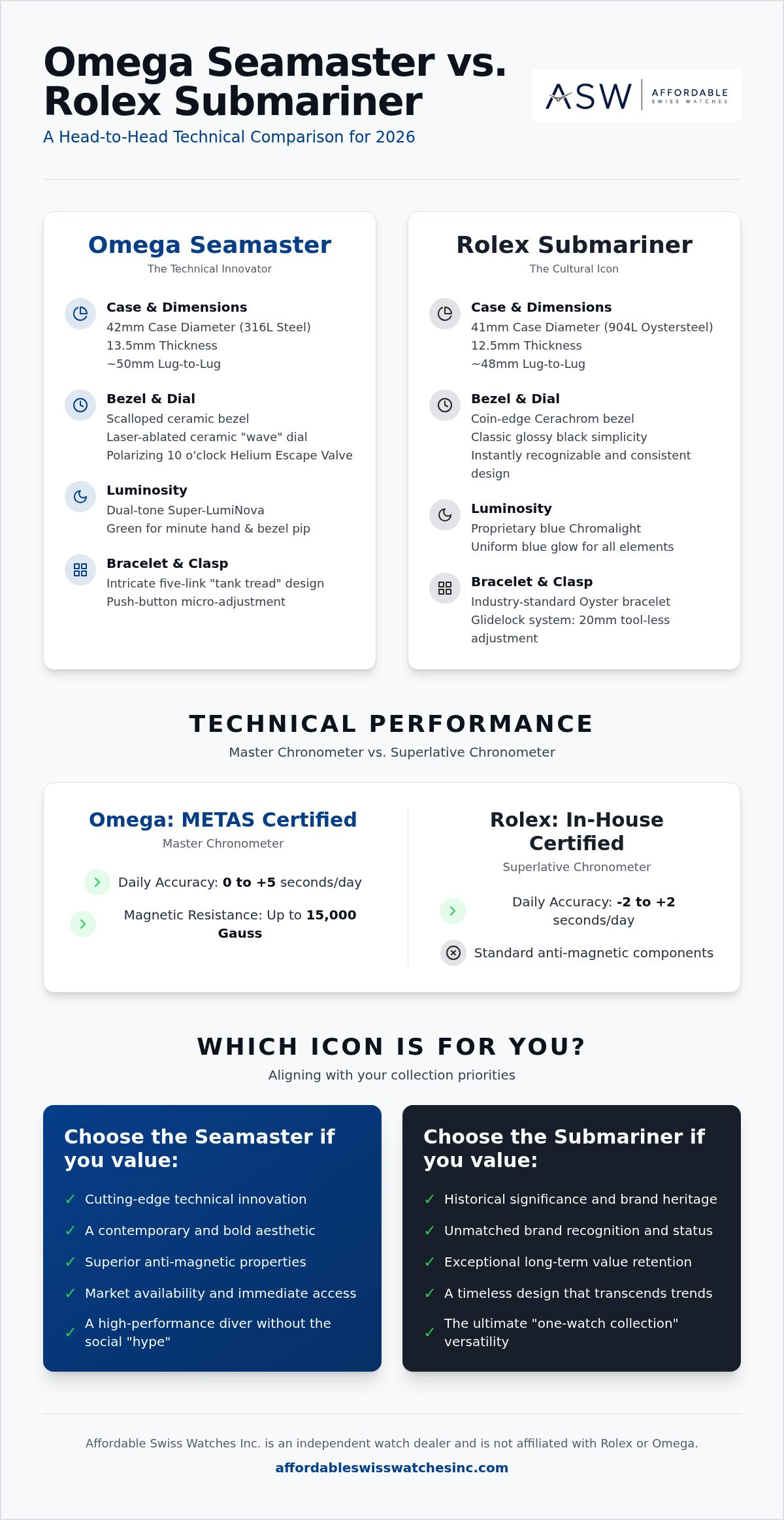
The visual identity of the omega seamaster vs rolex submariner highlights two different approaches to luxury dive watches. Rolex uses a 41mm case crafted from 904L Oystersteel. This alloy is known for its exceptional corrosion resistance and high polish. Omega opts for a slightly larger 42mm case made from 316L stainless steel. While the size difference seems minimal on paper, the physical architecture creates a distinct experience on the wrist.
Rolex utilizes a Cerachrom bezel insert with a classic coin-edge grip. This design is utilitarian and easy to operate even with gloves. In contrast, Omega features a scalloped bezel that offers a more refined, decorative silhouette. The dials are equally divergent. The Submariner favors a deep, glossy black simplicity. The Seamaster Professional 300M showcases a laser-ablated wave pattern on a ceramic base. Even the lume differs. Rolex uses its proprietary blue Chromalight. Omega employs a dual-tone Super-LumiNova system, using green for the minute hand and bezel dot to assist divers in low-light conditions.
Wearability and Wrist Presence
Lug-to-lug measurements often dictate how a watch feels more than the case diameter. The Submariner measures approximately 48mm from lug to lug, making it remarkably wearable for most wrist sizes. The Seamaster is longer at roughly 50mm. The 10 o'clock helium escape valve on the Omega is a polarizing design element. Some appreciate its technical purpose, while others find it disrupts the case symmetry. At 12.5mm thick, the Rolex easily passes the "shirt cuff" test for office wear. The Omega is slightly bulkier at 13.5mm, lending it a more substantial presence.
Bracelet and Clasp Engineering
Rolex's Oyster bracelet remains the industry standard for comfort and durability. Its Glidelock extension system allows for 20mm of adjustment in 2mm increments without tools. This is ideal for managing wrist swelling during summer months. Omega's five-link "tank tread" bracelet is heavier and more intricate. It offers a push-button micro-adjustment system within the clasp for quick sizing. Many enthusiasts prefer the Seamaster on its integrated rubber strap, which reduces weight and emphasizes its modern tool-watch identity. If you're comparing the omega seamaster vs rolex submariner for daily use, trying both on is essential. You can explore our current inventory of authenticated models to find the right fit for your wrist.
Technical Performance: Master Chronometer vs. Superlative Chronometer
The technical debate between the omega seamaster vs rolex submariner centers on two distinct philosophies of mechanical precision. Both brands have moved beyond standard third-party testing to establish proprietary benchmarks that define modern horology. While the average wearer might not notice a few seconds of deviation, these specifications reflect the long-term reliability and engineering depth of each timepiece.
Rolex utilizes the Caliber 3235, a movement that carries the "Superlative Chronometer" designation. This internal standard requires the watch to maintain a precision of -2/+2 seconds per day after the movement has been cased. It also features a 70-hour power reserve, which is a practical benefit for those who rotate between multiple watches. This allows the Submariner to remain active over a full weekend without needing to be wound or reset on Monday morning.
Omega's Caliber 8800 takes a different approach by achieving METAS Master Chronometer certification. While its 55-hour power reserve is shorter than its rival's, it offers a massive advantage in magnetic resistance. The Seamaster remains accurate when exposed to magnetic fields of up to 15,000 Gauss. In a world filled with tablets, smartphones, and magnetic bag clasps, this resistance provides a level of security that traditional movements can't match. When comparing the omega seamaster vs rolex submariner, you're choosing between the Rolex's longer autonomy and Omega's superior environmental shielding.
Movement Architecture and Finishing
Rolex adheres to a philosophy of industrial perfection. The movement is hidden behind a solid Oystersteel caseback, emphasizing the watch's identity as a sealed, professional instrument. Omega celebrates its engineering by featuring a sapphire exhibition caseback. This allows the owner to view the rhodium-plated finish and Arabesque Geneva waves. Omega's Co-Axial escapement is designed to reduce sliding friction within the movement. This mechanical efficiency is intended to extend service intervals, ensuring the watch remains a reliable companion for years without frequent maintenance.
Real-World Durability and Depth Ratings
Both icons are rated for 300 meters of water resistance, which is more than sufficient for any professional or recreational diving scenario. Rolex relies on its proprietary blue Parachrom hairspring to provide shock resistance and stability during temperature fluctuations. Omega utilizes a Silicon Si14 balance spring to achieve similar goals while enhancing magnetic immunity. The METAS standard's rigorous 8-step testing process verifies that every watch maintains its chronometric precision and water resistance while being subjected to extreme magnetic loads and varying power levels. This level of transparency ensures that the Seamaster's performance is verified by an independent federal institute, providing an extra layer of confidence for the discerning collector.
Market Dynamics: Pricing, Value Retention, and 2026 Availability
The financial landscape of the omega seamaster vs rolex submariner has shifted significantly by 2026. While retail prices have risen across the board, the secondary market remains the primary battlefield for serious collectors. A Rolex Submariner continues to command a significant premium over its original MSRP due to persistent scarcity at authorized dealers. This creates a high barrier for new buyers but rewards long-term owners with unmatched value retention. Rolex remains the undisputed gold standard for those who view their timepiece as a liquid asset that can be traded or sold with ease.
Omega offers a more transparent and accessible value proposition. The Seamaster Professional 300M is generally available at retail and provides exceptional value for money on the pre-owned market. You aren't paying for artificial scarcity or "relationship building" with a salesperson; you're paying for the technical engineering of the watch itself. This makes the Omega an incredibly attractive entry point for enthusiasts who want high-tier horology without the heavy secondary market markup often associated with the crown.
The True Cost of Ownership
Owning a luxury dive watch involves ongoing expenses that go beyond the initial transaction. Rolex service costs are generally higher, and the current 126610LN reference requires specialized equipment to maintain its Superlative Chronometer precision. Insurance is another critical consideration. High-value Rolex models often require specific riders on insurance policies due to their high market value and desirability. Omega's Co-Axial movements are specifically engineered to reduce friction, which can lead to longer service intervals and lower maintenance costs over a 10-year period. While Seamaster models typically follow a steeper initial depreciation curve than Rolex, they tend to stabilize quickly on the secondary market. This allows savvy buyers to acquire a nearly-new timepiece at a significant discount compared to its original retail price.
Investment Potential vs. Daily Utility
Historical price trends for the Submariner show a consistent upward trajectory, making it a reliable choice for those prioritizing financial stability. However, the Seamaster is often the superior "daily driver" for the pragmatic buyer. Its lower market profile makes it less of a target in urban environments, while its technical specifications, like the 15,000 Gauss magnetic resistance, make it more resilient to modern life. Recent 2026 auction trends indicate that while Rolex holds the price ceiling, the volume of high-quality Omega trades is rising. Collectors are increasingly seeking watches they can actually wear without fear of losing value from a single scratch. If you're ready to bypass the authorized dealer waitlists and secure a timepiece today, you can browse our authenticated Submariner and Seamaster models. Every watch we sell undergoes a verified authenticity process and includes a two-year warranty for your peace of mind.
The Final Verdict: Which Icon Belongs on Your Wrist?
Choosing between an omega seamaster vs rolex submariner is a decision that balances historical prestige with modern engineering. The Submariner is a financial anchor. It represents a safe harbor for your capital, offering unmatched cultural recognition and a design that has remained relevant for over 70 years. If your priority is status, heritage, and the security of a liquid asset, the Rolex remains the definitive choice for your collection.
Conversely, the Seamaster appeals to the pragmatist. It offers technical superiority through its 15,000 Gauss magnetic resistance and the aesthetic charm of an exhibition caseback. You're getting a watch that pushes the boundaries of horological science without the inflated secondary market premiums. For those who value innovation and "value for money" over brand signaling, the Omega is the superior daily instrument.
Bypassing authorized dealer waitlists is the most efficient path to ownership in 2026. The pre-owned market allows you to acquire these icons immediately, often in unworn or mint condition. Before finalizing your purchase, consider this checklist:
- Resale Liquidity: Does the watch need to hold its value for a future trade? (Advantage: Submariner)
- Technical Specs: Do you require high magnetic resistance or a visible movement? (Advantage: Seamaster)
- Wrist Presence: Do you prefer the 41mm classic proportions or the 42mm modern bulk?
- Availability: Are you willing to wait years at a boutique, or do you want the watch today?
Buying with Confidence: The Independent Advantage
Purchasing a high-value timepiece requires absolute certainty regarding provenance. We bridge the gap between investment and accessibility by providing a verified authenticity process for every watch in our inventory. Our two-year warranty on all pre-owned timepieces ensures that your investment is protected from mechanical failure. This professional oversight provides the peace of mind that traditional private sales cannot offer. Transparency in condition and history is our core priority, allowing you to focus on the enjoyment of the watch rather than the risks of the transaction.
Next Steps for Your Collection
If the Submariner feels too ubiquitous, you might consider the Rolex GMT-Master II for added functionality or the Rolex Sea-Dweller for increased depth ratings. Collectors seeking a more technical Omega experience can explore the broader Seamaster range, which offers various materials like titanium and ceramic. Whatever your preference, the right watch is the one that aligns with your personal style and financial goals. You can browse our curated collection of authenticated Rolex and Omega watches to find your next cornerstone piece today.
Elevating Your Horological Standard in 2026
The debate of omega seamaster vs rolex submariner ultimately reveals that both watches are masterpieces of their respective domains. Whether you prioritize the unmatched value retention and cultural heritage of the Submariner or the technical precision and magnetic resistance of the Seamaster, your choice reflects a commitment to excellence. You don't have to navigate authorized dealer waitlists or secondary market risks alone.
At Affordable Swiss Watches Inc., we provide a transparent path to ownership. We offer a two-year warranty on all pre-owned timepieces and a guaranteed 100% authenticity process to protect your investment. If you're looking to trade up, our team provides expert appraisals for luxury watch consignment to ensure you receive fair market value for your current piece.
Secure your next investment: Shop our authenticated Rolex and Omega inventory. Your next iconic dive watch is ready for its place in your collection, and we're here to ensure your purchase is handled with the precision it deserves.
Frequently Asked Questions
Which watch holds its value better, the Submariner or the Seamaster?
The Rolex Submariner consistently holds its value better than the Omega Seamaster on the secondary market. High demand and limited retail availability often result in pre-owned Submariners selling above their original MSRP. While the Seamaster experiences higher initial depreciation, it offers a more accessible entry point for collectors. The market for an omega seamaster vs rolex submariner shows that Rolex remains the primary choice for those prioritizing capital preservation and long-term liquidity.
Is the Omega Seamaster more accurate than the Rolex Submariner?
Accuracy depends on the specific certification standards used by each brand. Rolex guarantees a precision of -2/+2 seconds per day for its Superlative Chronometers. Omega's Master Chronometers are tested to a range of 0/+5 seconds per day. While the Rolex has a tighter daily deviation, Omega offers superior resistance to magnetic fields up to 15,000 Gauss. This makes the Seamaster more resilient to accuracy loss caused by modern electronic devices.
Why does the Rolex Submariner cost so much more than the Seamaster?
The price disparity is driven primarily by brand positioning and market demand rather than technical specifications. Rolex uses 904L Oystersteel, which is more difficult to machine than the 316L steel used by Omega. Additionally, the Submariner's status as a global symbol of achievement sustains high secondary market premiums. When comparing the omega seamaster vs rolex submariner, the Omega often provides more advanced technical features at a significantly lower price point for the pragmatic enthusiast.
If you are interested in how the aesthetic of these high-end models is captured through high-quality replicas, click here.
Can you actually dive with these watches in 2026?
Both timepieces remain fully functional professional instruments in 2026. They are rated for 300 meters of water resistance and meet ISO 6425 standards for dive watches. While most owners wear them as luxury accessories, their construction includes screw-down crowns and unidirectional bezels designed for underwater timing. We recommend a pressure test every two years if you plan to use your watch for recreational diving to ensure the gaskets remain intact and effective.
What is the difference between a Master Chronometer and a Superlative Chronometer?
Superlative Chronometer is a Rolex internal standard that tests the watch after the movement is cased to ensure -2/+2 seconds of daily precision. Master Chronometer is a certification by METAS, an independent Swiss federal institute. METAS testing requires the watch to maintain 0/+5 seconds of accuracy while exposed to 15,000 Gauss of magnetism. Both standards exceed the basic COSC requirements, but they prioritize different aspects of mechanical performance and environmental resilience.
Does the Omega Seamaster's helium escape valve serve a purpose for most users?
The helium escape valve is a specialized tool that serves no practical purpose for recreational divers or daily wearers. It is designed for professional saturation divers who spend days in pressurized environments. For the average user, the valve at 10 o'clock is a signature design element that defines the Seamaster's silhouette. It remains a point of contention for some collectors, but it serves as a reminder of the watch's professional diving heritage.
Is it better to buy a new Omega or a pre-owned Rolex?
The choice depends on whether you value technical innovation or investment potential. A new Omega provides the latest Master Chronometer technology and a manufacturer warranty. A pre-owned Rolex offers immediate status and historically better resale value. We bridge this gap by offering authenticated pre-owned models from both brands with a two-year warranty. This allows you to acquire a Submariner without the authorized dealer waitlist while maintaining the security of a verified purchase.
How often do these watches need to be serviced?
Modern luxury watches generally require maintenance every 8 to 10 years. Rolex officially recommends a 10-year service interval for its newer movements like the Caliber 3235. Omega's Co-Axial escapement is also engineered for longevity, with similar 8 to 10-year recommendations. However, the actual frequency depends on your usage patterns and environmental exposure. Regular water resistance checks and keeping the movement wound will help extend the time between full mechanical overhauls.