

The most recognizable Omega isn’t automatically the right one for you. A Speedmaster, Seamaster, Constellation, or De Ville can suit a different wrist, routine, and set of priorities, so start with how you plan to wear the watch rather than the collection name alone.
It’s useful to compare design and technical features first, but reference numbers and listing descriptions can make the details harder to assess. This guide helps you narrow your options by intended use and fit, then compare the exact reference, condition, materials, and functions in each listing.
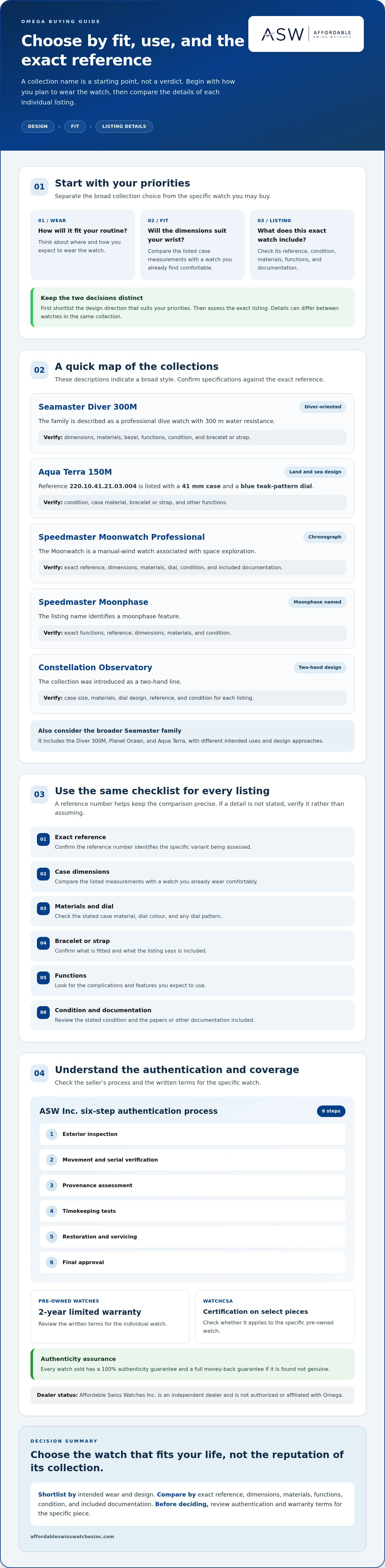
You’ll also learn what to check before buying, including seller authentication and warranty terms. Affordable Swiss Watches Inc. is an independent dealer, not an authorized Omega dealer. Its six-step authentication process includes an exterior inspection, movement and serial verification, provenance assessment, timekeeping tests, restoration and servicing, and final approval. Unworn watches carry the original manufacturer warranty; pre-owned watches carry ASW Inc.’s 2-year limited warranty. Every watch sold has a 100% authenticity guarantee and a full money-back guarantee if it’s found not genuine. With those checks in mind, you can choose an Omega that fits your priorities with greater confidence.
Key Takeaways
- Choose an Omega based on how you plan to wear it, then compare each collection’s design and useful functions rather than treating one family as universally superior.
- Compare case dimensions with a watch you already find comfortable, and verify the exact reference before weighing listing details.
- Check each listing for its stated condition, materials, functions, and warranty terms. Don’t assume details apply across every reference.
- Use the Aqua Terra 150M reference 220.10.41.21.03.004 as one comparison point: its confirmed listing details include a 41 mm case and blue teak-pattern dial.
- Understand the seller’s authentication steps and written guarantees, and check whether WatchCSA certification applies to the specific pre-owned piece.
What should you compare when buying an Omega watch?
Start with how you expect to wear the watch, the design you prefer, and the functions you’ll use. Those priorities help narrow the Omega collections before you compare individual listings. A collection name signals a design direction, not a ranking of quality. Popularity alone can’t tell you whether a particular watch suits your wrist or routine.
Keep two decisions separate: first choose the type of watch that fits your priorities, then assess the exact listing. Condition, included documentation, and reference-specific details can make two watches from the same collection quite different choices.
Which Omega collection suits your everyday use?
Seamaster and Speedmaster are useful starting points if you’re drawn to sport-oriented designs. The Seamaster family includes the Diver 300M, Planet Ocean, and Aqua Terra, with different intended uses and design approaches. The Speedmaster includes the Moonwatch, a manual-wind watch associated with space exploration. Constellation offers another distinct design direction. For background beyond shopping criteria, see this overview of Omega SA history.
These broad distinctions can help you build a shortlist, but don’t assume every model in a collection shares the same dimensions, materials, or functions. Begin with how you plan to wear the watch, then compare the specifications for each exact reference.
Which details deserve attention before choosing?
Read the listing rather than relying on a collection label or a general description. A reference number identifies the exact model variant you’re assessing, so use it to keep comparisons precise. Check the stated condition and what’s included, then compare the specifications that matter to you. If a detail isn’t stated, treat it as something to verify rather than filling in the gap with assumptions.
- Case dimensions: Compare the listed measurements with a watch you already wear comfortably.
- Materials and dial: Check the case material, dial colour, and any stated dial pattern.
- Bracelet or strap: Confirm what’s fitted and whether the listing describes it as included.
- Functions: Look for the complications and features you’ll actually use.
- Condition and documentation: Review the stated condition and the included papers or other documentation.
First comparison checklist: intended wear, case dimensions, materials, dial, bracelet or strap, functions, condition, and included documentation. Apply the same checklist to each candidate. It makes differences easier to spot and keeps the decision focused on your needs rather than which model attracts the most attention.
How do Omega collections and features differ?
Collection names help identify a broad design direction, but they don’t confirm a particular watch’s size, materials, condition, or included bracelet. Compare the exact reference and listing details before deciding that watches from different families suit the same purpose.
| Collection or example | Intended style | Confirmed details | What to verify |
|---|---|---|---|
| Seamaster Diver 300M | Diver-oriented design | The family is described as a professional dive watch with 300 m water resistance. | For the exact reference, check case dimensions, materials, bezel, functions, condition, and bracelet or strap. |
| Aqua Terra 150M, reference 220.10.41.21.03.004 | Versatile design for land and sea | The cited listing specifies a 41 mm case and blue teak-pattern dial. | Confirm condition, case material, bracelet or strap, and other functions in the listing. |
| Speedmaster Moonwatch Professional | Chronograph with space-exploration associations | The Moonwatch is a manual-wind watch. | Check the exact reference, case dimensions, materials, dial, condition, and included documentation. |
| Speedmaster Moonphase | Chronograph with a moonphase description | The listing name identifies a moonphase feature. | Verify the exact functions, reference, dimensions, materials, and condition. |
| Constellation Observatory | Two-hand design | The collection was introduced as a two-hand line. | Check each listing for case size, materials, dial design, reference, and condition. |
How do Seamaster and Aqua Terra listings compare?
The Diver 300M’s family description gives you a diver-oriented starting point. The Aqua Terra example has specific listing details: reference 220.10.41.21.03.004, a 41 mm case, and a blue teak-pattern dial. These details describe that example, not every Aqua Terra. Compare each listing’s reference, dimensions, materials, and bracelet or strap before drawing conclusions.
How do Speedmaster and Constellation listings compare?
A Moonwatch Professional may suit a buyer who values manual winding; a Speedmaster Moonphase listing may appeal to someone seeking that named function. The Constellation Observatory’s two-hand format offers another point of comparison, but its case and dial details need to come from the individual listing. For additional Speedmaster context, read Sotheby’s Omega Speedmaster Collector's Guide.
Build a shortlist around the function, styling, and fit you prefer, then check the listing instead of assuming the collection label fills in missing specifications. You can compare Omega watch listings using the same criteria.
How can you choose the right Omega size, condition, and reference?
Use a consistent order: decide how you’ll wear the watch, assess fit, identify the exact reference, choose the condition that suits you, then verify the listing. This keeps an appealing design from distracting you from practical differences between individual watches.
- Use case: Decide whether you want a watch for regular daily wear, specific activities, or occasional use. This helps you judge which functions and design details matter.
- Fit: Compare the listed case dimensions with a watch you already wear comfortably. Think about the wrist presence you prefer rather than assuming a particular size will suit everyone.
- Reference: Record the full reference number for each candidate. It identifies the specific variant you’re considering and helps you check that the title, description, and photographs align.
- Condition: Decide whether you’re considering an unworn or pre-owned watch, then review the listing’s condition description and photographs closely.
- Listing verification: Confirm the details that matter to you, including materials, dial, bracelet or strap, included box and papers, and warranty type. Ask for clarification when information is absent or unclear.
How should you assess case size and wearing comfort?
Start with the stated case dimensions, then compare them with a watch already in your rotation. Consider whether the wrist presence feels comfortable for your usual activities. Case material and bracelet or strap can also affect how a watch feels, so account for those details when the listing provides them. There’s no universally right size; comfort depends on your wrist and preference.
What should you verify in an individual listing?
Check that the product title and reference number match the description and photographs. Review the stated condition and confirm whether the box and papers are included. Don’t assume they’re part of the sale unless the listing says so. Also confirm the warranty terms: unworn watches carry the original manufacturer warranty, while pre-owned watches carry ASW Inc.’s 2-year limited warranty.
“Unworn” and “pre-owned” describe different purchase conditions, and their warranty terms aren’t interchangeable. Read the specific listing rather than inferring condition or coverage from the collection name. If a detail you need is missing, get it confirmed before making a decision.
Once you’ve narrowed your criteria, you can review Omega watch listings and apply the same sequence to each candidate.
How do authenticity, condition, and warranty affect an Omega purchase?
Assess the specific watch, not only its collection or reference. Affordable Swiss Watches Inc. is an independent dealer, and its six-step authentication process covers the watch from initial inspection through final approval. Every watch sold has a 100% authenticity guarantee and a full money-back guarantee if it’s found not genuine. Warranty coverage depends on whether the listing describes the watch as unworn or pre-owned.
What does the six-step authentication process check?
The process follows a defined sequence:
- Visual inspection: The watch receives an initial visual assessment.
- Movement and serial verification: The movement and serial details are checked.
- Provenance assessment: Available background information, including certificates and service records, is assessed.
- Timekeeping tests: Performance is tested against brand tolerances.
- Restoration and servicing: Restoration and servicing are conducted at ASW Inc.’s dedicated service center.
- Final approval: The watch receives a final review before approval.
These steps describe ASW Inc.’s process; they don’t establish authorized-dealer status or an affiliation with Omega. Some pre-owned listings may carry WatchCSA Pre-Owned Certified status. Check the specific listing for that status rather than assuming it applies across the inventory.
What do Omega watch condition and warranty terms mean?
“Unworn” and “pre-owned” refer to different conditions, and their warranty terms differ. Unworn watches carry the original manufacturer warranty. Pre-owned watches carry ASW Inc.’s 2-year limited warranty. Check the selected listing for its exact condition description and warranty wording so you know which coverage applies.
Also review the listing for included accessories and documentation. Treat a box, papers, or other original items as included only when the listing says so; their presence isn’t guaranteed for every watch. If the description leaves a question open, ask for clarification rather than assuming an item or document comes with the purchase.
Before choosing, compare the stated condition, warranty, and included items alongside the reference and photographs. You can review current Omega watch listings and check these details for each candidate.
Which Omega watches are worth shortlisting from this collection?
A useful shortlist reflects different priorities, not a claim that one watch is universally best. These three references offer distinct starting points: compare the Aqua Terra example for its listed dial and case details, then assess the Moonwatch Professional and Diver 300M using their exact listing information and your preferred design.
Which current listing examples illustrate different priorities?
- Aqua Terra 150M, reference 220.10.41.21.03.004: The confirmed details include a 41 mm case and a blue teak-pattern dial. Shortlist it if those design features appeal to you, then check the listing for its condition, materials, bracelet details, and other specifications.
- Speedmaster Moonwatch Professional, reference 310.32.42.50.01.002: Use this as a Speedmaster comparison point. Confirm the current listing’s condition, dimensions, materials, and included items rather than assuming details from the collection name or reference alone.
- Seamaster Diver 300M, reference 210.30.42.20.10.001: This gives you a Seamaster example to compare with the other two. Check its listing for the specific functions, materials, dimensions, and bracelet or strap details that matter to you.
Product details and availability can change. Before publication or purchase, verify that each reference is currently listed and confirm its condition and specifications on the live product page. The reference number helps identify the intended variant, but the current listing is where to confirm what’s being offered.
How can you move from shortlist to purchase?
Compare candidates side by side. Match the exact reference to the product title and photographs, then review the stated condition, included documentation, and applicable warranty. Unworn watches carry the original manufacturer warranty; pre-owned watches carry ASW Inc.’s 2-year limited warranty. If the listing leaves a detail unclear, ask for confirmation rather than treating it as included.
Affordable Swiss Watches Inc. is an independent dealer, not an authorized Omega dealer. Listed prices reflect the current market value of the specific watch. Compare the current Omega watch listings using the reference and listing details to decide which candidate merits closer consideration.
Choose your Omega with clear priorities
The right Omega is the one that fits your intended wear, wrist, and preferred functions. Compare collection and design first, then verify the exact reference, listed dimensions, condition, and included documentation. Those details help distinguish similar-looking options without treating popularity as a measure of suitability.
Before you decide, check the warranty attached to the specific watch. Some pre-owned listings may state that they have WatchCSA Pre-Owned Certified status, but don’t assume this applies to every piece. Affordable Swiss Watches Inc. also provides a 100% authenticity guarantee and a full money-back guarantee if a watch is found not genuine.
Review the listing details and terms at your own pace, then browse the Omega collection to compare current options. Use the reference, condition, and specifications to build a shortlist that reflects your priorities.
Frequently Asked Questions
How do I choose the right Omega watch?
Start with intended wear, preferred design, fit, and functions you’ll use. Then compare the exact reference and listing details instead of choosing by collection name alone. Check the stated condition, materials, dimensions, included documentation, and applicable warranty. If a specification is missing or unclear, ask the seller to confirm it before deciding. No single Omega model suits every buyer, so use your priorities to narrow the options.
What is the difference between the Omega Seamaster and Speedmaster?
They are distinct Omega families, but the collection name alone doesn’t tell you every watch’s purpose or features. Examples include Seamaster Diver 300M and Aqua Terra listings, as well as Speedmaster chronograph models. Compare the exact reference, confirmed functions, dimensions, materials, and condition for each watch. Those listing-specific details provide a sounder basis for deciding which design and features fit your preferences.
How can I check whether an Omega watch is authentic?
Review the exact reference, photographs, condition description, and available documentation, then examine the seller’s verification process and guarantees. Affordable Swiss Watches Inc. uses six steps: visual inspection; movement and serial verification; provenance assessment; timekeeping tests against brand tolerances; restoration and servicing; and final approval. WatchCSA Pre-Owned Certified status applies only to select pre-owned pieces, so check the specific listing.
Do unworn and pre-owned Omega watches have the same warranty?
No. Under Affordable Swiss Watches Inc.’s terms, unworn watches carry the original manufacturer warranty, while pre-owned watches have ASW Inc.’s 2-year limited warranty. Check the selected listing to confirm its condition and applicable warranty wording before purchase. Don’t assume coverage stated for one watch applies to another listing, even if both belong to the same collection or share similar specifications.
Are the listed prices for Omega watches negotiable?
Affordable Swiss Watches Inc. states that listed prices reflect the current market value of the specific watch. Check the selected page for current details, then compare the exact reference, condition, materials, and included items alongside the displayed price. Browse current Omega listings to compare available options.