

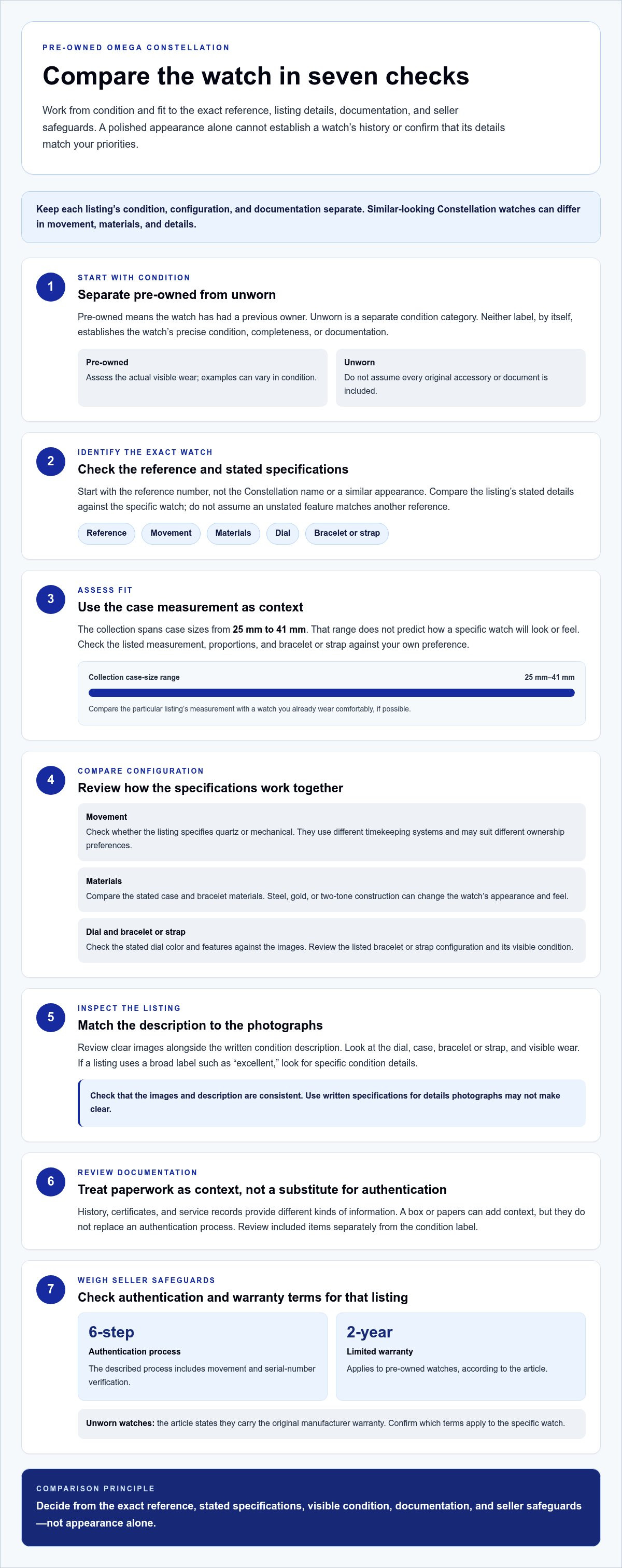
The Constellation that looks right in a listing may not be the right watch for you. When comparing a pre-owned Omega Constellation, start with fit and condition, then check the reference, materials, movement, and documentation. A polished appearance alone cannot establish a watch’s history or confirm that its details match your priorities.
Design matters: case size, bracelet style, and dial all affect how a Constellation looks and wears. Condition, authenticity, and warranty terms matter just as much. A box or papers can provide useful context, but they do not replace an authentication process.
This guide explains how to compare Constellation configurations, assess listing details, and weigh seller safeguards. Affordable Swiss Watches Inc. authenticates every watch it sells through a six-step process that includes movement and serial-number verification. Pre-owned watches carry a 2-year limited warranty from Affordable Swiss Watches Inc.; unworn watches carry the original manufacturer warranty. Use the steps below to compare condition, documentation, and specifications without relying on appearance alone.
Key Takeaways
- Compare the exact reference and stated specifications. Similar-looking Constellation watches can differ in movement, materials, and configuration.
- Use the collection’s 25 mm to 41 mm case-size range as context, then consider the listed size and bracelet or strap against your own fit preferences.
- Assess a pre-owned Omega Constellation’s condition separately from its provenance. History, certificates, and service records provide different kinds of information.
- Review case size, movement, materials, dial, and bracelet or strap together to identify the configuration that suits you.
- Use listed prices as current-market context, and weigh the seller’s authentication and warranty terms before deciding.
What should you know before buying a pre-owned Omega Constellation?
Pre-owned means the watch has had a previous owner; unworn is a separate condition category. That distinction describes the watch’s history, not its precise condition today. One pre-owned example may show visible wear, while another may be carefully preserved. An unworn example is not automatically sold with every original accessory or document.
Pre-owned and unworn describe different condition categories. Neither label, by itself, establishes the watch’s physical condition, completeness, or documentation. Review the condition, included items, and identifying details separately. This gives you a clearer basis for comparing listings than relying on one label.
What does pre-owned mean for an Omega Constellation?
Prior ownership is a fact about a watch’s history, not a uniform condition grade. Read the description alongside the photographs. The listing explains the seller’s description, while clear images let you examine the dial, case, bracelet or strap, and visible wear. Check that the images and description are consistent. If the listing uses a broad term such as “excellent,” look for specific details about visible condition and separately stated accessories or paperwork.
Keep unworn examples separate from pre-owned ones when comparing listings. A similar reference or appearance does not make their condition descriptions interchangeable. Completeness is another separate consideration: a condition label alone does not tell you which box, papers, or other items accompany the watch.
Why does the Constellation appeal to different buyers?
The Constellation has a dress-watch character and a design that spans multiple generations and configurations. Omega introduced the collection in 1952, drawing on the brand’s history of observatory chronometer competition. That heritage provides context, but it does not establish an individual watch’s current condition, service history, or authenticity.
Reference details matter because they affect the wearing experience and the kind of watch you choose. Case size influences fit; the dial and materials shape the appearance; movement type affects how the watch operates; and documentation can add context about its history. Define your priorities before comparing individual pieces.
Start with the reference number rather than assuming two watches are the same because they share the Constellation name. Then compare the listed specifications against your priorities: how the watch sits on your wrist, which style you prefer, and what information is available for that specific example. Collection history is background; the individual listing should guide your assessment.
How do case size, movement, and materials shape your Constellation choice?
Compare specifications as a group, then decide which details matter most for your wrist and routine. Omega’s Constellation collection spans case sizes from 25 mm to 41 mm, but that range does not tell you how a specific watch will look or feel. The listed case measurement is one factor in fit, alongside the watch’s proportions, bracelet or strap, and your own preference.
Use this checklist to compare listings. Each entry is a prompt to review the specific watch’s stated details, not a specification that applies to every Constellation.
| Detail | What to compare | Why it matters |
|---|---|---|
| Case size | The measurement stated in the listing | Helps you assess visual presence and likely fit. Compare it with a watch you already wear comfortably. |
| Movement | Quartz or mechanical, as specified | These use different timekeeping systems and may suit different ownership preferences. |
| Materials | The listed case and bracelet materials | Steel, gold, or two-tone construction can change the watch’s appearance and feel. |
| Dial | Stated color and features, checked against images | Color, markers, and contrast affect the look and how easily you read the time. |
| Bracelet or strap | The listed configuration and visible condition | Fit and overall appearance depend on what is actually included with that watch. |
How should you compare case size and dial design?
Start with the case measurement, then consider the proportions you prefer. Wrist size can inform your choice, but a gender label is a poor substitute for assessing how a watch’s dimensions and design will look on you. If possible, compare the measurement with a watch you own. In listing images, check dial color, markers, and legibility. Use the written specifications for details photographs may not make clear.
Do not infer an unstated dimension or dial feature from a photograph or from another watch that looks similar. If the listing does not name a detail, leave it out of your comparison rather than assuming it matches another reference.
Should you choose quartz or a mechanical movement?
Quartz movements use an electronic timekeeping system regulated by a quartz crystal. Mechanical movements keep time through a wound mainspring and a system of components. The choice is practical as well as personal: consider which type of ownership and operation you prefer, then verify the movement stated for the specific watch. Do not assign a movement or calibre based on appearance or collection name alone.
Materials and configuration also deserve close attention. Photographs can help you compare the dial and overall style, but the listing should identify the materials and whether the watch has a bracelet or strap. Keep your comparison tied to the individual watch. You can browse Omega Constellation listings and compare their stated configurations with your preferences.
Which Constellation details are worth comparing across available listings?
Compare the reference number first, then use each listing’s stated condition and specifications to decide whether two watches are genuinely comparable. Similar case shapes or dial colors do not make different references identical. The examples below are unworn, so they illustrate configurations rather than the condition of a pre-owned watch.
The table records only the details provided for each example. “Not stated” means the description does not give that specification. Do not assume a feature from another reference.
| Reference | Stated condition | Case size | Movement | Listed materials |
|---|---|---|---|---|
| 140.13.39.21.01.001 | Unworn | 39.4 mm | Not stated | O-MEGASTEEL case |
| 140.13.39.21.10.001 | Unworn | 39.4 mm | Not stated | O-MEGASTEEL case |
| 140.13.39.21.03.001 | Unworn | 39.4 mm | Not stated | O-MEGASTEEL case |
| 131.10.28.60.01.001 | Unworn | 28 mm | Quartz | Not stated |
| 131.55.25.60.55.001 | Unworn | 25 mm | Quartz | Not stated |
| 131.20.25.60.02.002 | Unworn | 25 mm | Quartz | Not stated |
What do the supplied Observatory examples illustrate?
The three 140.13 references share two stated details: a 39.4 mm O-MEGASTEEL case and faceted dog-leg lugs. All three descriptions identify the watches as unworn. They do not provide further details here about movement or dial differences. Do not infer those from the reference numbers or assume a visible variation in a photograph indicates a particular specification.
Use the shared specifications to see what these examples have in common, then compare the full description for the exact reference you are considering. Matching case material and size does not establish that every other feature is the same.
How can smaller quartz examples help define your preferences?
The supplied 131.10.28.60.01.001 example is an unworn 28 mm quartz Constellation. The 131.55.25.60.55.001 and 131.20.25.60.02.002 examples are unworn 25 mm quartz watches. These references offer a direct comparison of stated case sizes and movement type, but the available details here do not specify their dial or case materials.
Use exact references to build a shortlist, and leave unstated features open rather than filling gaps with assumptions. These examples compare configurations; they are not pre-owned listings. Condition, specifications, and availability can change, so use each individual listing for its current details.
How can you assess condition, provenance, and authenticity before buying?
Keep three questions separate: what condition is the watch in now, what is known about its history, and what verification supports its authenticity? A box or certificate can contribute information, but it does not answer all three. Review the listing alongside any available records, and look for a clear account of the checks performed on the watch itself.
ASW Inc.’s authentication process covers these six stages:
- Visual inspection: An initial examination reviews the watch’s visible features and condition.
- Internal component verification: The movement and serial number are checked.
- Provenance assessment: Available history, certificates, and service records are considered.
- Timekeeping testing: Performance is tested against brand tolerances.
- Restoration and servicing: Restoration and servicing are addressed through ASW Inc.’s dedicated service center.
- Final approval: The watch receives a final review.
What does ASW Inc.’s authentication process check?
The process combines a visual review with checks of internal components, provenance, and timekeeping, followed by restoration and servicing and a final approval. For a pre-owned Omega Constellation, this helps distinguish authentication from a condition description: one concerns verification, while the other describes the watch’s present state.
Provenance records can provide useful context without forming a complete history. Note which records are available and what each one documents. A service record can support information about recorded service, while a certificate may relate to a particular aspect of the watch’s documentation. Consider each record for what it says, not as a substitute for the separate authentication assessment.
What should box, papers, certification, and warranty tell you?
Original accessories and documentation are included where available. Check the individual listing to establish what accompanies that watch. Do not assume a box, papers, or both are included based on appearance or a broad condition label.
Some pre-owned pieces carry third-party Pre-Owned Certified status from WatchCSA. This status applies to select watches. Treat certification as a separate listing detail from condition and included accessories. Warranty terms also depend on condition: pre-owned watches carry a 2-year limited warranty from ASW Inc., while unworn watches carry the original manufacturer warranty. ASW Inc. provides a 100% authenticity guarantee on every watch sold and a full money-back guarantee if a watch is ever found not to be genuine.
Compare the stated condition, available records, certification, and applicable warranty for each listing. You can browse Omega Constellation listings and review those details at your own pace.
How to choose and buy a pre-owned Omega Constellation?
A sound purchase decision follows a clear order: decide how you want the watch to fit and look, compare exact references, assess condition, then review the seller’s safeguards. This keeps an appealing dial or familiar design from distracting you from details that determine whether a specific watch suits your preferences.
- Set fit and style preferences. Decide which case size, dial appearance, materials, and bracelet or strap configuration you would enjoy wearing.
- Compare references. Use the reference number and stated specifications to distinguish watches that may look similar but have different configurations.
- Review condition. Read the condition description alongside the listing photographs, and keep pre-owned and unworn examples in separate categories.
- Assess safeguards. Consider the authentication process, included documentation, any stated certification, and the warranty terms that apply to the watch’s condition.
Prices listed by ASW Inc. reflect current market value. Compare watches by reference and condition rather than treating price alone as a measure of whether two examples are equivalent. ASW Inc. is an independent luxury watch dealer, unaffiliated with any single watch brand.
Once you have a shortlist, browse Omega Constellation listings and compare the details that matter to you.
What common buying mistakes should you avoid?
A close visual match can conceal meaningful differences. Verify the reference and stated specifications for each watch instead of assuming similar cases or dials indicate identical configurations. Photographs help you assess appearance, but they do not replace the listing details.
Keep condition and warranty terms connected. An unworn listing describes a different category from a pre-owned watch, and the warranty terms differ accordingly. Do not transfer assumptions from one category to another. A box and papers can provide useful context about what accompanies a watch, but they are not a substitute for authentication. Treat documentation, condition, and verification as separate parts of your decision.
Where can you compare Constellation listings from ASW Inc.?
Use each listing as the source for that watch’s current details. Check the reference number, condition, included documentation, and applicable warranty together. If a detail matters to your choice, confirm that it is stated for that specific piece rather than inferred from another Constellation with a similar appearance.
A measured comparison makes it easier to decide which trade-offs you are comfortable with. Return to your preferred fit and configuration, then weigh those priorities against the information and safeguards attached to each listing. Browse the Omega Constellation collection to compare current listings and identify a watch that fits your criteria.
Take the next step at your own pace
Choosing a pre-owned Omega Constellation is a personal decision, and a useful shortlist starts with how you expect to wear the watch. Before browsing, decide which details are essential and where you are flexible. You might prioritize a particular case size or consider different dials if the fit and overall configuration are right. Clear preferences help you compare listings on their own terms.
As you review listings, focus on the details that matter most and assess each watch individually. A strong choice should suit your preferences and have clear information about that specific piece. Take the time you need to compare.
Browse the Omega Constellation collection to explore current listings and compare configurations with your preferences.
Frequently Asked Questions
Is an unworn Omega Constellation the same as a pre-owned watch?
No. A pre-owned watch has had a previous owner, while unworn is a separate condition category. A pre-owned watch from ASW Inc. has a 2-year limited warranty; an unworn watch carries the original manufacturer warranty. Compare the applicable warranty with the specific watch’s condition and listing details.
Does every pre-owned Omega Constellation include its original box and papers?
No. Original accessories and documentation are included where available, so check the individual listing for what accompanies the watch. If a particular item matters to your decision, look for it to be named in the listing rather than relying on a general label such as “complete set.”
What does an Omega Constellation reference number identify?
A reference number identifies the model configuration, not the individual watch. Record it beside each listing, then compare the stated features under that exact reference. This helps keep details from one listing from carrying over to another. The reference alone does not establish the watch’s current condition or service history.
Can an Omega Constellation be worn as an everyday watch?
It can suit everyday wear if its size, comfort, and specifications fit your routine. Consider when you plan to wear it, then check the individual listing for relevant specifications rather than assuming suitability for water, sport, or other activities. Your comfort with the materials and bracelet or strap will also affect how often you choose to wear it.
What is the difference between a quartz and mechanical watch movement?
Quartz watches generally require battery replacement, while mechanical watches need winding, either by hand or through an automatic mechanism. Consider which routine you prefer, then confirm the movement type in the listing for the Constellation you are considering.
When you are ready, browse the Omega Constellation collection and compare the references, condition details, and warranty terms that fit your priorities.