

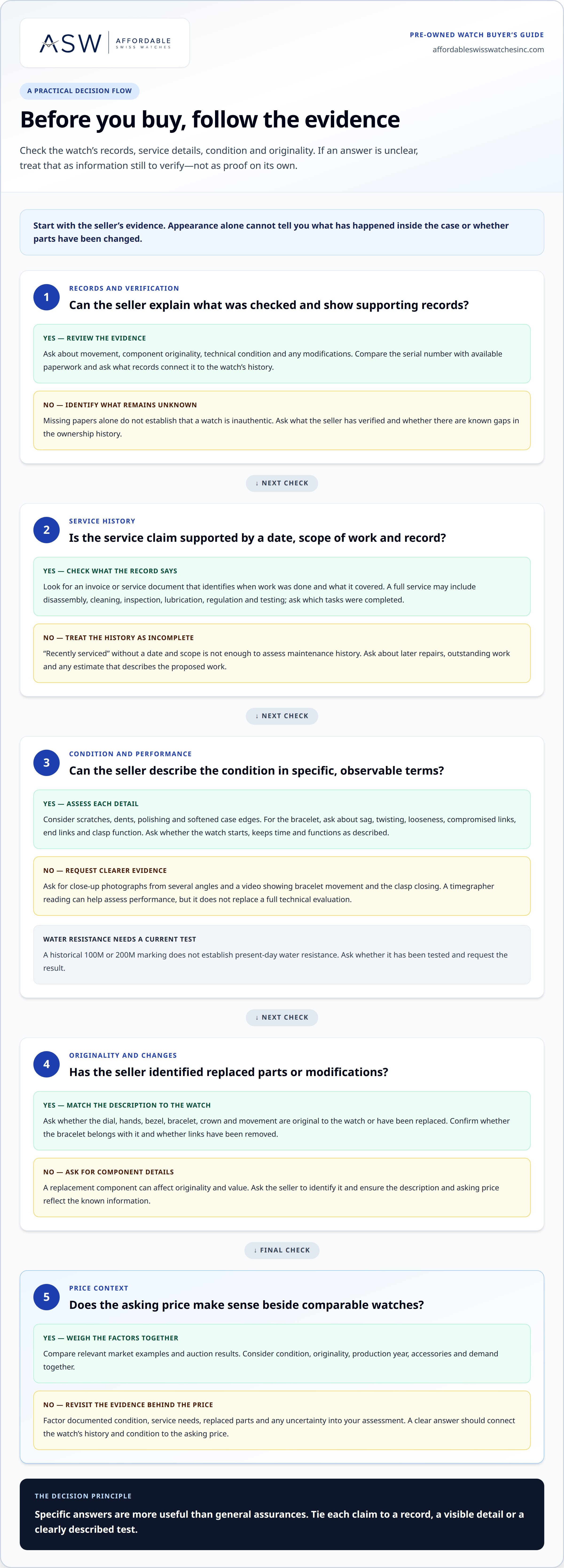
A polished exterior can’t answer the most important questions about a pre-owned watch. The right questions to ask a pre-owned watch seller cover authenticity, condition, previous work, service history, and the evidence behind the asking price.
It’s reasonable to want clear answers before a significant purchase, especially when a watch’s appearance doesn’t reveal what has happened inside the case. Ask whether the movement and components have been examined, whether parts have been replaced or the watch modified, and what documentation supports its history. Missing papers alone don’t establish that a watch is inauthentic, but the seller should explain what has been verified.
Ask about servicing: When was the watch last serviced, what work was done, and is there a record? A recent-service claim is more useful when the seller can describe its date and scope. This guide explains how to assess an authentication report, inspect condition and originality, interpret service details, and compare prices with relevant market examples. The goal is a clearer basis for deciding whether the watch is right for you.
Key Takeaways
- Assess bracelet play and compromised links as structural concerns, not merely cosmetic wear.
- Look for signs that polishing or replacement parts may have changed a watch’s original lines and character.
- Judge an asking price against comparable watches, weighing condition, originality, production year, accessories, and demand together.
- A useful authentication report should explain how the watch’s movement, engravings, finishing, and components were evaluated.
- Use the seller’s specific answers to decide whether the watch’s history and condition justify its price.
1. How can I tell if a pre owned Rolex is authentic?
Start with a professional evaluation, not appearance alone. A Rolex assessment should examine movement authenticity, component originality, technical condition, and signs of modification. Ask whether the seller has opened, repaired, or modified the watch. Request details about replaced parts, since non-original components can affect value and should be reflected in the description and price.
How do I check a watch’s serial number and ownership history? Ask the seller to show the serial number and explain what records connect it to the watch’s history. Compare it with any accompanying paperwork, then ask who owned the watch and whether there are known gaps in its ownership history. A single previous owner may offer a clearer account of alterations, but missing documents alone do not establish that a Rolex is inauthentic.
Ask for the last service date, a description of the work, and supporting evidence. A useful record identifies the date and work performed, such as an invoice or service document. “Recently serviced” isn’t enough to assess the watch’s maintenance history without those details. Ask whether the work involved a full service. This may include disassembly, cleaning, inspection, lubrication, regulation, and testing. The record should clarify which tasks were completed, rather than leaving the service scope open to interpretation.
Use service history to assess future maintenance, not just past care. Ask whether the watch has been repaired since its last documented service, what prompted the work, and whether the seller has records for each visit. If you intend to wear a vintage Rolex regularly, factor possible servicing into your decision. If the record is incomplete, treat uncertainty about past maintenance as part of your assessment, not as proof of a problem.
Budget for the work the watch may need, rather than relying on a seller’s general assurance. Ask what signs of wear or performance issues were observed, whether any repair remains outstanding, and what evidence supports the watch’s current condition. A service estimate should identify the proposed work and its scope. For example, documented cleaning and regulation differ from a watch with no service record or explanation. These questions help you weigh maintenance needs alongside authenticity and price.
Keep the records with the watch’s purchase details. A clear service timeline can help explain its care, while gaps call for specific questions about prior work. Useful questions to ask a pre-owned watch seller connect each claim to evidence: a date, a description of work, or an ownership record.
2. Question 2: What Is the Watch's True Condition?
Ask for a condition description that separates cosmetic wear from mechanical concerns. Request details about scratches, polishing, bracelet stretch, water resistance, and timekeeping. Ask when the watch was last serviced, what work was performed, and what records support that account.
For an online purchase, ask which payment methods provide transaction records and what protections apply. Before paying, get the shipping method, tracking details, insurance arrangements, delivery confirmation, and return terms in writing.
Inspect the case and crystal in clear light, or request close-up photographs. Look for scratches, dents, uneven surfaces, and marks around the lugs. Ask whether polishing changed the case’s original edges. A polished case may look cleaner, but repeated work can soften its lines. Compare photographs from several angles, including the sides and clasp, rather than relying on one frontal image.
Check the bracelet’s structure as carefully as its finish. On a worn vintage bracelet, pins can wear down and enlarge the holes in links, creating excess play. Ask whether the bracelet sags, twists, or feels loose when held horizontally. Hollow links can become compromised with extended wear. Inspect end links for bends or damage, since compromised end links can increase the risk of the watch coming loose. A bracelet that twists deserves particular attention and may need replacement.
Ask for a clear video of the bracelet moving and the clasp closing. A photograph can hide looseness between links or a clasp that doesn’t engage properly. Confirm whether the bracelet belongs with the watch and whether any links have been removed. Missing links can affect fit, while a replacement bracelet may change the watch’s originality and value.
For mechanical condition, ask whether the watch starts, keeps time, and functions as described. A timegrapher reading can help assess a mechanical watch’s performance, but it does not replace a full technical evaluation. Treat any reported timekeeping deviation as one part of a broader assessment, not a standalone verdict on the watch. Ask how and when any reported reading was taken.
Do not treat a water-resistance marking as proof of current performance. A historical 100M or 200M marking does not establish the watch’s present-day water resistance. Ask whether its water resistance has been tested and request the result. If the watch has not been tested, account for that uncertainty before relying on it.
Normal scratches don’t automatically mean a watch has lost value. Consider their depth alongside polishing, bracelet integrity, mechanical performance, and documented care. A clear condition assessment connects each visible flaw or performance issue to a specific question before you buy.
3. Checking whether the dial, hands, or case were reworked
Ask whether the dial, hands, bezel, bracelet, crown, and movement are original to the watch or have been replaced. A replacement component doesn’t tell the full story by itself. Its identity, fit, and effect on originality matter. Ask who performed the work, when it occurred, and whether a service record or parts description documents it.
Inspect the dial in clear, close-up photographs. Look for uneven lettering, inconsistent marker placement, or paint that appears newer than the surrounding surface. For a vintage watch, ask whether the dial or hands were repainted. Uniform color can reflect restoration rather than natural aging, so ask directly about any refinishing. Compare the dial, hands, and markers together; differences in their appearance can prompt useful follow-up questions.
Case shape offers another clue. Ask whether the case has been polished and request side views of its lugs and edges. Repeated polishing can soften crisp lines and angles, changing the case’s original profile. A polished surface alone doesn’t establish poor condition. The key is whether the remaining shape, finish, and disclosed work match the seller’s description and the watch’s expected originality.
Ask for photographs of the exact watch being offered, not stock images. Request clear views of the dial, case sides, case back, clasp, and any visible serial or reference markings. A dated image beside a written note can help establish that the photographs show the offered piece. For a vintage watch, request a short video showing it running, then ask how its timekeeping was assessed. A consistent account of timing results, service work, and visible condition is more useful than an unqualified claim that it works well.
What are the risks of buying a pre-owned watch from a private seller versus a dealer? A private seller may know the watch through direct ownership, but the buyer often has fewer business records and less structured recourse. A dealer’s value depends on the documented description, authentication process, and written terms, so assess those specifics rather than relying on seller type alone.
Ask how the seller handles questions about undisclosed repairs, inaccurate descriptions, or a watch that differs from its photographs. Request the return policy and any warranty in writing before payment. What warranty or return policy should a used watch seller provide? Look for clear terms that identify coverage, exclusions, duration, and the return process. A verbal assurance is harder to assess than written conditions.
Assess transparency through the details. Ask the seller to explain every known alteration, identify replaced components, and provide references when possible. If a response conflicts with the photographs or written records, pause and resolve the inconsistency before buying. These checks help distinguish disclosed restoration from an unclear account of the watch’s past.
4. Comparing prices with market data and auction results
Start with genuinely comparable watches, not just the same model name. Match the reference, production year, dial, material, and included accessories where possible. A Rolex Submariner with box and papers isn’t directly comparable to a watch-only example. Record each match and its asking price, then separate close comparisons from watches with different specifications or completeness.
Distinguish asking prices from completed sales. A listing shows what a seller hopes to receive; an auction result shows a completed transaction, but not necessarily a direct match. Check the sale date, watch condition, included items, and whether the result reflects the final amount paid. A result for a scarce dial or unusually complete set may not represent the market for a standard example.
Build a comparison around the details that affect value. Production year, demand, rarity, originality, and maintenance history all matter, as do condition and accessories. For example, a watch with documented service and its original bracelet may warrant a different comparison from one with an unexplained replacement part. A higher asking price alone doesn’t establish superior quality.
Account for cosmetic work. Ask whether the case has been polished, and assess whether polishing softened its original lines. Compare clear photographs of the case sides, lugs, clasp, and dial. If one listing shows sharp case edges and another has rounded contours, treat them as different condition examples. Weigh cosmetic appearance alongside originality and mechanical performance, not in isolation.
Keep a simple comparison record with the reference, year, condition, accessories, service documentation, and sale or listing date. Remove examples that differ on important points. Then compare the asking price with the closest remaining examples. If the watch lacks papers, has substantial wear, or needs attention, reflect those differences in your assessment rather than applying a fixed deduction.
Use auction results as context, not a price guarantee. A result can reflect the specific watch, buyer interest, timing, and sale conditions. Likewise, a pre-owned Rolex doesn’t automatically rise in value. Its price depends on condition, demand, originality, and maintenance. Ask the seller how the asking price accounts for those factors, including polishing, replaced components, and included accessories. A clear explanation should connect the price to the watch itself, not simply to its model name or brand.
5. Verifying authenticity and requesting an authentication report
How can I verify a pre-owned watch is authentic? Request a professional assessment that checks the watch’s engravings, movement details, finishing, and internal components against its specific model. No single photograph or document establishes authenticity on its own; findings should relate to the actual watch offered for purchase.
Ask what the examination included. A useful report should identify the watch examined, describe the checks performed, and state the findings clearly. Ask whether the examiner assessed the movement and internal components or relied only on visible details. If the report concerns a different watch, reference, or serial number, it can’t establish the offered watch’s authenticity.
Read the report for scope, not just its conclusion. Look for a date, the watch’s identifying details, the examination method, and any stated limitations. Ask whether the case was opened and which components were inspected. A report that discusses engravings and exterior finishing but not the movement describes a narrower review than one that examines internal parts.
How can I have a pre-owned watch independently inspected before purchase? Arrange for an independent watch professional to examine the specific piece before payment, with the seller’s agreement and access to the watch. Ask the examiner to assess model consistency, movement, components, finishing, and signs of modification, then request written findings tied to the watch’s identifiers.
Check that the report and watch correspond. Compare the report’s serial or reference details with the watch and its accompanying records. If the seller provides photographs, make sure they depict the same piece described in the report. Ask for clarification when an identifier is obscured, omitted, or inconsistent; a report for another example of the same model isn’t proof.
Separate authenticity findings from condition findings. A watch may be authentic while containing replacement components or showing signs of previous work. Ask the examiner to identify replaced parts and explain whether the assessment covers originality, technical condition, or both. This distinction matters because authenticity alone doesn’t establish that every component is original or that the watch needs no maintenance.
Before deciding, ask who prepared the report and what expertise supports the evaluation. Request clear answers about any inconclusive finding, excluded component, or inspection limit. A seller’s description can help explain the watch, but a written assessment offers a more precise record of what was examined and found. Keep the report with the purchase documents, especially if it records component details or limitations relevant to future service.
Affordable Swiss Watches Inc.
Affordable Swiss Watches Inc. can help buyers apply these checks to a specific pre-owned timepiece. Its pre-owned inventory is verified through in-house, multi-step authentication and includes a 2-year limited warranty. A full money-back guarantee applies if a watch is found not genuine. These details give buyers a clear basis for considering authenticity and coverage alongside condition, service records, and price. The selection includes watches from brands such as Rolex, Omega, Breitling, and Audemars Piguet, with offerings that include the Rolex Submariner and Rolex Datejust. If you are weighing a purchase and want to discuss the details, contact Affordable Swiss Watches Inc.
Make the Decision on Evidence
A pre-owned watch purchase is easier to assess when each claim has supporting evidence. Use your questions to ask a pre-owned watch seller to clarify what matters for the specific piece, then decide whether its documented history, condition, and price fit your priorities. If the answers remain unclear or conflict with the watch’s records, take time to resolve the discrepancy before committing.
If you’re comparing Rolex Submariner, Rolex Datejust, and Rolex Land-Dweller watches, assess each example on its own details rather than the model name alone. Production year, condition, originality, and included documentation can shape how one example compares with another.
A careful decision does not require certainty about every detail. It does require a clear understanding of what has been checked and what the seller’s terms cover. For questions about a specific watch or its documentation, contact Affordable Swiss Watches Inc. A measured review can help you choose with greater confidence.
Frequently Asked Questions
Question 2: What Is the Watch's True Condition?
Ask for a description that distinguishes visible wear from limitations affecting use. A condition label such as "excellent" is subjective unless the seller explains what it means for that watch. Clarify whether the listing describes the exact piece and whether any feature or function is excluded from the description. This gives you a more useful basis for deciding whether its condition suits your intended use.
Are All Of The Parts Original?
No. A pre-owned watch may include replacement parts, so ask the seller to identify any known changes. Clarify whether a replacement is an original manufacturer component and whether the watch’s description identifies it as original. This distinction matters when assessing the piece as a complete example. If the seller can’t identify a component, ask that uncertainty be reflected clearly in the written description.
Are original Rolex papers important?
Original Rolex papers can add useful context to a watch’s documented history. Their value to you depends on whether you prioritize accompanying documentation and a more complete purchase record. Ask what papers are included and whether they relate to the specific watch. Keep any paperwork you receive with the purchase records, so the documents remain associated with that piece.
Can You Trust The Seller?
Assess trust through the seller’s conduct throughout the transaction. Do the written terms, payment instructions, and product description stay consistent? Does the seller answer specific questions without pressuring you to decide? A clear record of agreed details helps prevent later misunderstandings. Treat evasive answers or unexplained changes as reasons to pause, rather than relying on a polished listing or reassuring language.
Has The Case Been Polished?
Ask whether polishing occurred and whether the seller knows its extent. Your decision may depend on whether preserving the case’s original finish matters more than a refreshed appearance. Consider the watch’s intended role: a collector focused on originality may weigh past refinishing differently from a buyer prioritizing daily wear. The seller’s disclosure should let you make that trade-off deliberately.
How can I tell if a pre owned Rolex is authentic?
Affordable Swiss Watches Inc. states that it authenticates its watches through a multi-step in-house process and that every watch is 100% genuine. WatchCSA certification applies only to select pieces. For any purchase, ensure the authenticity statement and any certificate refer to the particular watch offered, rather than only to its model.
Is The Bracelet Stretchy?
Check whether the bracelet feels secure and sits comfortably on your wrist. Ask how it fits and which links are included. A bracelet that feels loose may affect wearability even if its appearance suits you. Decide whether the existing fit works for you before purchase, and make sure the listing describes the bracelet supplied with the watch.
Is The Watch Keeping Good Time?
A deviation of plus or minus 6 seconds per day should not be treated as a universal benchmark for Rolex watches. Timekeeping expectations vary by model and movement, so ask for the applicable specification and how the seller obtained the reading. Also ask whether the watch was fully wound for the test. A result without that context is harder to interpret when comparing two watches.