

The Daytona’s reputation has a practical origin: Rolex introduced the Cosmograph Daytona in 1963 as a driver’s chronograph. A Rolex Daytona buying guide should start with that history, then consider the watch’s generation, material, condition, and provenance, which all shape its appeal and market value.
The Daytona’s prestige is part of its appeal, but buying one also means deciding where and how to shop. New, pre-owned, and vintage examples can differ significantly in price, originality, and the records documenting their history.
This Rolex Daytona buying guide explains what makes the model distinctive, how steel compares with precious-metal versions, and what to inspect before you buy. It covers the trade-offs between pursuing a new watch through Rolex’s retail channel and choosing a pre-owned example, with practical checks for condition, authenticity, and provenance across modern and vintage references.
Key Takeaways
- Identify a Daytona’s generation by its reference and movement history before comparing examples.
- Compare steel and non-steel models by material, condition, rarity, and current market demand, not material alone.
- For a vintage Daytona, assess originality, condition, and service history together; changes to key components can affect its appeal.
- Weigh the authorized-dealer route against the secondary market, including access, price differences, and the value of documented provenance.
- Use a consistent authenticity and condition review when considering a new, pre-owned, or vintage watch.
Wait, Why Is the Rolex Daytona Such a Big Deal?
Rolex introduced the Cosmograph Daytona in 1963 as a driver’s chronograph. Its racing identity, changing movements, and collectible references make generation and condition central to understanding its value.
Daytona Generations and Key References
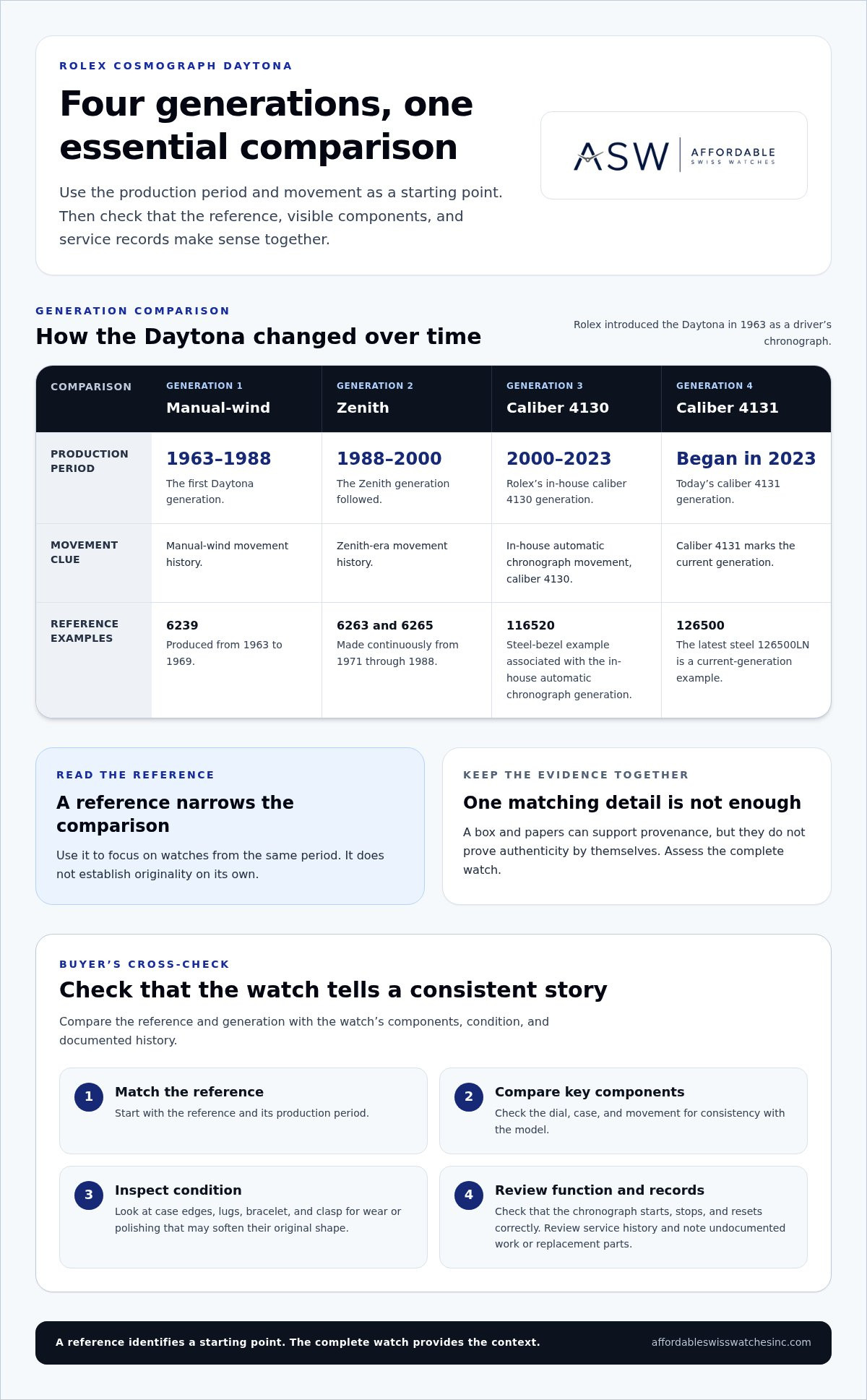
The Daytona’s history can be understood through changes in its production periods and movements. That history helps buyers assess whether a watch’s components and documents fit its model. The manual-wind generation ran from 1963 to 1988; the Zenith generation followed from 1988 to 2000. The in-house caliber 4130 generation ran from 2000 to 2023, followed by today’s caliber 4131 generation, which began in 2023.
Reference 6239 was produced from 1963 to 1969. References 6263 and 6265 were made continuously from 1971 through 1988. These identifiers narrow the comparison to watches from the same period, but they don’t establish originality by themselves. Match the reference to the dial, case, movement, and documented service history.
Prices, Comparisons, and Authentication
Comparing specific references helps show how generation and condition shape market prices.
Vintage Daytona prices vary widely. These figures are time-sensitive market snapshots, not guaranteed sale prices.
Compared with the Omega Speedmaster and other chronographs, the Daytona stands out for its racing heritage and tachymetric scale. Compare the specific reference, movement, condition, and intended use rather than assuming chronographs share the same features or value.
To assess a Daytona’s authenticity, match its reference and movement to the model’s generation, then check the dial, case, and paperwork for consistency. A box and papers can support provenance, but they do not prove authenticity on their own. Evaluate the watch as a complete timepiece, not by relying on one matching detail.
Condition affects both wearability and collectability. Inspect the case edges, lugs, bracelet, and clasp for wear or polishing that may have softened their original shape. Check that the chronograph starts, stops, and resets correctly. Service records help document the watch’s history. An undocumented service or replacement part may affect originality and value.
Box and papers can strengthen a watch’s provenance when their details correspond with its reference and period. Treat them as supporting evidence, not a substitute for examining the watch. For a vintage 6263 or 6265, prioritize consistency among reference, movement, dial, and condition before paying a premium for accessories.
2026 Market prices and steel-versus-non-steel value
In 2026, Daytona value depends on reference, material, condition, and whether the price is retail or secondary-market. Comparing those factors gives a clearer picture than treating every Cosmograph as equivalent.
Market Prices and Relative Value
Recent market figures illustrate price differences among Daytona models.
The gap reflects more than the material: reference, condition, demand, and configuration all influence value. These figures are market snapshots, not fixed valuations for every example.
The steel 126500LN remains a useful benchmark, but its retail and secondary-market prices are not interchangeable. A multi-year waitlist may face buyers seeking a new Daytona from an authorized dealer. As a result, a secondary-market asking price can reflect immediate availability as well as demand. Compare the exact reference and condition before drawing conclusions about a premium.
Steel Availability and Metal Variations
Steel, yellow gold, two-tone Rolesor, and platinum offer distinct wear and ownership considerations. The iconic steel 126500LN is the latest generation, while the 126503 pairs Oystersteel with yellow gold. The platinum 126506 occupies a substantially higher market tier in the August 2026 pre-owned figures.
The steel-bezel 116520 belongs to the generation associated with Rolex’s in-house automatic chronograph movement. The third-generation Daytona used caliber 4130 from 2000 to 2023. Buyers comparing a 116520 with a current 126500 should assess reference-specific condition and movement, not assume generation alone determines value.
The difference illustrates why retail access matters. Compare that spread with the two-tone 126503 and platinum 126506, then decide whether material, availability, or wearing preference carries the most weight for you.
Vintage originality, condition, and service history
The Cosmograph Daytona connects luxury watchmaking with motorsport history. Rolex introduced it in 1963 as a driver’s chronograph, and the model took its name from the 24 Hours of Daytona race, which Rolex sponsored. Rolex became official timekeeper of the Daytona 500 in 1962. That background gives vintage references cultural weight, but a racing association cannot establish a specific watch’s originality or condition.
For collectors, originality means assessing whether the dial, hands, bezel, case, and movement suit the reference and production period. Start with the reference engraved on the case, then compare the watch’s visible details with that reference. On a 6263, inspect the dial and bezel closely, and note any replacement or refinished parts. A part can be genuine yet still affect a vintage watch’s originality when it does not match its period.
Assess condition separately. Look for softened case edges, uneven wear, deep marks, corrosion, and damage around the lugs. Inspect the bracelet and clasp for wear, too. Compare photographs from multiple angles, as a polished surface can make the case look more even than it is. A box and papers may support provenance, but they do not prove that the components are original or that the service history is complete.
Service records help show what work the watch has received. Review the dates, work described, and any parts identified as replacements. For a vintage Daytona, distinguish routine maintenance from changes that may affect originality, such as a replacement dial or hands.
The Daytona’s auction history adds context, not a price target. That exceptional result reflects a particular watch and provenance, not the value of every 6263. A separate question is warranty and upkeep: new Daytonas purchased from authorized dealers carry a 5-year Rolex warranty. Service and maintenance costs depend on the work required and any parts replaced, so review the service scope alongside the watch’s records.
Daytona values overall can range from several thousand to several million, depending on material, rarity, condition, and historical significance. For comparison, original retail prices for the Rolex Daytona Ref. 6239 in the 1960s were around two hundred dollars, while modern stainless steel references retail for significantly more through authorized channels like Affordable Swiss Watches Inc. The original Rolex Daytona had a 37mm case and hand-wound Valjoux caliber 722 or 727 movements, useful reference points when comparing period specifications as part of any comprehensive rolex daytona buying guide.
Authorized dealers and secondary-market buying
The main decision is whether to pursue a new Daytona through Rolex’s retail channel or buy an existing example on the secondary market. Availability, reference, condition, and any premium over retail all matter.
To pursue a new Daytona in the United States, contact a Rolex authorized dealer and specify the reference and configuration you want. Steel Daytona availability is limited, and buyers seeking a new watch may face a multi-year waitlist. Retail access is possible, but the purchase timeline is uncertain.
The secondary market provides access to current and discontinued references without waiting for retail availability. The trade-off is price: when demand is high and supply is limited, secondary-market prices can exceed retail. Before judging an asking price, compare the exact reference and dial, the watch’s condition, and its documentation.
Price ranges show how configuration changes the comparison. These ranges provide market context, not one fixed value for every watch.
Production history also matters. The 126500LN’s pre-owned prices rose roughly 10 to 12 percent over the 12 months before August 2026. That movement reflects a particular period, not a reliable forecast of future returns.
Collectors may see a Daytona as a long-term luxury purchase, but its investment appeal depends on the individual watch and the price paid. A rare dial, strong condition, and consistent provenance can influence demand, but they do not guarantee resale performance. Paul Newman associations and auction history may attract attention, yet exceptional auction results are not typical market benchmarks.
Before choosing a route, compare the full offer rather than focusing on one headline figure. Distinguish retail prices from secondary-market asking prices, then assess the reference, condition, and papers. For a pre-owned watch, check whether its components and records align with its production period. For a new watch, weigh uncertain retail availability against the secondary market’s immediate access and potentially higher cost.
A careful comparison can help you decide whether a steel Daytona or a precious-metal reference better fits your priorities. Treat current prices as time-sensitive: demand and availability can shift, while originality and condition are specific to each watch.
Authorized dealer versus pre-owned buying
The right route depends on whether you prioritize buying new through Rolex’s retail channel or finding a specific existing watch. Compare what each transaction includes, how clearly the watch’s identity is documented, and whether its condition meets your expectations. This Rolex Daytona buying guide focuses on evaluating the individual offer rather than making assumptions about either route.
For an authorized-dealer purchase, identify your preferred reference and configuration before discussing the transaction. Keep the agreed configuration and purchase documents together so you can compare the delivered watch with the model discussed. This route may suit buyers who prioritize a new watch and can be flexible about timing and availability.
A pre-owned purchase puts the focus on the particular watch and its history. Read the seller’s description carefully and compare it with the reference, dial, case, and accessories shown. Request clear photographs of details that matter to your decision. If the description and watch do not match, pause and resolve the discrepancy before buying.
Read the written terms before paying. Check what the warranty covers, how returns work, and whether the listed accessories come with the watch. Keep these terms, the receipt, and any service records together. They document what was represented at purchase and provide a useful reference if questions arise later.
Compare prices against the exact configuration and what is included. Two watches with the same reference may differ in condition, service history, and completeness. A higher asking price should be supported by details about the watch. A lower price also warrants careful review of the included items and description.
Consider the authorized route if buying new matters most and you can accept uncertainty about access. Consider pre-owned if you have a particular reference in mind and are ready to assess its condition and documentation carefully. Neither route makes every offer a sound purchase. A focused comparison of the watch and written terms is more useful than a blanket preference for one channel.
If you want to compare the Daytona’s design with other luxury-watch styles, browse additional watch styles as a separate point of reference.
Affordable Swiss Watches Inc.: Rolex Submariner
After researching the Daytona, buyers comparing Rolex models may also consider the Rolex Submariner. Affordable Swiss Watches Inc. also offers the Rolex Datejust, Rolex Land-Dweller, and Rolex Oyster Perpetual.
Compare each model by design and intended wear, then assess the individual watch’s condition, reference, and documentation. Every watch is covered by a 100% authenticity guarantee, with a full money-back guarantee if it is ever found not genuine. Pre-owned watches include a 2-year limited warranty.
To explore the Rolex Submariner or discuss your options, contact Affordable Swiss Watches Inc.
Choose Your Next Watch with Confidence
Let your priorities guide the next comparison. Decide which design you would wear regularly and what documentation you expect with your purchase. A clear preference makes it easier to assess suitable options without letting market attention make the decision for you.
If you want to compare designs before deciding, explore the selection of luxury watches from Affordable Swiss Watches Inc.
Browse additional watch styles at your own pace, and continue your search with a clearer sense of what matters to you.
Frequently Asked Questions
What is the current retail price of a Rolex Daytona in the United States?
The 2026 U.S. These figures apply to specific configurations, not every Daytona. For a useful comparison, match the exact reference and material, then separate the retail figure from a pre-owned asking price. Market prices can differ from retail pricing.
What are the differences between Rolex Daytona models, materials, and dial options?
Daytona models differ by reference, generation, movement, case material, and dial. The current steel 126500LN uses caliber 4131; its prior-generation counterpart, the 116500LN, uses caliber 4130. Material choices include Oystersteel, yellow gold, two-tone Rolesor, and platinum. The 126500LN is offered with black or white dials in market comparisons. Match the reference first, then compare the dial and material.
What is the Rolex Daytona waitlist process, and how long does it usually take?
There is no single wait time that applies to every U.S. authorized dealer or Daytona configuration. Buyers seeking a new Daytona may face a multi-year waitlist. Identify the reference and configuration you want, then discuss the purchase process with an authorized dealer. Naming a specific model, such as the steel 126500LN, makes your preference clear, but it does not establish a delivery date.
What is the current pre-owned and gray-market price range for Rolex Daytona models?
These ranges reflect market activity, not a guaranteed transaction price. Compare the same reference and dial, then account for the individual watch’s condition and documentation.
What should you check when buying a used Rolex Daytona?
A Rolex Daytona buying guide should start by matching the reference to the movement, dial, case, and production period. In good lighting, inspect the case edges, lugs, bracelet, clasp, and crystal. Operate the chronograph and check that its hands reset to zero. Review service records for replaced components, and compare the watch’s identifying details with its papers. Accessories can support provenance but do not prove originality.
What are the risks and costs of buying a Daytona from a gray-market dealer or private seller?
A Rolex Daytona buying guide should consider more than the asking price. A premium over retail may not be justified by the watch’s condition, provenance, or warranty coverage. Private-sale terms may also offer less recourse if the watch differs from its description. Request written details about accessories, warranty coverage, return terms, and service history. Future service costs depend on the work needed and any replacement parts, so assess the watch’s condition before agreeing on a price.
What are Rolex Daytona warranty, servicing, and maintenance costs in the United States?
New Daytonas purchased from authorized dealers carry a 5-year Rolex warranty.