

Most luxury watches are designed for the boardroom, but the rolex deepsea is built to survive a depth that would crush a nuclear submarine. You likely recognize that while the Submariner is the icon, the Deepsea represents the true engineering peak of the Oyster case. However, its 44mm diameter and significant thickness often lead to questions about whether it can actually function as a daily wearer or if it's better suited for a professional dive locker.
This guide provides a comprehensive technical analysis of this series, moving beyond the marketing to examine the patented Ringlock System and the mechanical evolution of its three major reference numbers. We will clarify the structural differences between the 116660, 126660, and 136660 models while providing the specific details needed to verify authenticity in a market where sophisticated replicas are increasingly common. By the end, you will understand how this timepiece balances extreme utility with the technical refinements expected of a modern Rolex.
Key Takeaways
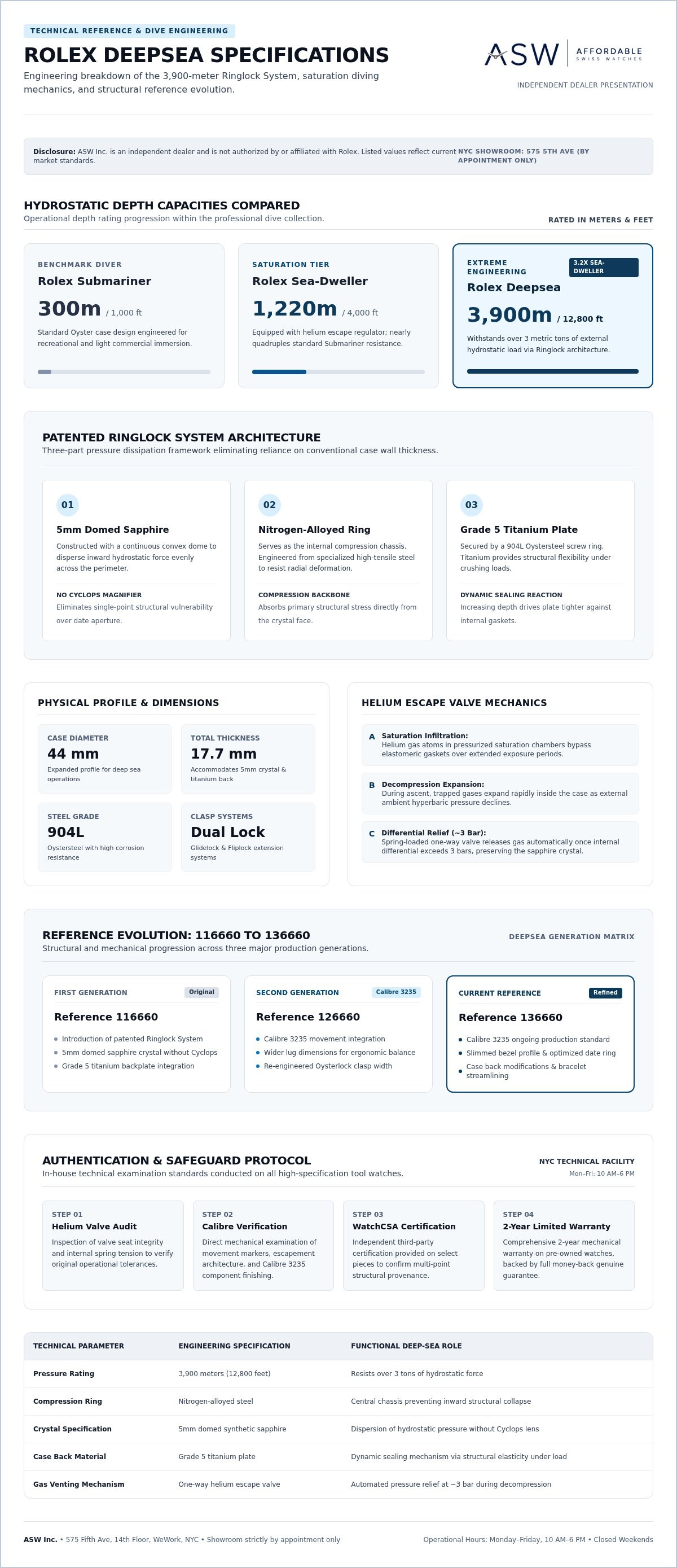
- Understand the engineering behind the Ringlock System, which allows the rolex deepsea to withstand over three tons of pressure at depths of 3,900 meters.
- Identify the specific technical differences between the 116660, 126660, and 136660 references, including movement upgrades and case refinements.
- Evaluate how the 44mm case and 17.7mm thickness translate to real-world wearability through the use of the Glidelock and Fliplock extension systems.
- Discover the critical visual and internal markers used during a professional authentication process to verify the integrity of the Calibre 3235 movement.
- Recognize why a 2-year limited warranty and professional certification are essential safeguards when acquiring high-specification tool watches.
What is the Rolex Deepsea?
The rolex deepsea is a professional tool designed for saturation diving. It exists within the broader Sea-Dweller family but offers capabilities that far exceed standard requirements. While a typical Submariner reaches 300 meters, this watch is engineered for depths of 3,900 meters, which is approximately 12,800 feet. The Deepsea is the intersection of experimental diving technology and wearable luxury. Its 44mm case and specialized Ringlock architecture allow it to survive pressures that would destroy most other mechanical timepieces. This watch is a dedicated piece of equipment for the world's most demanding environments, far exceeding the dimensions and capabilities of its siblings.
Deepsea vs Sea-Dweller: Key Differences
The primary distinction between these models lies in their structural engineering. While the Sea-Dweller is rated for 1,220 meters, the Deepsea nearly triples that capacity. This jump in performance requires a significantly thicker case and the inclusion of the Ringlock System. You can see the Rolex Sea-Dweller and Deepsea technical specifications to understand how the 5mm thick domed sapphire crystal provides the necessary rigidity. This crystal lacks a Cyclops lens over the date window to ensure there is no weak point in the glass. The Deepsea also features a wider lug width to balance the weight of its larger case, whereas the standard Sea-Dweller maintains more traditional proportions.
The Role of the Helium Escape Valve
Saturation divers live in pressurized environments where they breathe gas mixtures containing helium. Because helium molecules are exceptionally small, they can bypass seals and enter the watch case over time. This is a reality of physics. During decompression, these trapped gases expand rapidly as the external pressure drops. If the gas can't escape, the internal pressure will force the crystal out of the watch. The helium escape valve is a one-way regulator that allows these molecules to vent safely once internal pressure exceeds external pressure by about three bars. At ASW Inc., our authentication process includes a thorough verification of valve functionality. We examine the valve seat and the spring mechanism to ensure the watch retains its original professional specifications. This level of detail is critical for collectors who value the mechanical integrity of their investment.
Engineering the Ringlock System Architecture
The rolex deepsea utilizes a patented case architecture known as the Ringlock System. This design allows the watch to resist approximately three tons of pressure without requiring an excessively bulky case. While the exterior is crafted from 904L Oystersteel for its superior corrosion resistance, the internal structural integrity relies on three distinct layers. This specialized arrangement ensures the movement remains protected even at the crushing depth of 3,900 meters. Every component works in unison to manage the physics of extreme underwater environments.
The Central Ring and Sapphire Crystal
The heart of the Ringlock System is a high-performance nitrogen-alloyed steel ring. This component acts as the internal compression ring and serves as the structural backbone for the entire watch. Rolex selected this specific alloy for its extreme tensile strength and resistance to deformation. Resting against this ring is a 5mm thick domed sapphire crystal. Unlike the flat crystals found on standard divers, this dome shape is essential for distributing hydrostatic pressure evenly across the surface. This engineering was refined through data gathered during the DEEPSEA CHALLENGE Mariana Trench expedition; where experimental prototypes faced even greater extremes. The technical tolerances required for a waterproof seal at these depths are microscopic. Every micron of alignment matters to maintain the air-tight environment needed for the movement to function properly.
Titanium Case Back Integration
The third element of the system is the Grade 5 titanium case back. Titanium is favored for its unique physical properties; it's remarkably strong yet possesses a degree of elasticity that stainless steel lacks. This flexibility is vital for deep-sea survival. As the watch descends and external pressure increases, the titanium plate is pressed more firmly against the nitrogen-alloyed steel ring and its gaskets. A high-strength screw-down ring made of Oystersteel secures the titanium plate in place. This setup creates a dynamic seal. The deeper the watch goes, the tighter the assembly becomes. This mechanical reaction provides a layer of security that static case designs cannot match. If you are looking for a tool watch that prioritizes this level of over-engineered safety, you can browse our current rolex deepsea inventory to find a reference that meets your requirements. Each piece we handle undergoes a multi-step inspection to ensure these complex structural components are fully intact and functional.
Evolution of the Deepsea: Reference 116660 to 136660
The rolex deepsea has undergone three major iterations since its 2008 launch. Each update refined the balance between extreme technical specifications and daily wearability. The debut reference 116660 established the series as a professional powerhouse, utilizing the reliable Calibre 3135 movement. While technically impressive, its 20mm bracelet was often criticized for being too narrow for the 44mm case. This created a top-heavy feel that some collectors found difficult to manage during daily use.
In 2018, the 126660 addressed these concerns by widening the lugs and increasing the bracelet width to 22mm. This adjustment significantly improved the bracelet-to-case ratio; it provided better weight distribution and a more balanced aesthetic. The current 136660, which remains the technical standard for 2026, introduced further refinements. These include a slightly larger date window and a slimmed-down ceramic bezel. Rolex also removed the Fliplock extension link on this version to simplify the clasp mechanism while retaining the essential Glidelock system.
Movement Upgrades: Calibre 3135 vs 3235
The transition from the Calibre 3135 to the 3235 represents a significant technological leap. The older 3135 provided a 48-hour power reserve, whereas the 3235 offers 70 hours. This improvement is largely due to the Chronergy escapement. This component is made of nickel-phosphorus, which makes the movement insensitive to magnetic interference. At ASW Inc., an independent dealer, we verify these movements through a meticulous internal inspection. We check for the specific architecture of the balance bridge and the presence of the Paraflex shock absorbers. Because these movements are complex, our pre-owned pieces include a 2-year limited warranty to protect your investment.
The James Cameron D-Blue Dial Evolution
The D-Blue dial was introduced in 2014 to honor the 2012 Deepsea Challenge expedition. It features a unique gradient that fades from twilight blue to bottomless black, symbolizing the descent into the Mariana Trench. While the dial colors have remained consistent across the 116660, 126660, and 136660 references, the rolex deepsea "D-Blue" text placement has seen minor adjustments. Market value trends consistently show that 'James Cameron' dials command a higher price than standard black versions. Their commemorative nature and striking visual depth make them a priority for serious collectors. We track these market values closely to ensure our pricing reflects the current global demand for these specialized references.
Practical Wearability and Professional Features
The rolex deepsea is a substantial timepiece that commands attention through its sheer physical presence. With a 44mm diameter and a thickness of 17.7mm, it's significantly larger than a standard Submariner. This scale is necessary to house the Ringlock System and the 5mm sapphire crystal discussed in previous sections. On the wrist, the watch feels heavy and purposeful. While it may be too large for those with smaller wrists, the curved lugs and integrated bracelet help it sit as comfortably as possible. The Cerachrom bezel insert features graduations coated in a thin layer of platinum via physical vapor deposition. This ensures the markings remain legible and resistant to fading over decades of use. In low-light conditions, the Chromalight display provides a distinct blue glow that lasts up to eight hours, nearly double the duration of standard luminescent materials.
The Glidelock and Fliplock Systems
One of the most practical features for daily wear is the Oysterlock safety clasp. The Rolex Glidelock system allows for fine-tuning the bracelet length in 2mm increments without using any tools. This is particularly useful as your wrist expands and contracts throughout the day due to temperature changes. For professional divers, the Fliplock extension link found on the 116660 and 126660 references allows the watch to fit over a 7mm thick diving suit. This flexibility ensures the watch remains secure regardless of whether you are wearing it over bare skin or heavy equipment. Even though the current 136660 reference has removed the Fliplock link as part of its 2026 technical refinements, the Glidelock remains a standard feature for precise adjustment.
Oystersteel and Corrosion Resistance
Rolex utilizes 904L stainless steel, which they refer to as Oystersteel, for the case and bracelet. Most luxury watch brands use 316L steel. The primary difference is that 904L contains higher levels of chromium and molybdenum. This specific chemistry provides exceptional resistance to pitting and corrosion, which is a common issue for watches frequently exposed to saltwater. While the material is incredibly durable, it still requires basic maintenance. We recommend rinsing the watch with fresh water after every ocean swim to prevent salt crystals from accumulating in the bracelet links. If you are ready to experience the build quality of this professional diver in person, you can schedule an appointment to view our rolex deepsea collection at our New York City showroom. Each timepiece in our inventory is verified through our six-step authentication process to ensure it meets original factory standards.
Authenticating a Rolex Deepsea: The ASW Inc. Process
Our authentication protocol for the rolex deepsea is a rigorous multi-layered system designed to verify every technical detail. We start with a high-magnification visual inspection of the dial and case architecture. The laser-etched coronet at the 6 o'clock position on the sapphire crystal is a vital checkpoint. It is designed to be nearly invisible to the naked eye and must be composed of distinct, perfectly spaced dots. We also examine the rehaut engraving; the serial number has to align perfectly with the minute markers. Any deviation in font weight or alignment is an immediate indicator of a problem.
Beyond the exterior, we perform an internal component verification. This involves opening the case to inspect the Calibre 3235 movement. We look for the specific finish on the baseplate and the presence of genuine Rolex-patented parts like the Chronergy escapement. Provenance is also assessed through original documentation and service records when available. Finally, every watch undergoes timekeeping testing to ensure it meets Rolex Superlative Chronometer standards of -2/+2 seconds per day. This ensures the watch is genuine and performing to its original technical specifications.
Spotting Sophisticated Replicas
Non-genuine manufacturers are becoming more sophisticated, but they often fail in the technical details of the Ringlock System. The "Original Gas Escape Valve" and "Ring Lock System" text on the internal ring must be engraved with absolute precision. These pieces often show slight font irregularities or shallow etching. The Grade 5 titanium case back is another critical area. Genuine titanium has a darker, matte finish and a specific thermal conductivity that feels different against the skin compared to stainless steel. Additionally, the helium escape valve on a non-genuine piece is frequently a non-functional aesthetic plug. We test the valve's seating to confirm it is a true pressure-relief mechanism rather than a cosmetic addition.
The ASW Inc. Security Framework
We understand that purchasing a rolex deepsea is a significant investment. ASW Inc. provides a 100% authenticity guarantee backed by a full money-back policy if a watch is ever found to be not genuine. Every pre-owned model includes a 2-year limited warranty, which is especially important for protecting the complex Calibre 3235 movement. For added peace of mind, we offer WatchCSA certification on select pieces as an independent third-party verification. Our showroom at 575 Fifth Ave, 14th Floor, WeWork, NYC, is open Monday to Friday from 10 AM to 6 PM. Since we are an independent dealer and not an authorized retailer, visits are strictly by appointment only. We are closed on weekends to focus on our meticulous inspection and sourcing processes.
Selecting a Professional Diving Instrument
The rolex deepsea is more than a luxury accessory; it's a specialized tool that represents the peak of modern horological engineering. From the high-performance nitrogen-alloyed steel ring to the Grade 5 titanium case back, every component exists to withstand the most extreme physical environments on earth. Choosing the right reference requires a clear understanding of these technical nuances and a commitment to verified authenticity.
As an independent dealer and Chrono24 Trusted Seller since 2020, ASW Inc. provides the security needed when acquiring such a complex timepiece. Every watch in our inventory undergoes a six-step authentication process and comes with a 100% authenticity guarantee. We also offer a 2-year limited warranty on pre-owned models to ensure your investment remains protected. If you're ready to add this engineering marvel to your collection, you can browse our curated collection of Rolex Deepsea timepieces or visit our NYC showroom by appointment only. We look forward to helping you find a piece that meets your exacting standards for performance and precision.
Frequently Asked Questions
Is the Rolex Deepsea too big for an average wrist?
Whether the rolex deepsea is too big depends on your wrist size and comfort preference. At 44mm wide and 17.7mm thick, it's significantly larger than most luxury sport watches. It's designed for presence and professional utility rather than sliding under a shirt cuff. The curved lugs help the case contour to the wrist, but those with a circumference under 6.5 inches may find the weight and height challenging for daily wear.
What is the difference between the Deepsea and the Deepsea Challenge?
The standard Deepsea is rated for 3,900 meters and features a 44mm Oystersteel case. In contrast, the Deepsea Challenge is a massive 50mm watch made of RLX titanium with a depth rating of 11,000 meters. While the Deepsea is a wearable professional tool, the Challenge model is an extreme engineering piece inspired by James Cameron's Mariana Trench descent. The Challenge is significantly thicker and larger, making it less practical for most collectors.
Does the Rolex Deepsea hold its value well?
This model typically maintains its market value well due to its specialized technical status and lower production volume compared to the Submariner. Professional Rolex tool watches are historically stable assets in the secondary market. At ASW Inc., an independent dealer, we list our timepieces at current market value to reflect global demand. Collectors often view the D-Blue dial as a particularly strong choice for long-term value retention within the series.
How often does a Rolex Deepsea need to be serviced?
Rolex generally recommends a service interval of approximately 10 years for modern movements like the Calibre 3235. However, if you use the watch for actual diving, you should have the waterproof seals and the helium escape valve tested every year. Regular maintenance ensures the Ringlock System remains airtight. Our pre-owned models include a 2-year limited warranty, providing peace of mind regarding the movement's performance and mechanical integrity after purchase.
Can I wear my Rolex Deepsea for swimming and showering?
You can certainly wear this watch for swimming and most water activities given its 3,900-meter depth rating. It's engineered for much harsher environments than a standard pool. We recommend rinsing the watch with fresh water after exposure to salt or chlorine to protect the Oystersteel finish. While it's waterproof, avoid exposing any mechanical watch to high-pressure steam or extreme heat in showers, as this can eventually affect the rubber gaskets.
What is the 'Original Gas Escape Valve' text on the dial?
The Original Gas Escape Valve text is located on the internal nitrogen-alloyed steel compression ring. This ring is a visible part of the Ringlock System architecture that allows the watch to withstand immense pressure. It highlights the presence of the helium escape valve, which is a critical feature for saturation divers. This engraving is a hallmark of the model's professional identity and serves as a key point of reference during our authentication process.
Why does the Deepsea have a titanium case back?
The rolex deepsea features a Grade 5 titanium case back because titanium offers a unique combination of strength and flexibility. Under extreme depth, the pressure forces the titanium plate against the internal steel ring and gaskets. Titanium's slight elasticity allows it to absorb this pressure without cracking or deforming permanently. This dynamic seal becomes more effective as the watch descends deeper. It also provides a more comfortable, hypoallergenic surface against the wearer's skin.
How can I tell if a Rolex Deepsea is authentic?
Authentic models feature precise engravings on the Ringlock ring and a centered laser-etched coronet on the crystal. Replicas often struggle with the weight and matte finish of the titanium case back. At ASW Inc., we use a six-step process including internal movement verification and provenance assessment. Every watch we sell comes with a 100% authenticity guarantee and a full money-back policy if the timepiece is found to be not genuine. Visits to our NYC showroom are by appointment only.