

The Sea-Dweller’s most impressive number isn’t necessarily its strongest investment argument. A rolex sea-dweller buying guide should start with the exact reference, condition, and provenance: the model’s 1,220-meter water-resistance rating and history, which began in 1967, help explain its identity but don’t determine its value on their own. The investment case depends on the individual watch.
That distinction matters because the Sea-Dweller has changed in size, movement, and materials over time. Buyers can appreciate its technical purpose and distinctive design while considering whether its proportions suit everyday wear.
This guide explains how the Sea-Dweller’s history and changing materials shape its appeal, which reference-specific details to consider, and how case size and movement affect daily wear. Use these points to compare models and decide which qualities matter most to you.
Key Takeaways
- Assess a Sea-Dweller’s investment appeal by reference, condition, and provenance rather than its depth rating alone.
- Compare case dimensions and movement details by reference; they can affect both daily comfort and the watch’s practical appeal.
- Trace the model’s development from its early professional-diving purpose to later changes in water resistance and design.
- Consider how materials and proportions shape the watch’s character as well as its suitability for everyday wear.
- Use the Sea-Dweller’s distinctive design as a starting point for comparing it with other Rolex models that suit your priorities.
Is the Rolex Sea-Dweller a Good Investment?
A Sea-Dweller can interest collectors, but its technical credentials alone don’t establish investment value. Rolex introduced the model in 1967 with a 610-meter water-resistance rating. A Rolex Sea-Dweller buying guide should start with the exact reference, condition, originality, and provenance. Those details distinguish an individual watch from broad claims about the model’s market appeal.
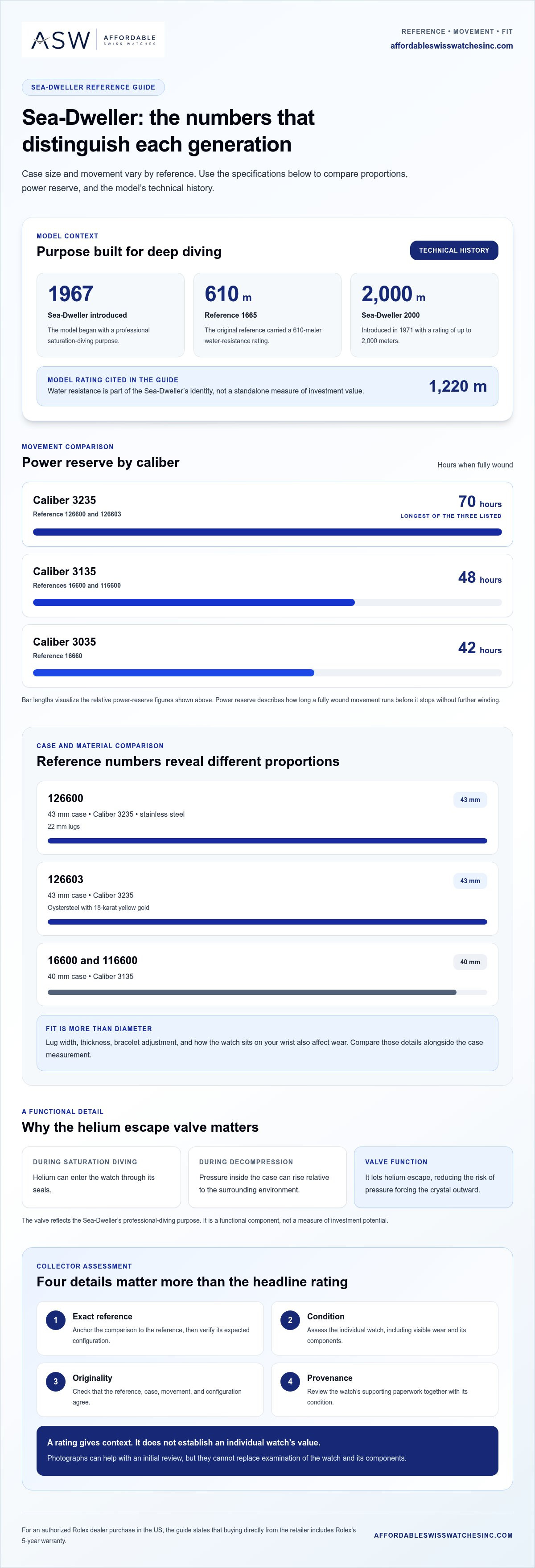
The helium escape valve reflects the Sea-Dweller’s professional-diving purpose. During saturation diving, helium can enter a watch through its seals. During decompression, pressure inside the case can rise relative to the surrounding environment. The valve lets helium escape, reducing the risk of pressure forcing the crystal outward. It is a functional component, not a decorative marker or a measure of investment potential.
This history connects directly to the model’s water-resistance ratings. The original Sea-Dweller reference 1665 was rated to 610 meters, while the Sea-Dweller 2000 introduced in 1971 was rated up to 2,000 meters. Reference 16660 reflects a later stage in the Sea-Dweller’s technical development. These specifications reflect engineering changes; they don’t make every example equally desirable. A rating offers useful context, but reference-specific details matter more when comparing watches.
Collectors may also encounter the “Double Red” name for reference 1665, tied to red dial text. That exceptional auction result doesn’t establish a standard value for another watch. Yellow gold belongs to later design discussions, not a shortcut for assessing the investment potential of a steel Sea-Dweller.
For warranty and maintenance, authorized Rolex dealer purchases come with a 5-year Rolex warranty.
In the US, buy through a Rolex-authorized dealer and complete the purchase directly with that retailer. The purchase includes Rolex’s 5-year warranty, distinguishing this route from a transaction with an independent seller.
Buying online or through the gray market can involve uncertainty about condition, provenance, documentation, and warranty coverage. Match the stated reference and configuration to the watch, then assess its condition and paperwork together. Photographs can help with an initial review, but they cannot replace an examination of the watch and its components.
For a sound decision, treat the helium valve and depth rating as evidence of the Sea-Dweller’s purpose, not as a forecast of resale value. A useful principle in a Rolex Sea-Dweller buying guide is to compare the individual watch’s reference, condition, and provenance with your collecting priorities. This keeps investment considerations grounded in the specific watch, not just the mythology of saturation diving.
Case sizes and movements
Reference numbers distinguish meaningful differences in Sea-Dweller dimensions and movement specifications. Compare those details together: the model name alone does not tell you how the watch will wear on your wrist.
The current Sea-Dweller references 126600 and 126603 have 43mm cases and use Caliber 3235. That shared size makes movement and materials useful distinctions between them. Reference 126600 is stainless steel, while 126603 combines Oystersteel with 18-karat yellow gold. Case diameter is only one part of the fit: lug width, thickness, bracelet adjustment, and how the watch sits on your wrist also matter. The 126600 has 22mm lugs, a detail that affects the bracelet’s width at the case.
Earlier references provide a different set of proportions and mechanics. The 16600 has a 40mm case and uses Caliber 3135. The 116600 also measures 40mm and uses Caliber 3135. By contrast, the current 126600’s 43mm case marks a larger format. Production dates help place each reference in context, but the reference number is the practical starting point for identifying its case and movement.
Movement Specifications
A movement specification identifies the caliber inside a watch and its stated mechanical characteristics. For example, the Sea-Dweller 126600 uses Caliber 3235, while references 16600 and 116600 use Caliber 3135. That distinction helps buyers compare generations accurately, rather than assuming every Sea-Dweller shares one movement. Match the reference to the caliber when reviewing a listing, service record, or watch documentation.
Power Reserves
Power reserve describes how long a fully wound movement runs before it stops without further winding. Caliber 3235 has a 70-hour power reserve, Caliber 3135 has 48 hours, and the Caliber 3035 in reference 16660 has 42 hours. Those differences affect how long a watch can sit unworn and continue running. They also help distinguish movements across references, rather than serving as a measure of overall condition.
Technical details should agree across the reference, movement, case, and accompanying documents. For example, a listing for a 126600 should identify its 43mm case and Caliber 3235. A mismatch deserves attention because the reference anchors the expected configuration. Check the bracelet and crystal as part of the same assessment; visible wear or replacement components can affect how the watch presents, even when its movement designation matches.
For a direct comparison, browse the Sea-Dweller watch selection and focus on each listing’s reference, case dimensions, and movement details.
Sea-Dweller history and development
The Sea-Dweller’s history reflects the needs of professional divers, followed by its appeal to collectors and everyday wearers. Successive references show how Rolex developed its saturation-diving concept into distinct generations, each with its own specifications and market appeal.
Rolex introduced the Sea-Dweller in 1967 for the demands of saturation diving. The early reference 1665 established the model’s identity as a purpose-built dive watch, with a helium escape valve and a depth rating beyond the Submariner’s. The reference later became known as the Double Red because of its red dial text. For collectors, that original name and dial configuration matter: small differences in text, condition, and documentation can distinguish examples that otherwise share a reference.
The reference 16660, produced from 1978 to 1989, marks an important step in the model’s development. It carried a 1,200-meter depth rating and introduced a sapphire crystal, setting it apart from earlier Sea-Dwellers. The 16600 followed from 1989 to 2009, maintaining the professional tool-watch character through a long production run. Its extended catalog presence makes it a useful point of comparison for buyers weighing older design against later updates.
After the 16600, the 116600 returned in 2014 and remained in production until 2017. Its comparatively short run gives it a clear place between the older 40mm generation and the later 43mm format. Rolex introduced reference 126600 in 2017, adding the larger case and a red Sea-Dweller name on the dial. The two references offer different proportions and visual cues, so reference accuracy matters when comparing listings.
The Deepsea is a related but distinct branch of Rolex dive watches. Introduced in 2008, it uses a larger case and a higher depth rating than the Sea-Dweller. Buyers comparing the two should treat them as separate choices, not as interchangeable versions of one model. The Sea-Dweller’s history centers on practical saturation-diving features; the Deepsea extends that technical focus into a different size and specification.
Historical and current prices depend on more than production dates. For a vintage reference 1665, originality, dial condition, service history, and provenance can strongly affect market comparisons. For later models such as the 116600 or 126600, condition, completeness, and the specific configuration also shape value. Market values change over time, so use the reference and the individual watch’s condition as the basis for comparison rather than treating a single model-wide figure as definitive.
Is the Sea-Dweller Too Big for Everyday Wear?
The current Sea-Dweller has a substantial case that gives it a prominent wrist presence. Those dimensions create a substantial wrist presence, especially under a fitted shirt cuff. Diameter alone won’t settle whether it feels comfortable. The case’s height, 48mm lug-to-lug measurement, bracelet fit, and the wearer’s wrist shape all affect how it sits throughout the day.
For a useful comparison, the Sea-Dweller reference 116600 measures 40mm across. That smaller diameter may feel more familiar to someone accustomed to a traditional sports watch, though case thickness and shape still matter. Try each reference on the wrist when practical. Look at whether the lugs extend beyond the wrist’s edges, whether the case shifts during movement, and how easily the watch fits beneath a sleeve.
A wrist size of 6.5 to 7 inches is suggested as a comfortable range for the 126600, but wrist shape also affects fit. A flat wrist can support a broad case differently from a rounded wrist of similar circumference. Check the lug-to-lug span from above, then move your wrist as you normally would. This reveals pressure points and whether the bracelet stays centered.
Thickness is a separate consideration. At 15.5mm, the 126600 is thicker than the Submariner reference 126610LN, listed at 13mm. That difference can affect how each watch clears a cuff or rests against a desk. A Sea-Dweller’s greater depth rating is part of its design purpose, but daily comfort depends more directly on how its case and bracelet meet your wrist.
Modern materials also change the watch’s visual character. Reference 126600 pairs a 43mm case with stainless steel, while reference 126603 uses a 43mm case in Oystersteel and 18-karat yellow gold. The double-tone finish makes the latter more visually prominent. Material choice affects appearance, while case dimensions remain central to fit; compare both details rather than assuming two 43mm references wear identically.
Consider the bracelet as well as the case. A secure, well-adjusted bracelet helps keep the watch stable as you move. A poorly centered case may feel heavier or more intrusive than its diameter suggests. Check the clasp position and how the bracelet rests across your wrist, particularly if you plan to wear the watch throughout the day.
The Sea-Dweller’s helium escape valve and robust profile signal its diving heritage, but they don’t decide everyday suitability. The practical test is whether the case clears your cuffs, stays comfortable during ordinary movement, and feels proportionate on your wrist. Compare the 40mm 116600 with the 43mm 126600 in person where possible; choose by fit, not dimensions alone.
Evolution of Sea-Dweller design and materials
The Sea-Dweller has evolved from a specialized steel dive watch into a broader family of technical designs. To understand that evolution, compare changes in the dial, case, and materials rather than treating every reference as visually interchangeable.
Vintage reference 1665 examples show how small design details became central to collector interest. The Double Red has two lines of red dial text, while the later Great White uses white text. These names help identify distinct dial generations, but condition and originality matter. For a vintage example, compare the dial, hands, bezel, and case as a complete configuration. A compelling name cannot substitute for parts that belong together.
Crystal and case design also mark practical changes across generations. The reference 16660 introduced a sapphire crystal and a 1,200-meter depth rating, separating it from earlier acrylic-crystal examples. That shift reflects a broader design principle: visible details often point to a technical update. Collectors should assess the reference and its expected configuration before treating a replaced or altered component as a minor cosmetic difference.
Modern Sea-Dweller design adds material contrast without abandoning the professional tool-watch format. Rolex introduced the 43mm reference 126600 in 2017. In 2019, reference 126603 added Oystersteel and 18-karat yellow gold in a two-tone case and bracelet. The change gives the Sea-Dweller a more formal presence while retaining its black dial and dive-watch layout. Rolex began using the term Oystersteel for its 904L stainless steel in 2018, adding brand-specific language to material descriptions.
The Deepsea branch pushes material and scale in other directions. Rolex released Deepsea reference 136660 in 2022, while reference 136668LB arrived in 2024 with a 44mm case made from 18-karat yellow gold. It is the first solid-yellow-gold Sea-Dweller model. The James Cameron Deepsea association adds another design reference: the D-Blue dial connects the collection’s visual identity with deep-ocean exploration. These models extend the family’s technical character through different materials and proportions.
For collectors, the practical takeaway is to compare design details by reference, not by broad family name. Start with dial text and material, then assess whether the case, bracelet, and crystal fit that configuration. A vintage Double Red and a yellow-gold 136668LB express very different priorities. One centers on early Sea-Dweller design; the other emphasizes a modern material statement. Their value depends on the individual watch, its condition, and its originality.
Explore the Sea-Dweller selection to compare available designs and materials.
Affordable Swiss Watches Inc.: Rolex Submariner
Affordable Swiss Watches Inc. is an independent dealer offering the Rolex Submariner, a useful comparison if the Sea-Dweller’s substantial proportions and specialized diving features aren’t your priority. For example, the Submariner Date reference 126610LN has a 41mm case and a 300-meter water-resistance rating, compared with the Sea-Dweller’s larger current case and higher depth rating. That difference can help clarify which design better suits your everyday wear.
Every watch sold carries a 100% authenticity guarantee, with a full money-back guarantee if a watch is ever found not genuine. Pre-owned watches also include a 2-year limited warranty, giving buyers clear terms to consider alongside condition and documentation.
Visit affordableswisswatchesinc.com to explore the Rolex Submariner selection or contact Affordable Swiss Watches Inc. with questions.
Choose the Watch That Fits Your Priorities
Make your next step a clear decision about how you plan to wear and value the watch. A Rolex Sea-Dweller buying guide is most useful when it helps you rank your priorities, such as wrist comfort, design, provenance, or a particular reference. That can narrow your options more effectively than choosing by reputation alone.
If the Sea-Dweller’s profile is not the right fit, Affordable Swiss Watches Inc. also offers the Rolex Submariner, Rolex Datejust, and Rolex Land-Dweller. Comparing these models can help you find a design that suits your collection and routine. Focus on the individual watch and the details that matter to you, then take time to make a considered choice.
Browse the available Rolex watches and continue your comparison at your own pace. A thoughtful choice is a strong place to start.
Frequently Asked Questions
Should You Buy the Sea-Dweller or the Submariner?
Choose the Sea-Dweller if you prefer a larger, more specialized dive-watch design; consider the Submariner if its slimmer profile better suits your routine. For example, someone who wears a watch beneath fitted cuffs may find the Submariner easier to accommodate. A collector drawn to the Sea-Dweller’s professional-diving heritage may prefer its distinctive case and helium escape valve. Prioritize wrist comfort and intended use over the maximum depth rating.
Do Sea-Dwellers Hold Value?
Sea-Dwellers can attract collector interest, but resale value depends on the specific watch, not just its model name. The reference, condition, originality, documentation, and market demand all matter. A complete, well-preserved example with consistent components is easier to assess than a watch with an unclear history or altered parts. Treat resale potential as one purchase consideration, not a substitute for choosing a watch you enjoy wearing.
Is the Sea-Dweller available with a blue dial?
Blue is associated with the Deepsea D-Blue configuration, rather than the standard black-dial Sea-Dweller references discussed here. Its gradient dial connects the Deepsea design with James Cameron’s deep-ocean expedition. Since model names and configurations can be easy to confuse, identify the exact reference and dial before comparing listings. The word “blue” alone does not establish which model or configuration is being offered.
What should I check when buying a pre-owned Sea-Dweller?
Start by matching the reference to the case, dial, bezel, and movement. Inspect the case edges for excessive polishing, the bracelet for looseness, and the crystal and bezel for damage. Compare the serial information and paperwork, then review service records for dates and completed work. On a saturation-diving model, pay particular attention to the helium escape valve and case condition, both central to its design.
Who Typically Chooses a Sea-Dweller?
The Sea-Dweller may suit buyers who value Rolex’s professional-diving heritage and want a more substantial presence than a conventional sports model. Some are drawn to its saturation-diving history; others focus on its distinctive design or reference history. It may be less suitable if you prioritize a slim profile beneath formal cuffs. Ask whether its size and visual character fit your everyday wardrobe.
What are the current Rolex Sea-Dweller models and specifications?
Current Sea-Dweller choices include the stainless-steel reference 126600 and two-tone reference 126603; both use Caliber 3235 and have 43mm cases. The Deepsea is a larger branch, with reference 136660 rated to 3,900 meters. The 44mm Deepsea reference 136668LB is made from 18-karat yellow gold. Compare the exact reference first, since “Sea-Dweller” can refer to watches with different sizes, materials, and depth ratings.
How much does a new Rolex Sea-Dweller cost at retail in the US?
There isn’t one retail price for every new Sea-Dweller: reference 126600 and two-tone reference 126603 have separate US retail prices. Rolex retail pricing is time-sensitive, so compare the exact reference against the current US price for that model. Also distinguish a manufacturer’s retail price from a secondary-market asking price. The two figures describe different channels and should not be treated as equivalent when planning a purchase.
What are current US prices for pre-owned Rolex Sea-Dweller models?
Pre-owned US market prices vary by reference, condition, configuration, and documentation. A 126600 and a 126603 belong to different market segments, while vintage references such as the 1665 can vary substantially with originality and provenance. For a useful comparison, group watches by exact reference, then account for condition and included papers. Market asking prices change over time, so treat any published range as time-sensitive rather than permanent.
If you’re comparing Sea-Dweller references, contact Affordable Swiss Watches Inc. with questions or browse its Rolex selection at your own pace.