

A bright, nearly flawless case can be a warning, not reassurance. The clearest signs of over-polishing on a used watch are softened or rounded case edges, thin or uneven lugs, and blurred boundaries between brushed and polished surfaces. Careful polishing can remove small marks while preserving the case’s shape; excessive polishing removes metal and can change its original lines.
It’s reasonable to want a watch that looks well cared for, but shine alone can’t show how much metal has been removed. This guide explains how to assess the case profile, lug edges, crown guards, and finish consistency, including why a smooth-looking dent or unusually uniform surface may merit a closer look. You’ll also learn why some collectors prefer visible scratches to altered case proportions, and how to distinguish routine refinishing from signs of substantial metal loss.
Key Takeaways
- Assess case edges, lug shape, crown guards, and the transition between the case and its back for signs of lost definition.
- Compare brushed and polished areas for consistent texture; uneven or blurred transitions can indicate refinishing.
- Distinguish a careful polish from excessive metal removal by looking at whether the watch’s original proportions and contours remain clear.
- When assessing case dimensions, consider how measurements relate to the watch’s design and whether the lugs appear even and well-defined.
- Visible scratches may be preferable to softened case lines, since polishing removes metal that cannot be restored through further polishing.
Preservation of original case proportions and lines
A case retains its character when polishing preserves the relationship between its lugs, edges, and surfaces. Before buying, assess those features together rather than judging the watch by its shine alone.
Case Proportions and Edge Changes
Polishing removes surface metal, so repeated or heavy work can change a case’s original proportions. On a watch with crown guards, compare their thickness and shape: rounded or asymmetrical guards may indicate uneven material removal. On cases with lug holes, check whether the holes sit unusually close to the outer edge or appear oval. These details can reveal changes that a straight-on view may hide.
A light refinish can remove small marks without necessarily changing the case shape. By contrast, tapered, uneven, or unusually slim-looking lugs may suggest more substantial alteration. Compare both sides of the case and every lug, not just the most visible top surface. A watch described as unpolished may still have been refinished, so judge its geometry rather than relying on a seller’s description.
Loss of Edge Definition
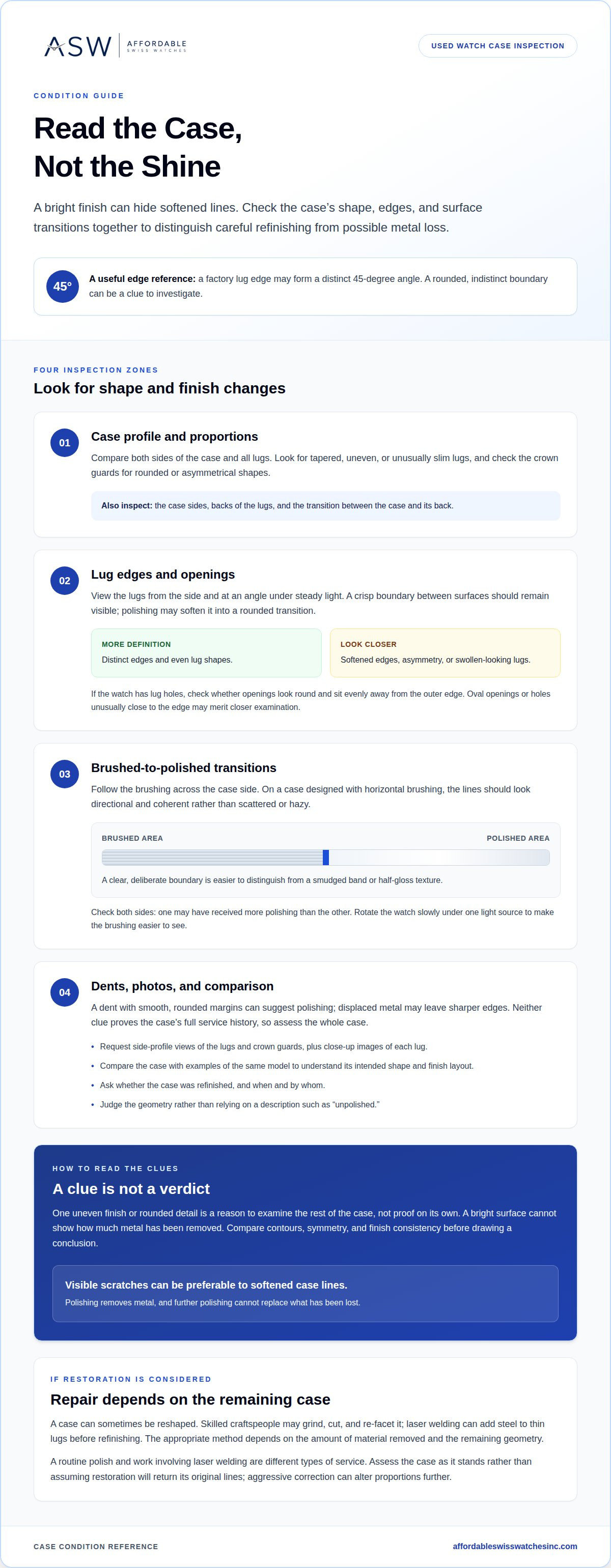
Edge definition is the crisp boundary where two case surfaces meet, such as a lug’s upper plane and side. A factory lug edge may form a distinct 45-degree angle; polishing can soften that boundary into a rounded transition. This matters because softened edges can indicate removed metal, even when the case remains bright and clean.
Inspect the lugs from the side and at an angle under steady light. A sharp line should remain visible along the case profile, while an over-polished lug may look swollen or indistinct. Also examine any remaining dent: displaced metal often leaves sharper edges, while a dent with smooth, rounded margins can suggest polishing. Neither clue proves the case’s full service history, but both help distinguish surface wear from possible material loss.
Pre-Purchase Case Quality Checks
Before buying, examine close-up photos of the case and inspect it in person if that option is available. Request side-profile views of the lugs and crown guards, along with macro images of each lug. These angles make differences in thickness, edge shape, and symmetry easier to see than a dial-facing photo. Compare the case with examples of the same model, since designs vary and no single outline suits every watch.
Check the case sides, the backs of the lugs, and the transition between brushed and polished surfaces. On a watch with lug holes, note whether the openings look round and sit evenly away from the edge. Ask whether the case has been refinished, and when and by whom. A bright finish with indistinct lines deserves closer scrutiny than a few visible scratches alongside well-defined contours.
Restoration and Refinishing Considerations
An over-polished case can sometimes be reshaped, but polishing cannot replace metal that has been removed. Skilled craftspeople may grind, cut, and re-facet a case; laser welding can add steel to thin lugs before refinishing. The right method depends on how much material was removed and the remaining case geometry. Restoration requires care, since aggressive correction can further alter the original proportions.
In the United States, refinishing costs depend on the case material, the extent of metal loss, and whether rebuilding is needed before surface work. A routine polish and a repair involving laser welding are different types of work, so their prices are not directly comparable. When deciding whether to buy, assess the case as it stands rather than assuming restoration will restore its original lines. A small scratch may be preferable to a case needing substantial reconstruction.
Brushed and polished finish consistency
A watch case often combines brushed and polished surfaces, each with a distinct visual boundary. On a case designed with horizontal brushing, check that the lines remain directional and even. A half-gloss appearance across a brushed area can suggest that polishing blurred its texture. Finish consistency can reveal refinishing that a bright surface alone may conceal.
Start with the case sides, where factory brushing is commonly described as clean horizontal lines. Tilt the watch under steady light and follow those lines from one end of the case to the other. They should look coherent, not scattered or replaced by broad, hazy reflections. If one section looks satin-brushed while another has mixed gloss, the unevenness may indicate that different areas received different amounts of polishing.
Next, inspect where a polished surface meets a brushed one. A defined transition should look deliberate and consistent along the case. Polishing across that boundary can soften it, leaving a smudged band or half-gloss texture instead of a clear change in finish. Check both sides of the case, since one may have been treated more heavily than the other. One uneven area is a clue to investigate alongside the rest of the case, not proof on its own.
Use examples of the same model to understand its intended finish pattern. Compare the locations of brushed and polished surfaces, their boundaries, and the direction of the brushing. A more worn example may still help show the design, although wear can obscure the original texture. Focus on the case’s finish layout, not whether another watch looks newer or brighter. A uniform shine does not prove that the condition has been preserved.
Photos can distort texture, especially when reflections wash out fine brushing. Request clear views of both case sides and the transitions between finishes. In person, rotate the watch slowly beneath one light source; horizontal brushing should remain visible as the reflections move. Check the area beside polished bevels, where an indistinct boundary may be easier to spot. A watch described as unpolished may still have been refinished, so judge the surface itself.
Finish consistency adds context to the case’s overall condition. A sharply defined boundary beside uniform brushed lines suggests the surfaces remain distinct, while patchy gloss or blurred transitions call for closer scrutiny. Compare the watch with another example of the same model, focusing on the finish pattern rather than overall brightness.
Collector preference for scratches over metal loss
A scratch records wear on the surface; polishing can remove metal and alter the case beneath it. That difference shapes how collectors assess condition, originality, and potential resale.
Scratches Versus Metal Loss
Collectors may accept visible scratches because those marks leave the case’s underlying shape intact. Polishing can level scratches, but further polishing cannot restore the removed metal. A worn Rolex with crisp original contours may therefore appeal more than a brighter example with softened geometry.
Consider a scratch on a lug beside a rounded edge. The scratch is visible evidence of use; the rounded edge may indicate lasting material loss. When comparing these features, collectors consider whether the watch retains its designed proportions, not simply which surface looks cleaner. On a vintage piece, age-related marks can be part of its documented physical condition.
This preference is not universal. A buyer prioritizing a clean appearance may value refinishing differently from a collector seeking preserved case lines. The practical question is whether the finish improved the appearance by removing marks or compromised the shape that gives the case its character.
Effects on Value and Resale
Over-polishing can reduce collectability and resale value when it rounds lugs, distorts proportions, or erases original case lines. Comparable heavily polished vintage Rolex watches can be worth 30-50% less than examples with sharp, original lines. Collectors may also pay a 20% to 50% premium for a Rolex with original factory lines compared with a polished example.
These comparisons describe condition-sensitive market differences, not a fixed resale calculation for every watch. Reference, originality, overall condition, and the depth of polishing all influence how buyers assess a particular example. A 1968 Rolex 5513 is cited as a case where an unpolished example could cost twice as much as even the best polished examples. That comparison shows why small condition differences can matter greatly within a specific reference.
When reselling, disclose refinishing accurately and assess the case alongside the watch’s other condition details. For collectors who prioritize originality, a bright finish cannot make up for visibly thinned lugs or softened bevels.
Risks of Buying an Over-Polished Watch
The main risk is paying for a case whose original geometry has been permanently changed. Thin or uneven lugs and rounded edges can affect collectability, while substantial metal removal may compromise case integrity. On some Rolex models, over-polishing can also affect bezel fit, crystal seating, or lug-hole usability.
Look beyond surface shine before deciding. A spring bar protruding from the case may indicate reduced support around the lug area following polishing. A rotating bezel that does not sit flush or turn smoothly with distinct clicks also merits attention, although that symptom alone does not establish polishing as the cause.
Compare the case with the intended design and weigh visible scratches against softened lines. If originality matters to your collecting goals, prioritize well-preserved geometry over cosmetic perfection. A polished watch can still suit a buyer, but its condition should inform the purchase decision and resale expectations.
Difference between polishing and over-polishing
Polishing is a surface treatment; over-polishing is repeated or excessive work that changes a watch’s original case geometry. A careful refinish can reduce small marks while preserving the lines and proportions that define the case.
How can you distinguish factory finishing from polishing damage? Compare the watch with examples of the same model, focusing on its original surface pattern, edges, and proportions. Factory finishing follows the case’s design; polishing damage may appear as rounded contours, uneven lugs, or blurred transitions.
A professional refinish may remove little metal, while repeated or heavy polishing can thin Rolex lugs and compromise case integrity. The key question is not whether a watch has ever been polished, but whether its original shape and finish remain clear.
Rolex has historically polished watches during service, so a service polish alone does not establish damage. Rolex Service Centers follow protocols to maintain factory standards when polishing, while excessive pressure or heat can alter stainless steel’s lustre and colour. A documented service history provides context, but the case itself still deserves close inspection.
Examine features across the case rather than relying on a glossy appearance. For example, compare the width of opposing lugs, the shape of the crown guards, and the boundary between brushed and polished surfaces. If one lug looks slimmer or one guard more rounded, the case may have received uneven or substantial work. These differences matter more when several appear together.
Surface marks can help distinguish normal wear from metal removal. A scratch may remain distinct against a well-defined edge; polishing can soften that edge while removing the scratch. Polishing can remove surface metal to level marks and restore shine. Another polish cannot return that material.
Finish matters as much as shape. A brushed case side should retain clean horizontal lines, while excess polishing can leave a half-gloss texture or blur the transition to a polished bevel. Heat and pressure can change stainless steel’s appearance, so an unusually uneven lustre may support other signs of refinishing.
Use the reference’s design as your baseline. Compare clear photos of the case sides, lug backs, and crown guards with examples of the same model. A skilled craftsperson can grind, cut, and re-facet a case so carefully that refinishing is difficult to recognize, so no single visual clue proves the full history. The strongest assessment considers geometry, finish, and surface evidence together.
What measurements reveal that a watch case has lost material from polishing?
No single case measurement proves that polishing removed metal. Measurements are most useful when compared with the same reference, the opposite side of the case, and the watch’s visible geometry.
Start with the model’s published case dimensions, if available, and treat them as a broad reference rather than proof of originality. Case diameter alone rarely identifies polishing, because metal loss may occur at the lugs, bevels, or crown guards without greatly changing the overall width. Case thickness can also vary with design and components, so a reading has limited value without a reliable comparison.
For a physical inspection, measure matching points on opposite sides. Compare lug width near the case and near each tip, then check whether corresponding lugs appear consistent. A noticeably narrower lug or uneven pair may support visual evidence of material loss. Also compare the crown guards’ height and thickness. Use the same points and angle for each measurement; otherwise, differences may reflect positioning rather than altered metal.
Record the results alongside close-up photos of the case. A digital caliper can measure accessible dimensions, but it cannot reveal the original contour on its own. For example, two lugs may have similar widths yet differ in edge shape because one has been rounded. Pair measurements with side-profile views of the bevel, lug backs, and case-to-back transition.
- Compare left and right lugs at matching points.
- Check crown-guard symmetry and thickness.
- Compare measurements with examples of the same reference.
- Use photographs to preserve the exact measurement locations.
Examples of the same reference are essential because case dimensions vary across models and production details. A measurement that seems unusual compared with another model may be correct for the watch under review. Give more weight to repeated mismatches across corresponding lugs, guards, and edges than to one isolated reading. A sharp difference in one feature, alongside visibly softened contours, provides stronger evidence of possible polishing-related loss.
Serial or reference markings can help identify which model to compare, but they do not measure metal loss. On Rolex watches, markings between the lugs may require removing the bracelet for inspection. Their presence helps establish the comparison model; it does not establish the case’s prior condition. Without context, measurements also cannot reliably distinguish factory variation from refinishing.
For a purchase decision, treat dimensions as supporting evidence, not a verdict on their own. If measurements conflict with the case’s visible proportions, request clear photos and a written condition description before deciding. Consider the measurements alongside the case profile and reference-specific details for a fuller assessment.
Affordable Swiss Watches Inc.
Affordable Swiss Watches Inc. offers pre-owned and unworn luxury watches for buyers weighing condition alongside model and provenance. Its selection includes Rolex Submariner, Datejust, Land-Dweller, and Oyster Perpetual watches. For a pre-owned piece, assess case lines and finish as part of its overall condition. Every pre-owned watch in the inventory undergoes in-house multi-step authentication and includes a 2-year limited warranty. These safeguards address authenticity and warranty coverage, while visible case condition remains an important part of your decision. Contact Affordable Swiss Watches Inc. with questions as you consider your next watch.
Make Case Condition Part of Your Buying Decision
Let your collecting priorities guide the final decision. A watch with visible wear may be a better fit than a brighter example if its case retains the proportions you value. Treat signs of over-polishing on a used watch as part of a wider condition assessment, then weigh them against the model, documented history, and your plans for ownership.
Affordable Swiss Watches Inc. offers Rolex Submariner, Rolex Datejust, and Rolex Land-Dweller watches. If you are considering a pre-owned watch and want to discuss how case condition factors into your choice, contact Affordable Swiss Watches Inc. A measured review of the details can help you choose with greater confidence.
Frequently Asked Questions
Is It Polished?
Appearance alone can suggest polishing, but rarely establishes the case’s full history. A clean surface may result from careful refinishing, while an untouched watch may still look bright after cleaning. Look for consistency between the finish, case shape, and wear marks. When service records do not document the case’s treatment, a seller’s description such as “appears unpolished” is more cautious than a definitive claim.
What are the visible signs that a used watch has been over-polished?
Signs of over-polishing on a used watch are more persuasive when several features point in the same direction. For example, softened contours paired with uneven lug thickness and a blurred finish boundary deserve more scrutiny than one rounded edge alone. Also examine the backs of the lugs, where wear or refinishing may be less obvious in standard listing photos. Consider the whole case before drawing a conclusion.
How can over-polishing affect watch case edges, lugs, and bevels?
Excessive polishing can reduce the definition of a case’s original surfaces. A bevel may appear narrow or fade into the adjoining plane, while lugs can look tapered or inconsistent from side to side. On a watch with crown guards, compare their profiles for symmetry. These changes can affect the model’s intended silhouette, even when the dial, bracelet, and overall finish look well cared for.
How do you spot over-polishing on a Rolex or other luxury watch?
Use the exact reference as your comparison point, since case shapes and finishing patterns differ across models. For a Rolex or another luxury watch, compare the crown guards, lug profile, bezel alignment, and case-side finish with reliable examples of the same reference. Also consider the service history: a recorded polish adds context, but condition still depends on how much material was removed and whether the geometry remains clear.
Can over-polishing be identified from watch photos, and what details should you inspect?
Photos can reveal possible refinishing, but reflections, lighting, and camera angles can hide surface detail. Request side-profile images, close views of each lug, and photos of the case under even lighting. Compare images taken from similar angles, especially around the bevels and case sides. One polished-looking photo is weak evidence; several views showing the same softened or uneven contours provide a more useful basis for assessment.
How can a watchmaker assess whether a watch has been over-polished?
A watchmaker can assess the case by comparing its dimensions and contours with reference-specific specifications and examining finish details under magnification. They may measure corresponding lugs or guards, inspect bevels, and review service records or prior photos. Measurements alone cannot establish the case’s history, so conclusions depend on how the physical evidence fits together. A written condition assessment can help distinguish cosmetic wear from meaningful changes to the case.