

What should your first pre-owned watch add to your life and your collection? Starting a watch collection with pre-owned pieces works best when you choose for how you’ll wear each watch, rather than chasing familiar names or short-term trends. Condition, provenance, and paperwork all matter, so a listing deserves more than a quick look at its photos.
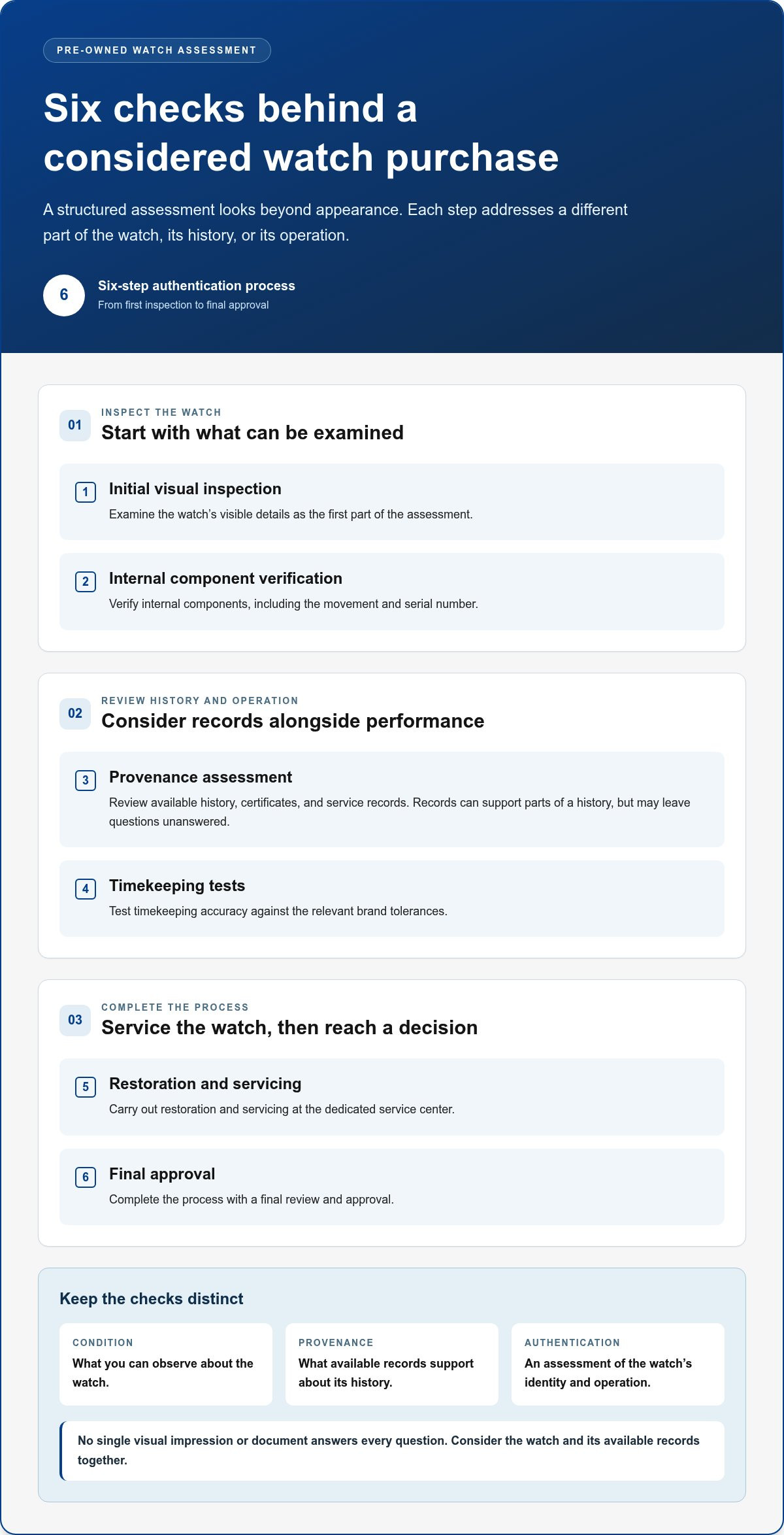
Begin with a simple framework: define the role you want a watch to fill, compare the specific piece’s condition and documentation, then consider how its authenticity was assessed. No single document or visual inspection tells the whole story. ASW Inc.’s six-step authentication process includes an initial visual inspection, internal component verification, provenance assessment, timekeeping tests, servicing, and final approval.
This guide will help you choose a first piece based on your needs, compare candidates consistently, and buy with greater confidence. It will also help you give each later purchase a distinct role, so your collection can develop with purpose as your interests change.
Key Takeaways
- Define a collection by the distinct reasons you choose each watch, not by how many pieces you own.
- Starting a watch collection with pre-owned pieces is easier when you set a clear role for your first watch.
- Assess visible condition separately from provenance and authenticity. No single document or inspection tells the whole story.
- Compare candidates by intended role, wearing context, design, condition, and documentation instead of looking for one universally best choice.
- Set a personal spending limit and keep a record of each watch’s reference details, purchase documents, condition, and service history.
Why start a watch collection with pre-owned pieces?
Pre-owned watches give you more pieces to consider as you build a collection around your own taste and priorities. But a wider selection also means condition and documentation deserve as much attention as design and appeal. Choose each watch for a reason, not simply because its name is familiar.
A watch collection is a group of watches chosen for distinct reasons. One might suit frequent daily wear, while another reflects your interest in a particular design or marks a personal milestone. Those different purposes give a collection coherence. A watch can be enjoyable to own without being expected to appreciate in value. Future financial performance is uncertain, so buy for your own interest and use.
What do you want your collection to represent?
Start with the subjects that hold your attention: design, brand history, watchmaking, or a meaningful event in your life. Then picture the first watch in the settings where you might wear it. Would you wear it often, reserve it for formal occasions, or choose it mainly for the pleasure of studying its construction? Write down your intention. It can help you stay focused when an appealing watch does not fit your priorities.
- My collection will focus on: a design, history, or personal interest.
- My first watch will be worn: in the settings that matter to me.
- A later piece should add: a role or perspective I do not already have.
This statement does not need to lock you into one brand or category. It is a reference point when several watches catch your eye. As your interests develop, you can explore other watch types and histories, then decide which details deserve closer study.
Why consider pre-owned rather than only unworn watches?
Pre-owned describes a watch that has had a previous owner; it is not a collecting goal in itself. Compare a pre-owned and an unworn option by looking at the specific watch’s condition, available history and documentation, applicable warranty, and your preference for a watch with prior ownership or one that is unworn. A well-presented exterior cannot establish a watch’s history, just as paperwork cannot tell you its current physical condition.
Affordable Swiss Watches Inc. is an independent dealer. Pre-owned watches come with a 2-year limited warranty, while unworn watches pass through the original manufacturer warranty. Every watch sold has a 100% authenticity guarantee and a full money-back guarantee if it is ever found not to be genuine. These terms give you clear points of comparison, but the right choice still depends on the individual watch and the role you want it to fill.
How do you assess a pre-owned watch before adding it?
Use the same order for each candidate: inspect its condition, review the available history, consider how authenticity was assessed, then compare the purchase terms. This keeps an attractive appearance or a folder of papers from deciding the question on its own. Each check tells you something different, making it easier to compare watches that appeal to you for different reasons.
- Inspect condition. Look at the case, dial, hands, crystal, and bracelet or strap. Note visible wear and compare the specific watch with its description. Keep observations factual, such as a mark on the case, rather than guessing how or when it occurred.
- Review provenance. Read available service records, certificates, and ownership documentation. These records vary, so distinguish what they establish from what they leave unanswered.
- Consider authentication. A thorough assessment goes beyond appearance and considers the watch’s identity and operation.
- Compare terms. Review the purchase details and the warranty that applies to the individual watch before deciding.
Which condition and provenance details matter?
Condition describes the watch as it is presented; provenance concerns the history supported by available records. Original accessories and paperwork can add context, but their presence does not independently establish authenticity or a complete ownership history. Likewise, the absence of a particular accessory does not, by itself, describe the watch’s physical condition. Keep these observations separate in your notes. The National Association of Watch & Clock Collectors provides broader horological resources for collectors who want to build their knowledge.
Condition describes what you can observe; provenance concerns what records can support; authentication evaluates the watch’s identity. Treat these as separate checks. A clean exterior cannot answer every question about a watch’s history, and documents need to be considered alongside the watch they accompany.
What does a documented authentication process examine?
Look at what an authentication process actually covers, not just whether a watch has been described as inspected. ASW Inc.’s six-step process starts with a visual inspection, then verifies internal components, including the movement and serial number. It assesses provenance through history, certificates, and service records, tests timekeeping accuracy within brand tolerances, carries out restoration and servicing at ASW Inc.’s dedicated service center, and ends with final approval.
This sequence considers both the watch and information associated with it. Comparing the steps with the questions you have about a particular piece is more useful than treating one visual impression or document as a complete evaluation. Once you’ve compared condition, available history, and purchase terms, you can browse ASW Inc.’s current watch selection and apply the same criteria to each candidate.
How should you compare watches for different collection roles?
Compare pre-owned watches by the role you want each one to play in your collection. Start with that role, then consider when you would wear the watch, which designs appeal to you, and how its condition and documentation fit your priorities. This makes the comparison personal and practical instead of turning it into a search for one universally best watch.
A collection gains coherence when each purchase adds a distinct reason to wear it. A watch that overlaps with one you already own may still be worthwhile. Be clear about what draws you to it and what it contributes.
What role should your first piece fill?
Choose a broad role before comparing individual watches. An everyday piece, a formal option, or a watch you associate with particular activities are useful starting points. These describe your intended use, not guaranteed capabilities. Consider whether you like the design, how often you expect to wear it, and whether its appearance suits the settings you have in mind.
For example, one candidate might appeal because you can picture wearing it often, while another interests you more as a formal choice. Neither is automatically better. Defining the role narrows the field and helps you assess watches against your habits, rather than against a general idea of what a first watch should be. That focus is especially useful when starting a watch collection with pre-owned pieces, since candidates can differ in condition and available documentation as well as design.
How can later purchases add variety without losing focus?
Keep a short record of the role you assign to each watch and the reason you chose it. Before considering another piece, note whether it adds a different wearing context or design perspective, or repeats a role you already have. Choosing a watch with a similar role can still make sense if you have a specific interest in a brand, design language, or aspect of watchmaking.
Use the table as a consistent comparison tool. Fill in the details for each candidate instead of relying on memory. The gaps can show you what you still need to learn before making a decision.
| Intended role | Wearing context | Design preference | Condition | Documentation |
|---|---|---|---|---|
| Everyday | Where you expect to wear it most | Features or overall look you prefer | Visible condition of the specific piece | Records and accessories available |
| Formal | Occasions or settings you have in mind | Details that suit your personal taste | Condition relative to your expectations | Documents available for review |
| Activity-oriented | The activities or settings you associate with it | Design qualities that interest you | Condition of the piece offered | History and records available |
Brand can be one organizing theme, but it need not be the only one. A collector drawn to Rolex might explore a focused interest such as the Submariner, while another may prefer to compare design or watchmaking across brands such as Omega, Tudor, Cartier, and Breitling. Choose a theme that reflects your curiosity, then use each candidate’s role to keep the collection intentional.
What buying habits help a pre-owned collection develop responsibly?
Responsible collecting depends on decisions you can sustain and records you can use later. Set a personal spending limit before comparing watches, and treat it as a boundary rather than a target to reach. A candidate should fit your finances and collection plan without relying on a prediction that it will retain or increase its value. Market conditions change; the value you place on wearing and owning a watch is more personal.
How can you keep each purchase aligned with your plan?
Use the same brief checklist for every candidate. If a watch does not fit your purpose or leaves important questions unanswered, pause rather than reshaping your plan to justify the purchase.
- Role: What place will this watch have in the collection?
- Preference: Do you genuinely like its design and want to wear it?
- Condition: Does the specific piece meet your expectations?
- Provenance: What history and supporting records are available?
- Terms: Do you understand the purchase terms and applicable warranty?
This pause is useful when a watch is compelling but duplicates a role you already own. You might still choose it for its design or personal significance, but write down that reason first. When starting a watch collection with pre-owned pieces, a clear reason for each purchase helps prevent changing market attention from setting the direction for you.
Maintenance is another part of a realistic plan. Needs vary by watch and its condition, so do not assume that every piece follows the same service schedule. Keep any service guidance and records that come with the individual watch, and document work as it is completed. ASW Inc. also provides complimentary bracelet or strap sizing and expert polishing services.
What records make a collection easier to manage?
Keep a separate file for each watch, digitally or on paper. Store its reference information with the purchase documents, available certificates, condition notes, and service records. Note what was present at purchase and record later changes, such as service or a change of strap. If records are incomplete, identify what you have rather than filling gaps with assumptions.
Add a short personal note, too: why you chose the watch, how you expect to wear it, and what you value about its design or history. These observations can clarify what you want from a later purchase. If you need a market valuation, ASW Inc. provides expert appraisal services to determine the market value of luxury timepieces for sale or insurance purposes.
Review the file before adding another piece. It gives you a practical view of your collection’s roles, history, and care needs. If you’re ready to compare candidates against your priorities, browse ASW Inc.’s current pre-owned watches.
How can ASW Inc. support a considered pre-owned collection?
Affordable Swiss Watches Inc. is an independent luxury watch dealer, not an authorized representative of any brand. Each watch should be considered on its own details, without assuming a brand relationship. Compare the information provided for the individual piece with the role you want it to fill, and keep your collecting criteria at the center of the decision.
When comparing listings, note the condition information, the accessories and documentation included where available, and any third-party status stated for that specific watch. These details can differ from piece to piece, so do not apply information from one listing to another. A clear comparison helps you identify which candidate merits closer consideration.
Which buyer protections apply to ASW Inc. watches?
Before purchasing, read the terms associated with the individual watch and note how they fit your priorities. ASW Inc. offers pre-owned and unworn watches, and the applicable warranty depends on which condition category the listing describes. Pre-owned watches have a 2-year limited warranty; unworn watches pass through the original manufacturer warranty. Some pre-owned pieces carry third-party Pre-Owned Certified status from WatchCSA. That status applies to the pieces identified, not every watch.
Original accessories and documentation are included where available. Their presence can help you understand what accompanies a particular piece, but record what is included and compare it with your preferences. If completeness matters to your collecting plan, use that criterion consistently rather than assuming every watch comes with the same accessories.
What is a practical next step for a new collector?
Choose a collecting priority before reviewing the current selection. It might be a design you return to, a brand whose history interests you, or a role your collection does not yet fill. Then compare each candidate against that priority and your personal spending limit. A watch that does not fit can remain a candidate for another time; there is no need to change your plan to justify it.
If Audemars Piguet is part of your collecting interest, make it a focused area of research before comparing individual watches. Otherwise, begin with the pieces that best match your stated purpose. Browse ASW Inc.’s current selection at your own pace and consider which watch fits the collection you want to build.
Let your collection grow with your interests
Starting a watch collection with pre-owned pieces doesn’t require a complete collecting plan from day one. Let your first choice reflect what you enjoy now, then use your experience wearing and learning about it to shape what comes next. Your interests may shift toward a different design, a brand’s history, or the details of watchmaking. A collection can evolve without losing its purpose when each new piece earns its place for a reason you can explain.
Take your time with the next step. Compare current watches against the role you have in mind, and focus on the pieces that genuinely hold your attention. Browse ASW Inc.’s current watch selection and consider which one fits your collecting interests. A thoughtful first choice is a strong foundation; the rest can develop at your own pace.
Frequently Asked Questions
Is a pre-owned watch the same as a vintage watch?
No. Pre-owned means a watch has had a previous owner; vintage is an age-related description whose use can vary by context. A relatively recent watch can be pre-owned without being considered vintage. If a listing uses both labels, assess the particular watch’s condition and supporting history rather than assuming the terms mean the same thing. This distinction helps keep your collecting criteria clear.
Can I build a collection with pre-owned and unworn watches together?
Yes. A collection can include both if each watch reflects your interests or has a distinct role. Keep condition and warranty details separate as you compare: ASW Inc. provides a 2-year limited warranty on pre-owned watches, while unworn watches pass through the original manufacturer warranty. Review the documentation and terms for each individual piece before deciding how it fits your collection.
Do box and papers prove a pre-owned watch is authentic?
No. A box, papers, or other accessories can support a watch’s documentation, but they do not establish authenticity on their own. Consider them alongside the watch’s condition, available history, movement and serial verification, and the authentication process. ASW Inc. guarantees the authenticity of every watch sold, with a full money-back guarantee if a watch is ever found not to be genuine. Original accessories and documentation are included where available, so assess what accompanies the individual piece.
Should I buy a pre-owned watch as an investment?
Buy primarily for personal interest, not a predicted financial return. Future prices depend on the specific watch and changing market conditions, so no collecting guide can promise an outcome. Consider whether you value the design, history, or place the watch would have in your collection even if its market value changed. ASW Inc.’s listed prices reflect each watch’s current market value, not a forecast of future performance.
What records should I keep for each watch I collect?
Keep purchase documents, available certificates, service records, and your own dated condition notes together. Record reference information exactly as it appears in the watch’s documentation rather than inferring details from appearance. If the watch receives service or changes ownership, add the relevant records and update your notes. This file gives you a useful history to consult when comparing another candidate or reviewing what matters most in your collection.