

A professional watch appraisal for insurance is an authentication report first and a price valuation second. Most collectors feel a justified sense of anxiety regarding market volatility, especially when luxury prices can shift significantly within a single year. It's common to worry that a standard homeowner's policy, which often caps jewelry coverage at a few thousand dollars, leaves a high-value timepiece dangerously under-insured.
We understand that your priority is securing a document that a major insurer will actually honor. This guide teaches you exactly how to obtain a professional valuation that ensures your watch is fully protected against loss, theft, or damage. You'll learn the critical difference between retail price and replacement value, why internal movement verification is mandatory for accuracy, and how to maintain a schedule of appraisals that keeps pace with the current market. We provide a clear breakdown of the certification steps, from technical inspection to receiving a USPAP-compliant document that offers true peace of mind.
Key Takeaways
- A professional watch appraisal for insurance is a certified document that validates authenticity and establishes replacement value, which often exceeds the original purchase price.
- Gather original warranty cards, sales receipts, and service records before your appointment to provide a complete history of the watch's provenance.
- Reliable valuations require internal movement verification; visual inspections are insufficient for modern insurance standards and high-value claims.
- Update your documentation every two to three years to ensure your coverage reflects the current market value of luxury Swiss timepieces.
- Discover how ASW Inc. uses a multi-step authentication process to provide the verifiable guarantees required by major insurance providers.
Why a professional watch appraisal for insurance is essential
A formal Appraisal is a certified document and a technical blueprint of your timepiece. It validates the watch's authenticity by documenting reference numbers, serial numbers, and specific movement calibers. Establishing its current replacement value in a shifting market is the primary goal. Many owners rely on original sales receipts, but these documents are often insufficient for modern insurance claims. A receipt only proves what you paid in the past; it doesn't reflect what it would cost to replace the item today. Claims adjusters require contemporary proof that the asset still exists in its stated condition.
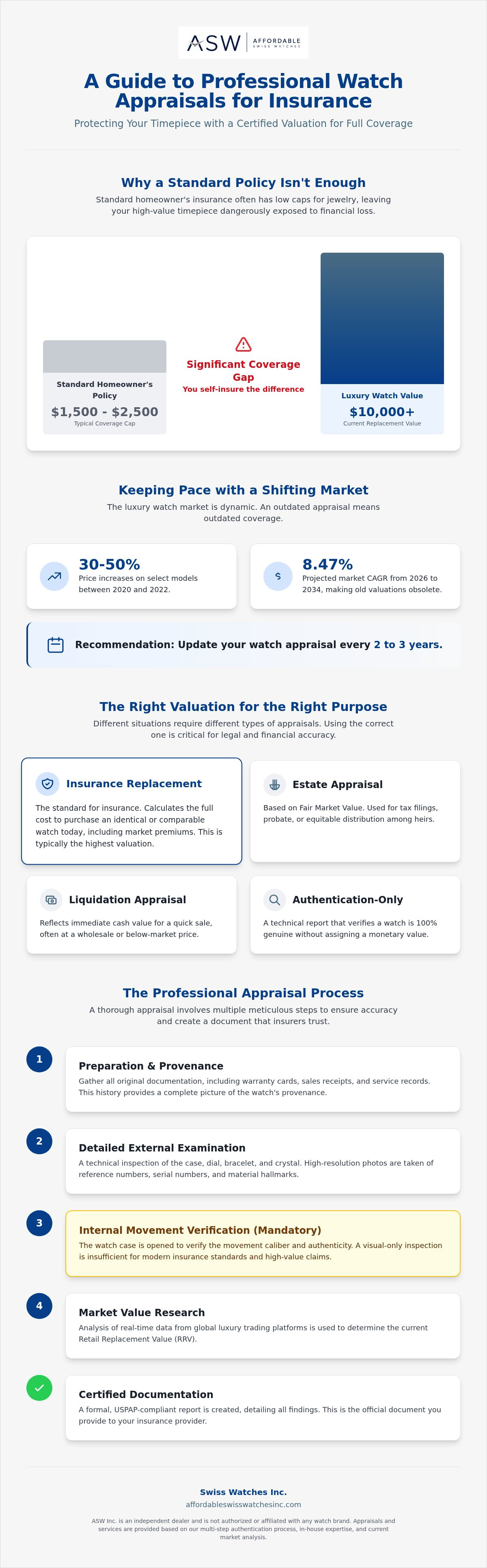
Market volatility remains a significant factor for brands like Rolex and Patek Philippe. Between 2020 and 2022, certain models saw price increases of 30% to 50%. If your documentation is outdated, you're effectively self-insuring the difference in value. We recommend obtaining a new watch appraisal for insurance every two to three years. This frequency ensures your coverage keeps pace with the compound annual growth rates seen in the luxury sector. With the market projected to grow at a CAGR of 8.47% between 2026 and 2034, an appraisal from five years ago is likely obsolete.
Replacement value vs. market price
Retail Replacement Value (RRV) is the standard for most insurance policies. It represents the cost to purchase a new, identical watch from an authorized dealer or a comparable secondary market source if the model is discontinued. This differs from Fair Market Value (FMV), which is the price a willing buyer pays a willing seller. Because secondary market demand for steel sports models often exceeds retail supply, the RRV is frequently higher than the original MSRP. Insurers require this specific valuation to ensure they can actually source a replacement in the event of a total loss.
The risk of being under-insured
Standard homeowner's insurance policies typically include sub-limits for jewelry, often capped between $1,500 and $2,500. For a luxury watch, this is rarely enough. Without a scheduled personal property endorsement backed by a professional watch appraisal for insurance, you risk massive out-of-pocket losses. If a watch purchased for $10,000 has doubled in value due to scarcity, an outdated policy may only pay out the original cost. A professional valuation prevents this gap. It provides the authenticated proof needed to secure the full current value of your asset.
Types of watch valuations and their specific purposes
Understanding the specific purpose of a valuation is the first step in protecting your investment. A watch appraisal for insurance serves a different legal and financial function than an appraisal for an estate or a private sale. Professional standards, such as those maintained by the National Association of Jewelry Appraisers, ensure that these documents are prepared with technical precision and ethical clarity. Choosing the wrong type of valuation can lead to significant financial gaps during a claim or legal dispute.
There are four primary categories of professional valuation:
- Insurance Replacement: Focused on the current cost to purchase an identical item in a retail environment.
- Estate Appraisal: Based on Fair Market Value for tax filings, probate, or equitable distribution.
- Liquidation Appraisal: Reflects the immediate cash-in-hand value for a quick sale, usually at a wholesale level.
- Authentication-Only: A technical report verifying that a watch is 100% genuine without assigning a specific dollar amount.
Insurance replacement valuation
Insurers require specific technical data to accept a watch appraisal for insurance. These documents must include high-resolution photography of hallmarks, serial numbers, and reference numbers. They also require a detailed description of the movement caliber and case material. This is typically the highest valuation type because it accounts for the full cost of replacing the item immediately, including any secondary market premiums for scarce models like the Rolex GMT-Master II or the Omega Speedmaster.
ASW Inc. determines these costs by analyzing real-time data from global luxury trading platforms. This methodology ensures your coverage reflects the actual cost of acquisition rather than an outdated MSRP. Our status as an independent dealer allows us to provide unbiased, market-accurate valuations that major insurance providers trust. If you are curious about how these market premiums affect your collection, you can browse our collection of luxury watches to see current market pricing in action.
Fair market value for resale
Fair Market Value (FMV) is the standard for private sales or tax purposes. Unlike a replacement valuation, FMV assumes a transaction between a willing buyer and a willing seller where neither is under pressure to act. Condition and provenance play much larger roles here than in a standard retail replacement report. A "full set" including the original box, papers, and warranty cards can increase a watch's value by as much as 30%.
Mechanical health is another critical factor. Service records from reputable specialists confirm the watch's longevity and performance. A Rolex Submariner with a documented service history and original factory finish will always command a premium over a similar model with unverified internal components. We take these details into account during every appraisal to ensure your document reflects the true market standing of your timepiece.
How to prepare for a luxury watch appraisal
Preparation is a critical step in securing an accurate watch appraisal for insurance. While the appraiser's technical inspection is the foundation of the report, the supporting materials you provide can significantly impact the final valuation. Before your appointment, gather every piece of documentation associated with the timepiece. This includes original sales receipts, warranty cards, hangtags, and even the original shipping materials if available. These items collectively form the "full set," which can increase the replacement value by up to 30% compared to a "naked" watch.
Mechanical health is equally important. Service records from authorized centers or reputable independent specialists prove that the watch has been maintained to factory standards. If you've recently had the movement overhauled or the gaskets replaced, bring those receipts. A watch with a documented service history is easier to value accurately because it removes the uncertainty regarding internal wear and tear. You should also clean the watch gently with a soft cloth. Dirt and oils can obscure serial numbers or hallmarks between the lugs; these are essential for the verification process.
The role of provenance in valuation
Provenance refers to the documented history of ownership and maintenance. Insurance underwriters prioritize watches with clear provenance because it reduces the risk of disputed claims. If you've lost your original papers, don't panic. A professional appraisal from ASW Inc. includes a multi-step authentication process that verifies the watch's genuineness regardless of missing paperwork. While the lack of papers may slightly lower the market replacement value, a certified document from an independent authority still provides the protection you need. This is especially true for models like the Rolex Datejust or Omega Seamaster, where original documentation is highly prized by collectors.
Physical condition assessment
The appraiser will distinguish between "honest wear," such as light surface scratches, and structural damage that requires repair. Be prepared to discuss the watch's history, specifically regarding polishing. In the luxury market, an unpolished case with its original factory lines is often more valuable than a heavily polished one that looks new but has lost its original geometry. Before the session, note any specific issues you've noticed, such as a stiff crown or a bezel that doesn't click precisely. Providing these details upfront helps the appraiser conduct a more thorough and efficient inspection during your scheduled appointment.
The step-by-step process of a professional appraisal
A professional watch appraisal for insurance follows a methodical, technical workflow. It ensures that every assertion of value is supported by verifiable physical evidence. The process typically requires 30 to 60 minutes and utilizes specialized tools to inspect the watch's internal and external architecture. This structured approach is what separates a certified valuation from a casual price estimate.
The standard professional process includes five distinct phases:
- Phase 1: Comprehensive visual inspection of the dial, hands, bezel, and case under high magnification.
- Phase 2: Internal component verification to match the movement caliber with the case reference.
- Phase 3: Documentation and provenance verification, cross-referencing serial numbers with manufacturer records.
- Phase 4: Mechanical performance testing using a timegrapher to ensure the watch operates within brand tolerances.
- Phase 5: Comparative market analysis to establish the final retail replacement value.
Internal movement verification
Opening the case back is a non-negotiable step for any high-value timepiece. It allows the appraiser to verify that the movement caliber matches the reference number exactly. This step is critical for identifying "Frankenstein" watches; these are genuine watches composed of non-original or mismatched parts that significantly lower the insurance value. We use high-resolution photography to document the movement's finishing, bridge markings, and serial engravings. These images are included in your final report to provide an indisputable record of the watch's internal state. This level of detail is a prerequisite for major insurers when processing high-value claims.
Market data analysis
The final valuation isn't a guess. It's the result of rigorous market data analysis. We utilize professional databases and platforms like Chrono24 to track real-time transaction prices globally. This is vital for modern Rolex or Audemars Piguet models where scarcity and multi-year waitlists drive market prices far above original retail. A certified watch appraisal for insurance must include the appraiser’s signature, the date of inspection, and a statement of USPAP compliance. This ensures the document is legally binding and accepted by all major insurance underwriters. If you're ready to secure your collection, you can schedule an appraisal appointment at our showroom, which is available strictly by appointment only.
Securing your watch with ASW Inc.’s expert services
ASW Inc. provides a watch appraisal for insurance that combines technical precision with real-time market data. We operate as an independent specialist, which allows us to provide unbiased valuations that reflect the current global demand for luxury timepieces. Unlike authorized dealers who may rely on outdated retail price lists, we analyze actual transaction data to ensure your coverage is sufficient. Every document we produce is supported by a multi-step authentication process and our 100% authenticity guarantee. This framework provides the verifiable proof required by major insurance underwriters to protect your investment.
Our facility includes a dedicated service center where we perform internal component verification and mechanical testing. This in-house capability is a significant advantage. It means your watch is handled by experts who understand the intricate calibers of brands like Rolex and Omega. We serve a national clientele of serious collectors who value discretion and technical accuracy. Whether you've acquired a Rolex Sea-Dweller or an Omega Moonwatch, our team ensures the valuation reflects its true heritage and condition.
Why choose an independent specialist?
Independent specialists offer a level of market-driven insight that traditional retail environments often lack. We provide expertise across a broad range of luxury brands, including Audemars Piguet and Breitling. Our focus remains on the specific needs of the secondary market, where scarcity often dictates value. We prioritize a high-touch, consultative experience for every client. To maintain this standard of personalized service, our showroom is available strictly by appointment only. This ensures that our specialists can focus entirely on the technical details of your collection during your visit.
Next steps for your appraisal
Initiating a watch appraisal for insurance with ASW Inc. begins with a simple inquiry. Our team will guide you through the necessary preparation and documentation requirements discussed earlier in this guide. During the consultation, we provide a clear breakdown of our multi-step verification results. This transparency builds long-term trust and ensures you leave with a certified document that stands up to insurance scrutiny. If you're looking to expand your collection or protect your current assets, you can browse our authenticated collections or contact us for appraisal inquiries.
Protecting your investment for the long term
Maintaining an accurate watch appraisal for insurance is a continuous responsibility for any serious collector. As market demand for luxury Swiss timepieces fluctuates, your coverage must evolve to prevent significant financial gaps. A professional valuation is more than just a price tag; it is a technical blueprint and authenticated proof of ownership that major insurers require for high-value claims. By prioritizing internal movement verification and keeping documentation current every two to three years, you ensure your asset is fully protected against the unexpected.
Affordable Swiss Watches Inc. brings years of expertise to every valuation. As a Chrono24 Trusted Seller since 2020, we combine our rigorous multi-step authentication process with a 100% authenticity guarantee to provide documents you can trust. Our independent status ensures that your appraisal reflects real-world market values rather than static retail lists. If you're ready to secure your collection with a USPAP-compliant report, contact Affordable Swiss Watches Inc. to schedule a professional appraisal appointment at our showroom, which is available strictly by appointment only. Proper documentation is the most effective tool for preserving your watch's legacy and your peace of mind.
Frequently Asked Questions
Can I use my original sales receipt for insurance instead of an appraisal?
Original sales receipts are generally insufficient for modern insurance claims because they only reflect the price paid at the time of purchase. Luxury markets are volatile; a Rolex bought five years ago doesn't reflect what it costs to replace today. A professional valuation provides the current retail replacement value that underwriters require. This ensures your coverage limits are high enough to actually source an identical timepiece if a total loss occurs.
How often should I have my Rolex appraised for insurance purposes?
You should update your documentation every two to three years to stay aligned with current market trends. Prices for brands like Rolex or Audemars Piguet don't stay static. If you wait too long between valuations, you risk being under-insured during a period of high demand. Regular updates are the only way to ensure your policy reflects the true cost of acquisition in the secondary or retail markets.
What is the difference between an appraisal and an authentication?
Authentication is the technical process of verifying that every component is genuine and original to the watch. An appraisal builds upon that verification by assigning a specific dollar value for insurance or legal purposes. While an authentication report proves the watch isn't a fake, a professional watch appraisal for insurance provides the financial evidence your insurer needs to set your policy premiums and coverage limits correctly.
Does a watch appraisal guarantee that I can sell my watch for that price?
An insurance appraisal doesn't guarantee a specific resale price. These documents focus on Retail Replacement Value, which is the cost to buy the watch again in a retail environment. If you sell to a dealer, you'll likely receive a lower buy-in or wholesale price. It's important to understand that your insured value is designed to make you whole after a loss, not to predict a future private sale price.
Will my insurance company accept an appraisal from an independent dealer?
Most major insurers accept appraisals from independent dealers as long as the document is professional and technically detailed. ASW Inc. is an independent dealer that provides USPAP-compliant valuations accepted by leading providers. Our reports include internal movement verification and high-resolution photography. This level of technical evidence gives underwriters the confidence they need to approve a watch appraisal for insurance and a scheduled personal property endorsement.
Does the presence of the original box and papers increase the appraisal value?
The presence of the original box, warranty cards, and hangtags can increase the appraised value by as much as 30%. Collectors and insurers refer to this as a full set. These items provide a clear chain of provenance and make the watch more desirable in the secondary market. If you have these accessories, always bring them to your appointment to ensure your valuation reaches its highest justifiable level.
What happens if my watch is found to be non-genuine during an appraisal?
If a timepiece is found to be non-genuine, a professional appraiser cannot issue a certified valuation for insurance purposes. Our six-step authentication process identifies mismatched parts or non-original components immediately. We provide a 100% authenticity guarantee on everything we sell, but for external appraisals, we simply report our technical findings. A non-genuine watch can't be insured for luxury value because it lacks the heritage and mechanical integrity of a genuine piece.
How long does a professional watch appraisal typically take?
A thorough technical inspection typically takes between 30 and 60 minutes. During this time, the specialist performs a visual examination, opens the case back for movement verification, and tests timekeeping accuracy. While the physical session isn't long, the research and final document preparation may take additional time. Our showroom operates strictly by appointment only to ensure each client receives the focused attention required for a precise, professional valuation.