

The quickest way to liquidate a Swiss timepiece is often the most expensive mistake an owner can make. While an outright dealer buyout provides immediate liquidity, luxury watch consignment consistently yields a significantly higher net return because you bypass wholesale trade-in discounts. It is natural to feel hesitant about handing over a prized Rolex or Omega, particularly when you face common anxieties over low appraisals, ambiguous commission fees, and the physical safety of your asset during the sales period.
You don't have to choose between personal peace of mind and securing top dollar. In this guide, you will learn exactly how watch consignment operates, how rigorous authentication and buyer warranties drive higher final prices, and what safeguards ensure your timepiece remains fully protected throughout the transaction. From evaluating dealer commission structures to analyzing current secondary market dynamics, here is how to maximize the return on your luxury watch in 2026.
Key Takeaways
- Understand how professional watch consignment allows you to retain legal title to your timepiece while leveraging established collector networks to secure full market value.
- Learn what to expect during each intake phase, from the initial valuation assessment to multi-step physical authentication inside a secure facility.
- Compare the financial advantages of structured dealer consignment against public auctions to avoid aggressive buyer premiums and prolonged settlement periods.
- Identify the critical documentation, including original factory boxes, warranty cards, and service records, required to protect your watch's secondary market premium.
- Discover how value-added buyer incentives, such as comprehensive movement verification and a 2-year limited warranty, eliminate buyer hesitation and drive higher net payouts.
What is luxury watch consignment?
At its core, luxury watch consignment is an arrangement where an owner entrusts a timepiece to a professional dealer who markets and sells it on their behalf. Under the standard legal definition of consignment, you retain full legal title to your watch until the sale completes and funds clear. Unlike generic resale platforms that treat fine mechanical horology like standard secondhand goods, a dedicated dealer curates the presentation, handles collector vetting, and coordinates secure payment processing in exchange for an agreed commission.
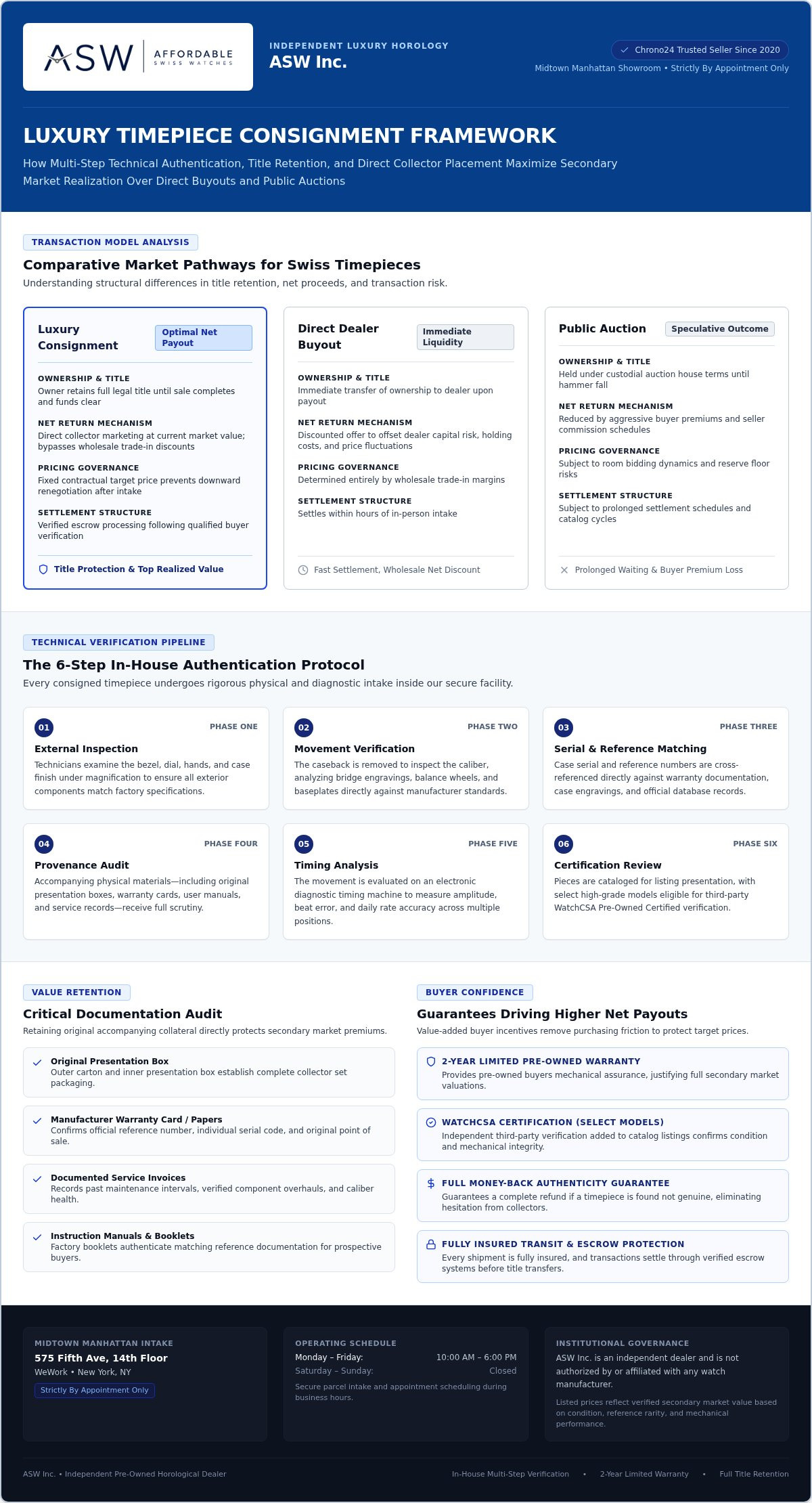
Consignment vs. direct dealer buyout
A direct buyout offers immediate cash, but that speed comes at a distinct cost. When a dealer purchases a watch outright, they discount their offer substantially to offset inventory holding costs, capital risk, and future price fluctuations. Watch consignment takes a different route by marketing the piece directly to prospective collectors at current market value.
This model produces distinct operational differences:
- Capital return: Consignment yields a higher net payout because the dealer acts as an agent rather than taking on inventory risk.
- Transaction speed: Buyouts settle within hours, while consignment requires patience until the right buyer is secured.
- Price control: Consignment contracts set a fixed target price, preventing aggressive downward renegotiation after intake.
The role of the independent dealer
Independent luxury dealers deliver objective market pricing unconstrained by authorized retail quotas or single-brand obligations. A seasoned specialist understands the technical distinctions in reference numbers, dial variations, and mechanical health that determine the real-world value of timepieces from manufacturers like Rolex, Omega, and Audemars Piguet.
Dealers such as ASW Inc. balance localized security with wide national visibility. By pairing an appointment-only Manhattan presence with established platforms like Chrono24, an independent dealer positions your watch in front of qualified buyers across the country. This network ensures your timepiece receives serious offers backed by insured transit and verified escrow systems.
The step-by-step watch consignment process
Executing a successful watch consignment requires a systematic intake that protects both the owner and prospective buyers. The workflow begins with a preliminary assessment based on high-resolution images, reference numbers, and production dates. Once an initial target price is established, the watch enters a secure intake pipeline via insured transit or hand-delivery to our Midtown Manhattan facility. Upon intake, a binding agreement fixes the consignment terms, and the watch transitions into technical inspection.
The 6-step authentication check
Every timepiece undergoes a rigorous physical intake protocol to verify mechanical integrity and visual originality before it is listed:
- External inspection: Technicians examine the bezel, dial, hands, and case finish under magnification to ensure all parts match original factory specifications.
- Movement verification: The caseback is removed to inspect the caliber, checking bridge engravings, balance wheels, and baseplates against manufacturer standards.
- Serial matching: The case serial and reference numbers are cross-referenced directly against warranty documentation and database records.
- Provenance audit: Accompanying materials, including presentation boxes, warranty cards, manuals, and service receipts, receive full scrutiny.
- Timing analysis: The watch is placed on a diagnostic timing machine to measure amplitude, beat error, and daily rate accuracy across multiple positions.
- Certification review: Timepieces are prepared for cataloging, with select models eligible for third-party WatchCSA Pre-Owned Certified verification.
Marketing and global exposure
Secondary market valuations reflect buyer confidence. As detailed in the Boston Consulting Group's luxury watch market study, strong secondary market performance relies on institutional buyer trust and documented provenance. Studio photographers capture reference-specific details, including chamfer edges, bracelet stretch, and dial text, presenting an unedited visual record.
Your watch is then published across high-volume sales networks. Beyond our primary inventory at Affordable Swiss Watches Inc., we feature consignments on Chrono24, where ASW Inc. has operated as a Trusted Seller since 2020. Our team fields inquiries, filters speculative offers, and vets prospective collectors across the country. Once the sale closes, payment is processed through verified escrow, and final proceeds are disbursed directly to you.
Consignment vs. auctions: which is right for you?
Choosing between an auction house and private watch consignment comes down to risk tolerance and pricing control. Traditional auctions thrive on competitive bidding wars, making them viable for museum-grade, historic vintage models. For modern luxury watches, auctions introduce variable outcomes. If the room is cold or registered bidders look elsewhere, a watch risks selling at a compromised reserve or failing to meet it entirely, leaving a public record that suppresses future resale interest.
Consignment provides a controlled environment where the watch remains listed at a realistic, fixed valuation until a buyer meets the price. To accelerate this interest, specialized dealers often publish educational resources, such as our pre-owned Audemars Piguet guide, which gives prospective collectors the exact reference knowledge and condition context needed to commit without delay.
Control over the final sale price
Setting your net proceeds in advance is the defining advantage of consignment. Instead of letting room dynamics dictate your payout, you agree on an exact secondary market price before the timepiece is presented to buyers. ASW Inc. tracks real-time transaction indices across global secondary platforms to justify listed figures with verifiable sales data, preventing arbitrary price adjustments.
Public bidding environments offer no such predictability:
- Price realization: Consignment secures a negotiated net sum, while auctions depend on the erratic turnout of specific bidders on a single day.
- Listing visibility: A consigned timepiece remains active until sold, whereas an unsold auction lot becomes visibly burned in catalog archives.
- Price defense: Independent dealers justify asking figures directly to potential buyers through hands-on technical consultation.
Speed of liquidity vs. final return
Auction houses operate on fixed seasonal schedules that force sellers into sixty- to ninety-day cataloging delays before an event occurs. Settlement adds another month of administrative wait time. According to McKinsey research on the secondhand watch industry, transparency and established authentication protocols are what truly drive sustainable secondary market value, rather than artificial auction exclusivity.
Fee structures also diverge sharply. Major auction houses impose buyer premiums ranging from 22% to 29% on top of the hammer price, alongside seller commissions and catalog fees. This friction drives down the opening bids collectors are willing to make. Consignment with ASW Inc. avoids inflated buyer surcharges entirely, operating on a transparent dealer commission that protects your final net proceeds.
How to maximize your watch’s consignment value
Maximizing the return on a luxury timepiece requires preparation before submitting it for intake. The secondary watch market rewards transparency, mechanical integrity, and historical completeness. While market demand sets the baseline for any reference, your watch's specific condition and accompanying collateral dictate whether it commands top-tier pricing. Owners studying specific model histories through resources like our Rolex Submariner guide understand that small details create wide price variations between seemingly identical pieces.
A common mistake is attempting cosmetic restoration before an appraisal. Aggressive or improper polishing removes metal from the case bevels, softens the lug chamfers, and degrades the original factory geometry. Discerning collectors prioritize sharp, unpolished case lines with honest wear over an over-polished exterior. Unless refinishing is handled by an authorized service center to factory standards, preserving the original metal finish is the safer path to protecting resale value.
The value of "Full Set" timepieces
A watch offered as a complete set routinely commands a substantial market premium over a piece presented on its own. Serialized warranty cards, green chronometer tags, instruction manuals, and inner and outer presentation boxes serve as physical proof of identity. ASW Inc. verifies every piece of documentation during the initial multi-step intake review to ensure serial numbers, country codes, and dates align seamlessly.
Collectors view complete sets as lower-risk investments. Original sales receipts and service records establish a clear timeline, removing ambiguity about how the piece was maintained. Missing paperwork cannot be replaced from the factory, which permanently impacts collectible ceiling value.
Mechanical condition and servicing
Provenance is the documented history of ownership and service. Documented interventions from certified watchmakers reassure buyers that a watch was cared for properly throughout its life. Timepieces running within factory accuracy tolerances with healthy amplitude figures sell faster because they require no immediate maintenance investment from the purchaser.
Movement inspections also confirm that internal components remain entirely correct to the caliber. Replacing worn parts with non-genuine components drastically diminishes market standing. If you are considering entering a watch consignment agreement, review your documentation and connect with the specialists at Affordable Swiss Watches Inc. to receive an accurate, data-backed assessment of your timepiece's current resale position.
Why consign with Affordable Swiss Watches Inc.?
Selecting the right partner for watch consignment hinges on security, market reach, and buyer confidence. As an independent luxury dealer, ASW Inc. operates without factory retail quotas or single-brand obligations. This status allows us to provide unbiased, data-backed valuations for your Audemars Piguet, Omega, or Rolex timepiece. High-value intakes take place securely at our Midtown Manhattan showroom, located at 575 Fifth Ave, 14th Floor. Open Monday through Friday from 10 AM to 6 PM strictly by appointment, our facility provides a private environment for evaluating your watch before it reaches qualified collectors nationwide.
Democratizing luxury through transparency
Our mission focuses on making fine Swiss horology accessible to collectors through fair, transparent market pricing rather than inflated dealer markups. Listed prices reflect current secondary market figures, eliminating aggressive haggling and confusing commission splits. Every consigned piece is backed by our comprehensive authenticity guarantee, featuring a full money-back policy if a watch is ever found not genuine. By establishing clear standards, we remove the friction that often delays high-value transactions.
Buyer protections that help you sell
In the secondary market, protecting the purchaser is the single most effective way to maximize returns for the consignor. Private buyers routinely submit low offers on unvetted marketplaces to hedge against hidden mechanical flaws. ASW Inc. eliminates that hesitation by attaching tangible institutional guarantees to your watch:
- Two-year limited warranty: Pre-owned timepieces include a 2-year limited warranty from ASW Inc., giving collectors immediate confidence in mechanical reliability.
- Third-party certification: Select high-value models receive optional WatchCSA Pre-Owned Certified verification to confirm technical originality.
- National reach: We market inventory across our dedicated digital storefront and Chrono24, where ASW Inc. has maintained Trusted Seller status since 2020.
Because the incoming buyer receives verifiable documentation and post-sale coverage, our team can defend full market value for your watch. This structured buyer protection directly translates into higher net proceeds and faster payouts for you.
Secure maximum value for your luxury timepiece
Navigating the resale market doesn't require compromising on price or personal security. Choosing professional watch consignment gives you full pricing control while avoiding the steep markdowns of wholesale dealer buyouts and the erratic premiums of public auctions. Preserving complete documentation, keeping original components intact, and presenting your timepiece through vetted channels ensures you capture true collector value.
Buyer confidence is what ultimately protects your final payout. ASW Inc. reinforces every transaction with a 100% authenticity guarantee, a 2-year limited warranty on pre-owned watches, and our established standing as a Chrono24 Trusted Seller since 2020. Whether you are ready to evaluate a single piece or schedule a private intake at our Midtown Manhattan showroom, which is strictly by appointment only, contact ASW Inc. today to discuss your consignment options. Our team is ready to help you achieve the return your timepiece deserves.
Frequently Asked Questions
How much does watch consignment cost?
Consignment fees operate as an agreed percentage of the final transaction price, deducted only after the timepiece sells. Unlike public auctions that add aggressive buyer premiums and administrative cataloging fees, luxury dealer consignment involves zero upfront listing costs. The dealer absorbs the expense of studio photography, multi-step technical authentication, and nationwide marketing. You receive a guaranteed net payout agreed upon prior to listing, ensuring complete transparency throughout the transaction.
How long does it take to sell a watch through consignment?
Listing duration depends on brand desirability, reference liquidity, mechanical condition, and pricing accuracy. High-demand stainless steel sports models from Rolex or Omega often sell within a few weeks, while specialized complications or precious metal pieces may take several months to connect with the right collector. Setting a realistic price based on current market data accelerates the sale, whereas overpricing inevitably lengthens the listing timeline.
Is my watch insured while it is with the dealer?
Yes, reputable independent dealers maintain dedicated commercial insurance policies for all client inventory held in their custody. During a luxury watch consignment, your timepiece is fully covered against theft, loss, and physical damage from initial intake through final delivery. This protection applies during physical evaluation in the service facility, secure vault storage, and fully insured priority transit to the verified buyer across the country.
Do I need the original box and papers to consign my watch?
Original packaging and paperwork are not mandatory to enter watch consignment, though complete sets command higher secondary market valuations. Retaining the factory warranty card, chronometer tags, presentation box, and service history proves authenticity faster and reassures prospective collectors. If you possess only the timepiece, vetted dealers still accept it, provided it successfully clears internal physical inspection, movement caliber verification, and mechanical timing diagnostic tests.