

The Moonwatch is the Omega Speedmaster Professional, the line associated with NASA’s Apollo missions. This Omega Speedmaster buying guide distinguishes that model from other Speedmasters, including racing-focused and vintage references that share the name but not the same history or specifications. The key distinction is simple: “Speedmaster” names a broad family, while “Moonwatch” refers to the Professional at the center of the spaceflight story.
Choosing one takes more than recognizing the name. The movement, crystal, reference, condition, and documentation can all shape a watch’s appeal and market value. Vintage examples call for particular attention to originality and service history. This guide explains the Moonwatch’s history, how its movements differ, and how to compare current and pre-owned models. You’ll have a clearer basis for deciding which Speedmaster fits your priorities, whether you prefer the familiar Professional or another chapter in the collection.
Key Takeaways
- The Moonwatch is the Speedmaster Professional, but the broader Speedmaster family includes models with different designs and purposes.
- Follow the watch’s spaceflight history to see how specific references became linked with NASA missions.
- Compare the Caliber 1861 and 1863 in the context of their place in the Moonwatch’s movement history.
- Use condition, reference, and configuration to make sense of differences between new and pre-owned Speedmaster prices.
- If you’re also considering a Rolex Submariner, Affordable Swiss Watches offers another luxury-watch option to explore.
Which OMEGA Speedmaster is the Moonwatch?
The Moonwatch is the Speedmaster Professional, the model linked to NASA’s Apollo missions. Other Speedmasters share its name but differ in design, movement, and history.
Modern Moonwatch Models
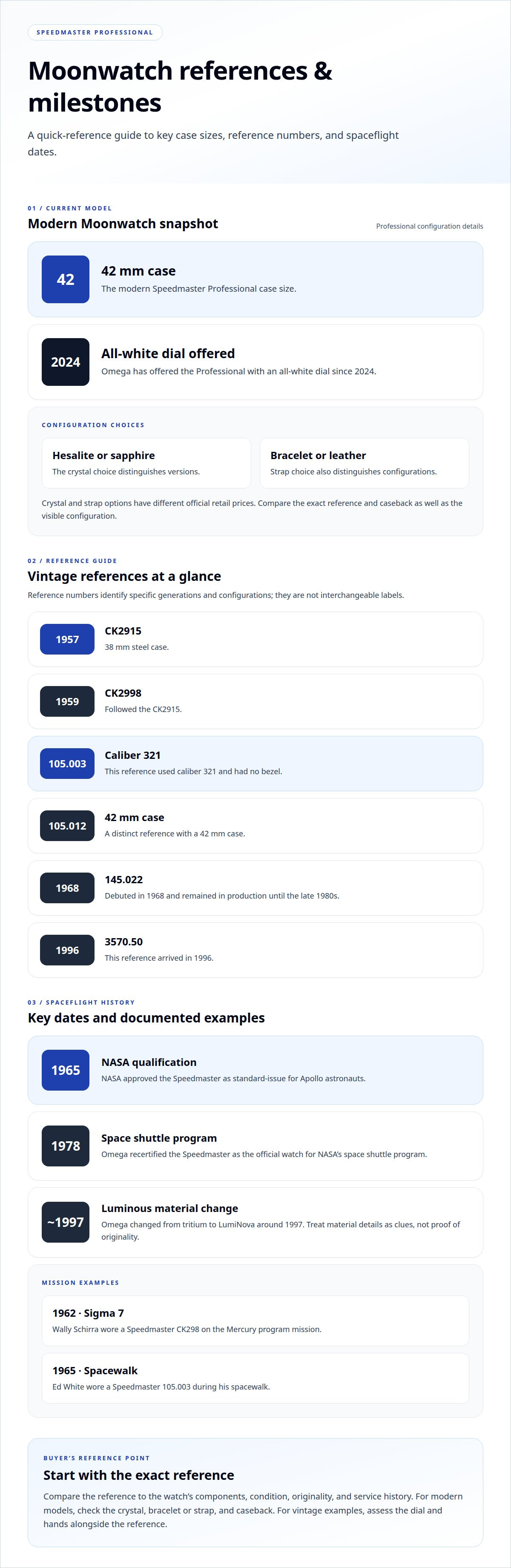
Modern Moonwatch models are Speedmaster Professional watches that continue the design and identity associated with the spaceflight-era Professional. That distinction matters because the Speedmaster collection also includes Racing, ’57, and other lines, each with its own character. The Professional has a 42 mm case, and Omega has offered it with an all-white dial since 2024. Crystal and strap choices also affect the configuration and official retail price: Hesalite and sapphire versions are distinct options, while bracelet and leather versions have different prices.
For a first-time buyer, the modern Speedmaster Professional is the clearest starting point if the goal is a Moonwatch. Compare the exact reference, crystal, bracelet or strap, and caseback before deciding; these details distinguish configurations within the same model family. A Racing or ’57 may suit someone who prefers another design, but neither is the same collection definition as the Professional Moonwatch.
Pre-Professional and Vintage Characteristics
Pre-professional Speedmasters are earlier watches that predate the Professional designation, while vintage references identify particular generations and configurations. The 1957 CK2915 had a 38 mm steel case; CK2998 followed in 1959. The 105.003 used caliber 321 and lacked a bezel, while the 105.012 has a 42 mm case. These distinctions matter because reference numbers describe specific watches, not interchangeable labels.
Vintage condition calls for attention to originality, dial and hand details, and service history. A reference 145.022 debuted in 1968 and remained in production until the late 1980s. The 3570.50 arrived in 1996. Matching the reference to the watch’s components helps distinguish a period example from a later model and gives a buyer a more useful basis for comparison.
What Speedmaster models are available, and how do they differ? The collection includes the Professional Moonwatch, Racing, ’57, and other lines. They differ in design, case dimensions, references, and movement; the Professional is the Moonwatch model.
How often does a Speedmaster need servicing, and what does it cost? Service timing depends on the watch’s performance and service history, including its timekeeping and chronograph operation.
What are the resale value and depreciation of popular models? Resale outcomes vary across the family. Reference, condition, originality, and service history all influence value. Compare examples with the same reference and configuration rather than assuming every Moonwatch depreciates in the same way.
How can you authenticate a Speedmaster? Match the reference and movement to the watch’s visible details, then assess the dial, hands, bezel, case, and service records together. A matching box or papers can support provenance, but those items alone do not establish that the watch and its components are correct.
NASA qualification and spaceflight history
The Speedmaster’s spaceflight history is grounded in NASA selection and documented missions. Those milestones help explain the historical importance of particular vintage references.
NASA Qualification and Testing
NASA approved the Speedmaster as standard-issue for Apollo astronauts in 1965. That qualification connects the watch’s history to an operational space program, rather than only to Omega’s marketing or later collector interest. For buyers, the year provides a useful reference point when comparing watches described as Moonwatches. A reference’s age alone, however, doesn’t establish its mission history or condition.
The milestone calls for precise wording. NASA selected the Speedmaster for space missions, and astronauts wore Speedmaster Professional Moonwatches during Apollo. The available facts establish that selection and use, but do not detail individual test procedures or results. Assess claims about a specific watch’s flight history separately from the model’s documented qualification.
Production Before 1978
Before the shuttle-era recertification, the Speedmaster evolved from a pre-professional chronograph into a watch associated with NASA missions. Early production history matters because vintage references can differ in case, bezel, hands, and movement. When comparing examples, identify the reference first, then assess whether the components and condition align with that model’s period.
Omega recertified the Speedmaster as the official watch for NASA’s space shuttle program in 1978. This marks a later chapter, not the start of the Moonwatch connection. For vintage research, distinguish the Apollo period from the shuttle program, then consider period details such as luminous material. Omega changed from tritium to LumiNova around 1997, which can inform an assessment of a later watch’s dial and hands.
Material changes are clues, not proof of originality. Consider a dial’s luminous appearance alongside its reference, hands, case, and documented service history. Replacement parts or later work can affect how a watch relates to its original production period. Spaceflight heritage provides context, but it does not establish an individual watch’s provenance.
Missions and Vintage References
Mission records connect specific watches to named astronauts. Wally Schirra wore a Speedmaster CK298 on the Mercury program’s Sigma 7 mission in 1962. Ed White wore a Speedmaster 105.003 during his 1965 spacewalk. These examples show why collectors study reference numbers: they link a model generation to a particular point in the program’s history.
The Apollo connection continued with the Speedmaster Professional, worn during the Apollo 11 lunar landing in 1969. Omega received NASA’s Silver Snoopy Award in 1970. Gene Cernan became the last person to set foot on the moon on December 13, 1972. These milestones explain the Moonwatch name, but a watch’s condition and provenance remain separate considerations when buying a vintage example.
Caliber 1861 and Caliber 1863 movements
Caliber numbers help distinguish Speedmaster generations, but the reference identifies the complete watch. Caliber 1861 is a manual-wind chronograph movement with an 18-jewel construction, a 27 mm diameter, and a 48-hour power reserve. It operates at 21,600 beats per hour. Those specifications give buyers concrete points for comparing an 1861 Speedmaster Professional with models using another movement.
Caliber 1863 is another movement designation associated with Speedmaster Professional models. The available specifications here establish fewer technical details for it than for caliber 1861, so avoid assuming the two are identical or different based only on their names. For a pre-owned watch, identify its reference and movement together, then compare the actual configuration with the model description and service documentation.
The caliber 3861 marks a later movement choice for the Speedmaster Professional. It is METAS certified and resists magnetic fields up to 15,000 gauss. Its stated accuracy rating is 0 to +5 seconds per day. These specifications make the 3861 a meaningful comparison for buyers weighing a newer Moonwatch against an 1861 example, rather than treating all Professional models as mechanically interchangeable.
Crystal choice can also help identify a 3861 Moonwatch configuration. The Hesalite version has a solid caseback and around 50 hours of power reserve; reference 310.30.42.50.01.002 has a sapphire crystal and display caseback. Check the reference and caseback as a pair. A sapphire window changes what the wearer can see, while the movement specification gives a separate basis for comparing versions.
Caliber 321 belongs to an earlier chapter of Speedmaster history. The original CK2915 used Omega’s manually wound caliber 321 chronograph movement, and Omega later produced a caliber 321 re-edition. That connection can matter to collectors seeking a historically linked movement. It doesn’t make every watch with a 321 designation equivalent: reference, originality, and condition still shape the individual example.
The Speedmaster ’57 is another distinct model in the broader collection, not a caliber designation. Keep the model name, reference number, and movement name separate when comparing watches. A useful buying comparison records each one, then considers movement specifications alongside case configuration, crystal, condition, and service records. This approach keeps the focus on the exact watch, not the prestige of a caliber name alone.
Moonwatch Professional specifications and price
The current Speedmaster Professional pairs familiar Moonwatch proportions with modern movement and crystal options. Its exact reference and configuration show what you’re comparing.
Professional Moonwatch Specifications
The Moonwatch Professional is a manual-wind chronograph with a 42 mm case, 20 mm lug width, and 50 meters of water resistance. Its typical proportions are 47 mm lug-to-lug and 13 mm thick. These measurements help you assess fit before purchase, while the reference identifies the particular crystal, caseback, and movement configuration.
Apollo 11 wore the Speedmaster during the 1969 lunar landing, giving the Professional its central place in Moonwatch history. The current 3861 version has around 50 hours of power reserve. The sapphire reference 310.30.42.50.01.002 has a display caseback; the Hesalite version has a solid caseback. Check both details against the reference.
Professional Moonwatch Variants
Professional Moonwatch variants differ by crystal, dial, and strap or bracelet. Hesalite offers the traditional closed caseback configuration, while sapphire versions provide a view through the back. Omega has offered an all-white dial Moonwatch since 2024. Those options affect the watch’s appearance and configuration, so compare complete references rather than relying on “Moonwatch” alone.
Bracelet and leather-strap versions also differ in official retail price. The sapphire-crystal versions carry a retail premium over classic versions. The reference 311.30.42.30.01.005 is identified as the last “real” Moonwatch reference, while 310.30.42.50.01.002 names a sapphire 3861 configuration. Precise reference matching helps prevent confusing separate generations.
New Speedmaster Pricing
In the United States, a Speedmaster’s price depends on its model and configuration. Moonwatch crystal and strap or bracelet choices affect retail price, while other Speedmaster lines occupy different price positions. Compare the specific reference and materials, not just the collection name, to understand what a quoted price represents.
The Speedmaster Professional differs from the Racing and Reduced in size and model identity. The Professional Moonwatch has a 42 mm case; Racing measures 44.25 mm, while the Reduced measures 39 mm. The Racing and Reduced are distinct alternatives, not Professional Moonwatch variants.
Older manual Moonwatches also require reference-specific comparison. The 145.022 debuted in 1968 and remained in production until the late 1980s; the 3570.50 followed in 1996. The CK2915 used caliber 321, but that early caliber doesn’t define every Moonwatch. Treat reference, movement, crystal, and condition as separate factors when comparing examples.
Example Speedmaster prices and retailers
Speedmaster pricing varies by reference, condition, and configuration. For a useful comparison, match the model and crystal first, then assess the bracelet or strap, included documentation, and service history.
New-retail listings and pre-owned offers describe different buying situations. A listed retail price applies to a specific new configuration; it shouldn’t be treated as a benchmark for every watch with “Speedmaster” on the dial. The Professional Moonwatch, Speedmaster ’57, Racing, and Chronoscope are distinct models. Their references and features need to match before their prices can be meaningfully compared.
Crystal choice can separate otherwise similar Professional models. A Hesalite Moonwatch has a solid caseback, while reference 310.30.42.50.01.002 has sapphire and a display caseback. Bracelet and leather-strap versions also have different retail prices. Compare like for like, since a crystal or strap difference can explain part of the gap between two listings.
Pre-owned comparisons call for closer attention to condition and completeness. Examine the dial, hands, bezel, case, and bracelet together, then review service records and any included box or papers. A full set can affect market value, but it does not replace an assessment of the watch itself. Consider missing documentation and visible wear alongside the reference.
Vintage examples add production history to the comparison. A 145.022 and a 3570.50 belong to different production periods, so a price comparison should account for reference, originality, and condition. Tritium and LumiNova can also help place a watch in its production context: Omega changed luminous material around 1997. That detail is one clue, not a complete measure of authenticity or value.
Retail listings vary in how clearly they identify a watch’s configuration and condition. A precise listing names the reference and movement, describes the crystal and bracelet, and records service or provenance details. Differences in those details may help explain a price gap beyond age or appearance. Read each listing as a description of a specific watch, not merely a model name.
The practical takeaway is to compare exact references and condition before interpreting a price gap. A sapphire edition, a Hesalite version, and a vintage watch each need their own comparison set. For another view of available watch styles, browse the watch collection.
Affordable Swiss Watches Inc.: Rolex Submariner
Affordable Swiss Watches Inc. offers the Rolex Submariner as an alternative for buyers comparing luxury watches beyond the Speedmaster. It gives you a distinct model to consider if you’re looking beyond a chronograph. You can also explore the Rolex Datejust, Rolex Land-Dweller, and Rolex Oyster Perpetual when comparing Rolex options.
Use your Speedmaster priorities as a comparison point: decide which design and wearing experience you want, then focus on the watch that fits. Affordable Swiss Watches Inc. is an independent watch dealer. If you’re weighing a Rolex Submariner against another model, contact Affordable Swiss Watches Inc. with your questions.
Choose the watch that fits your collecting priorities
Before choosing a Speedmaster, decide what matters most to you as an owner. You might prioritize a historically significant reference, a movement you value, or a design that feels right for regular wear. A clear preference helps you compare individual watches on relevant terms instead of letting a model’s reputation decide for you.
Use this Omega Speedmaster buying guide to weigh your priorities against each watch’s condition, configuration, and records. Note your essential features and acceptable compromises, then compare shortlisted watches against those criteria.
If your preferences lead beyond the Moonwatch, explore other styles at your own pace. Browse the watch collection to continue comparing options. A considered shortlist makes the next decision clearer, and the right watch is the one that fits your priorities.
Frequently Asked Questions
Caliber 1861 vs 3861: Is the Upgrade Worth the Premium?
Choose the 3861 if its modern certifications and technical specifications matter more to you than the 1861’s earlier production history. The 3861 is METAS certified, resists magnetic fields up to 15,000 gauss, and carries an accuracy rating of 0 to +5 seconds per day. The 1861 may suit buyers who prefer an earlier Moonwatch generation. Compare the actual watch’s condition and service history alongside its movement.
Hesalite vs Sapphire: Which Moonwatch Crystal Is Right for You?
Choose based on the configuration you prefer to wear and view. The Hesalite Moonwatch has a solid caseback, while sapphire reference 310.30.42.50.01.002 has a display caseback, letting you see the movement. These are practical differences, not simply reference details. Before buying, confirm the crystal and caseback match the stated reference; a listing that describes one combination but shows another needs closer scrutiny.
New, Pre-Owned, or Vintage Speedmaster: Which Buying Path Makes Sense?
An unworn Speedmaster suits buyers who want a watch with its original manufacturer warranty. Pre-owned examples offer another way to choose among references and configurations, but condition and service records deserve close review. Vintage is a fitting choice when a specific production period or reference matters most.
Should I Buy a New, Pre-Owned, or Vintage Omega Speedmaster?
Choose the condition category that matches your priorities, not simply the lowest asking price. Choose unworn if the original manufacturer warranty matters most; choose pre-owned if you value a particular reference and can assess its history. Vintage makes sense when the exact period and its design details are central to your interest. For any older watch, weigh originality, documented work, and current condition together.
What Should I Check When Buying a Pre-Owned Omega Speedmaster?
Compare the reference with the dial, hands, bezel, caseback, and movement, then review serial details and service records. Affordable Swiss Watches Inc. describes its authentication as a multi-step process that includes visual inspection, internal component and serial verification, provenance assessment, timekeeping tests, servicing, and final approval. Its pre-owned watches carry a 2-year limited warranty, with a full money-back guarantee if a watch is found not genuine.
What Are the Omega Speedmaster Case Sizes, Movements, and Power Reserves?
Sizes and reserves depend on the model and movement. The Professional Moonwatch measures 42 mm, Racing 44.25 mm, Reduced 39 mm, First Omega in Space 39.7 mm, and Speedmaster ’57 40.5 mm. Caliber 1861 has a 48-hour power reserve. The Moonwatch Professional with caliber 3861 has around 50 hours. Confirm the exact reference before comparing specifications across Speedmaster models.
Where Can I Buy an Omega Speedmaster in the US, and What Warranty Comes With It?
You can buy an Omega Speedmaster in the US through Omega boutiques, authorized dealers, or independent dealers such as Affordable Swiss Watches Inc. Warranty coverage depends on purchase channel and condition: a new watch from an Omega boutique or authorized dealer comes with a five-year Omega factory warranty. Affordable Swiss Watches Inc. provides the original manufacturer warranty on unworn watches and a 2-year limited warranty on pre-owned watches.