

An aggressive polish can erase thousands in value from an Audemars Piguet Royal Oak faster than mechanical wear ever could. When you evaluate an Audemars Piguet Royal Oak on the secondary market, success depends on inspecting three non-negotiable fundamentals: original case geometry, dial authenticity, and verified mechanical provenance.
With boutique waitlists stretching indefinitely and pre-owned listings varying dramatically in condition, collector hesitation is understandable. You want total confidence that the octagonal bezel retains its sharp factory chamfers, the Tapisserie dial reflects genuine manufacture tooling, and the internal movement matches its stated production era.
This evaluation guide delivers the technical specifications, reference evolutions, and condition criteria required to inspect any pre-owned piece. We break down key case and calibre shifts across generations, highlight vital structural checks for the integrated bracelet, and outline how rigorous independent verification protects your investment.
Key Takeaways
- Understand how the foundational architecture of the Audemars Piguet Royal Oak took shape in 1972 and why its octagonal case remains a benchmark of collector interest.
- Compare essential dimensions between classic 39mm Jumbo references and modern 41mm Selfwinding models to determine the right proportion for your wrist.
- Track mechanical improvements across movement generations, including differences in operating frequency, power reserve, and quick-set date mechanisms.
- Identify critical condition markers on the bezel and bracelet links to ensure factory case lines remain crisp rather than softened by aggressive polishing.
- Navigate secondary market sourcing confidently by relying on verified market valuations and multi-step independent authentication.
What Defines the Audemars Piguet Royal Oak Design and Heritage?
The Audemars Piguet Royal Oak established the modern luxury sports watch category upon its debut in 1972. Before its release, high-end Swiss watchmaking focused almost entirely on precious metals like yellow gold or platinum. Designer Gérald Genta altered that direction by treating stainless steel with the same hand-finishing techniques historically reserved for fine jewellery. That singular shift transformed industrial steel into an elite horological material.
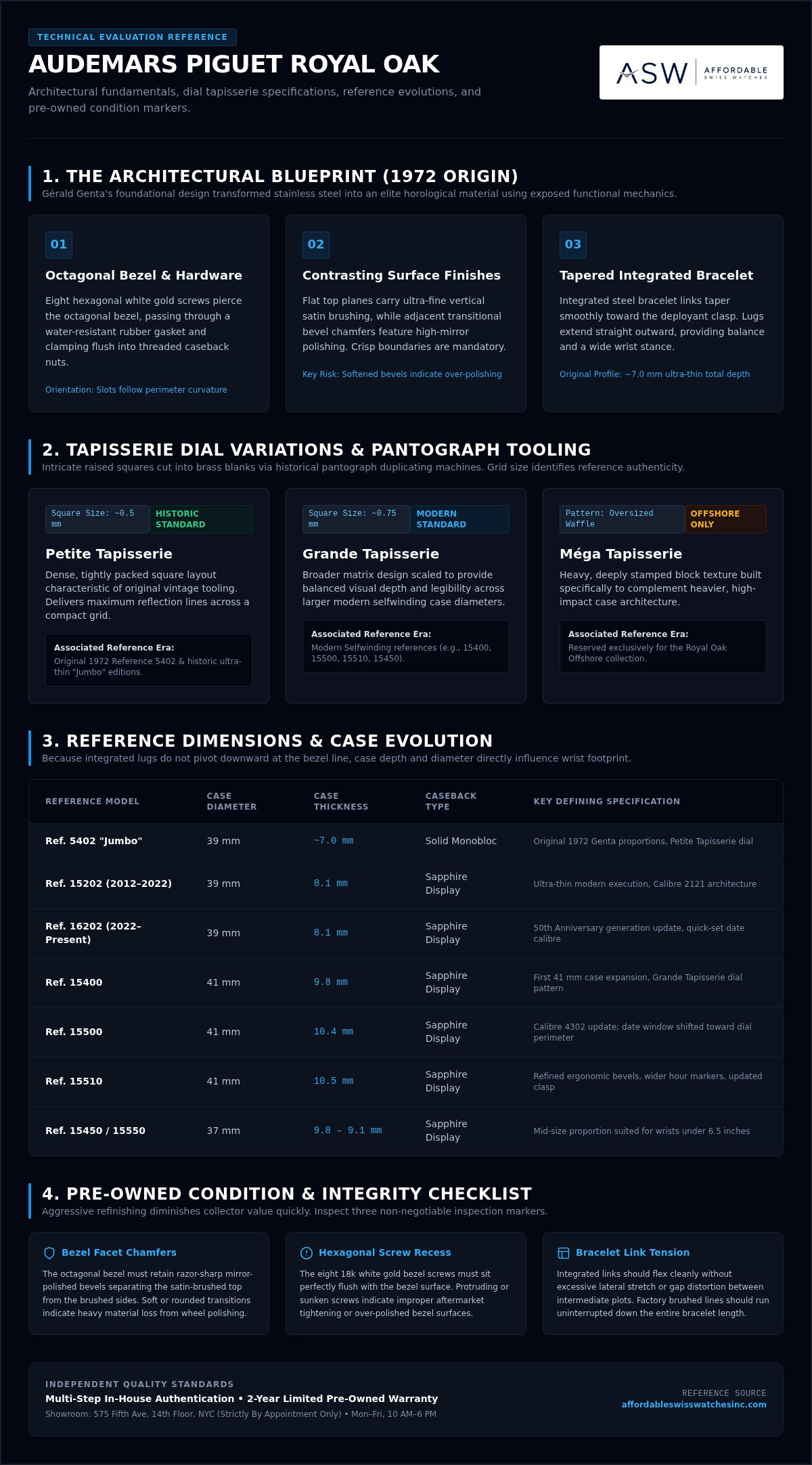
Central to Genta's design is the monobloc case construction secured by visible, functional hardware. Eight hexagonal white gold screws pierce the octagonal bezel, passing through a water-resistant rubber gasket and clamping directly into threaded nuts on the caseback. Rather than concealing assembly mechanics, the watch highlights them as structural assets. Paired with an integrated steel bracelet that tapers toward the deployant clasp, the case rests flat against the wrist to provide remarkable balance.
The Architectural Blueprint: Core Exterior Signatures
Evaluating an authentic case requires studying the interplay between adjacent surface treatments. Audemars Piguet applies distinct finishing across every external angle:
- Bezel Geometry: The octagonal bezel features sharp facets. Its eight hexagonal screws are counter-sunk flush with the metal, with their slots oriented to follow the curve of the perimeter.
- Contrasting Finishes: The top surfaces carry fine vertical satin brushing, while the transitional bevel edges display a mirror polish. Any softening of these crisp boundaries signals improper handling.
- Slim Proportions: Despite its sports watch designation, the original case profile measured approximately 7.0 mm thick, establishing a disciplined standard for subsequent generations.
Tapisserie Dial Variations: Petite, Grande, and Méga
The textured dial pattern remains one of the most recognizable traits of the audemars piguet royal oak. Craftsmen produce these surfaces using historical pantograph duplicating machines, cutting intricate raised squares alongside woven grooves into the brass dial blank. Identifying the specific grid pattern helps verify whether a dial matches its intended reference period:
- Petite Tapisserie: Sized at roughly 0.5 mm per square, this dense, tightly packed pattern defines the original 1972 reference 5402 and historic ultra-thin "Jumbo" iterations.
- Grande Tapisserie: Measuring approximately 0.75 mm per square, this broader layout was introduced to provide visual depth on larger, modern selfwinding models.
- Méga Tapisserie: This heavy, embossed pattern features oversized blocks and is reserved exclusively for the heavier Royal Oak Offshore line.
Recognizing these core architectural standards gives collectors an objective framework to assess case originality and avoid aftermarket modifications.
Which Audemars Piguet Royal Oak References Should You Consider?
Selecting an Audemars Piguet Royal Oak reference requires balancing case proportions against everyday ergonomics. Because the integrated lugs extend straight out before tapering into the bracelet links, the watch wears broader than standard round designs. A 39 mm or 41 mm case often covers the wrist like a traditional 41 mm or 43 mm piece, making thickness and lug-to-lug spread critical evaluation points.
The Classic Jumbo Profile: 39mm Ultra-Thin References
Purists prioritize the original 39 mm diameter. Reference 5402 set the standard at roughly 7.0 mm thick with a solid caseback. Modern collectors frequently focus on its successors: reference 15202, produced from 2012 to 2022 at 8.1 mm thick with an open display back, and the current reference 16202 launched in 2022. Both preserve the ultra-thin aesthetic while refining daily usability.
Modern Selfwinding Workhorses: 37mm and 41mm Variations
Standard production selfwinding models introduce deeper profiles to house high-capacity automatic calibres. Reference 15400 expanded the diameter to 41 mm with a 9.8 mm case depth. Its replacement, reference 15500, grew to 10.4 mm thick, while the current reference 15510 measures 10.5 mm. These references feature wider hour markers and a date aperture moved further toward the dial edge for improved legibility.
For wrist sizes below 6.5 inches, mid-size 37 mm references like the 15450 and 15550 prevent the rigid integrated bracelet from overhanging the wrist edges.
Royal Oak Chronograph Considerations: 38mm vs. 41mm Cases
Complicated models alter the wrist profile through added dial registers and screw-down crown guards. Modern references fall into two distinct sizing categories:
- Reference 26331 (41mm): Delivers a substantial sports watch stance with high-contrast subsidiary dials, measuring 11 mm thick.
- Reference 26715 (38mm): Balances chronograph complexity with manageable proportions, fitting wrists that find the 41 mm variant unyielding.
Both styles integrate hexagonal pushers aligned with the bezel screws. If you are comparing specific case profiles and reference eras across secondary listings, browse our inventory of verified Audemars Piguet watches to evaluate documented specifications firsthand.
How Have Royal Oak Movements Evolved Mechanically Over Time?
Internal mechanics dictate secondary market desirability just as sharply as exterior case condition. Across five decades of production, the Audemars Piguet Royal Oak transitioned from an ultra-thin architecture relying on shared historical engineering to robust, entirely in-house calibres. Understanding these mechanical milestones helps verify whether an internal movement correctly corresponds to the reference casing it occupies.
The Legendary Calibre 2121: Ultra-Thin Engineering
For four decades, the Jumbo profile relied on Calibre 2121, derived from the Jaeger-LeCoultre 920 base. Measuring just 3.05 mm thick, it allowed early references to maintain their slim dimensions. The movement features an unusual mechanism: an oscillating weight suspended along a peripheral beryllium copper ring, gliding smoothly over four ruby rollers.
Operating at a relaxed 19,800 vibrations per hour (2.75 Hz) with a 40-hour power reserve, it delivers fine finishing. Setting the date, however, requires patience. Calibre 2121 lacks a quickset function; setting the calendar means winding the hour hand repeatedly between 10 PM and 2 AM.
In-House Evolution: Calibre 3120, 4302, and 7121
As modern case profiles grew, Audemars Piguet developed proprietary workhorse engines to increase durability, daily shock resistance, and convenience:
- Calibre 3120: Debuting inside reference 15300 and powering the early 41 mm reference 15400, this movement introduced a full balance bridge and an engraved 22-carat gold rotor. It beats at 21,600 vph (3 Hz) with a 60-hour reserve. Measuring 26.6 mm across, it leaves modern 41 mm date windows positioned slightly inward.
- Calibre 4302: Introduced in reference 15500 and continued in the 15510, this larger 32 mm engine runs at a modern 28,800 vph (4 Hz). Its broader footprint pushes the date disc to the true edge of the dial while delivering a 70-hour power reserve.
- Calibre 7121: Engineered specifically to replace the 2121 inside the 39 mm Jumbo reference 16202, this 3.2 mm calibre operates at 28,800 vph with a 55-hour reserve. Crucially, it incorporates a rapid quickset date mechanism without compromising the classic slim profile.
Pieces assembled during 2022 feature a dedicated "50 Years" winding rotor, while watches built from 2023 onward carry standard Manufacture rotors. Meticulous timing machine tests and amplitude checks remain mandatory to ensure these high-tolerance movements run true to factory parameters.
What Condition Indicators Must You Inspect on a Pre-Owned Royal Oak?
Sharp geometric case lines represent the single most important indicator of an uncompromised audemars piguet royal oak. Because the design depends entirely on precise architectural transitions, aggressive wheel polishing permanently damages collector value. Once the factory bevels lose their crisp separation from the satin-brushed planes, the case cannot easily regain its original form without costly laser welding.
Review our detailed pre-owned Audemars Piguet guide to explore practical evaluation methods before entering the secondary market.
Case Bevels, Bezel Integrity, and Bracelet Tension
Condition evaluation requires a focused physical check across specific wear points:
- Bezel Screws and Recesses: Check that the eight hexagonal white gold screws sit counter-sunk flush with the brushed bezel surface. Over-polishing eats away the steel around them, leaving screw heads protruding past the frame.
- Factory Chamfers: Examine the wide, mirror-polished bevel running down the case flanks and bracelet edges. The boundary between brushed steel and polished chamfers must feel distinct rather than rounded or wavy.
- Bracelet Sag: Hold the watch sideways by the case. The integrated links should maintain structural tension with minimal horizontal droop. Excessive gap spacing points to worn internal pins.
- Link Fasteners: Ensure the proprietary slotted screws and threaded caps show no burring or tool slippage marks from improper past sizing.
Dial Condition, Lume Aging, and Water Resistance Seals
Moisture ingress poses a major risk to complex Tapisserie dials. Inspect the raised pyramids under magnification for flaking lacquer, bubbling, or oxidation spots around the hand pinion. On vintage pieces, luminous material should show uniform patina across markers and hands; mismatched coloration often suggests later service replacements. Because the multi-piece monobloc structure relies on specialized rubber gaskets, verified pressure testing is essential to confirm water integrity.
Multi-Step Authentication: Movement Verification and Provenance
Evaluating provenance demands more than matching paperwork. Reputable dealers carry out an in-house multi-step authentication process that opens the case to examine movement architecture, engraved font weights, and serial numbers against manufacture production records. Bridge beveling, balance wheel assemblies, and oscillating weights must correspond exactly to the reference generation. Timing equipment checks verify that beat error, amplitude, and daily rate adhere strictly to manufacture specifications.
To acquire fully vetted timepieces backed by our multi-step verification and a two-year limited warranty, view our verified inventory today.
How to Acquire an Audemars Piguet Royal Oak with Total Confidence
Securing an audemars piguet royal oak through authorized retail boutiques often involves navigating multi-year waitlists or building extensive purchase histories. Sourcing through the secondary market eliminates these administrative hurdles, granting collectors immediate access to current-production models and discontinued references alike. Because independent dealers operate outside factory allocation systems, listed prices reflect current market value determined by actual availability, reference rarity, and individual condition.
If you are weighing integrated luxury sport silhouettes against other legendary tool watches, study our comparative analysis in the Rolex Submariner guide. If you plan to trade or sell an existing piece to fund your acquisition, our watch consignment guide outlines how professional appraisal standards protect your equity.
Warranty Coverage: Pre-Owned vs. Unworn Luxury Watches
Understanding post-purchase coverage gives buyers crucial peace of mind when transacting on the secondary market. At Affordable Swiss Watches Inc., buyer protection is tied directly to inventory condition:
- Unworn Timepieces: Delivery includes the original manufacturer warranty, which transfers directly to the buyer for the duration of the factory term.
- Pre-Owned Timepieces: Every pre-owned piece carries a dedicated two-year limited warranty from ASW Inc. covering mechanical movement performance.
- WatchCSA Certification: Select timepieces carry third-party WatchCSA Pre-Owned Certified status, providing external verification of condition and integrity.
Guaranteed Authenticity and Independent Dealer Protections
Transacting with an independent dealer requires clear structural safeguards. ASW Inc. operates with complete transparency, maintaining an explicit 100% authenticity guarantee alongside a full money-back guarantee if any piece is ever found not genuine. That commitment is supported by our multi-step internal evaluation protocol and recognized standing as a Chrono24 Trusted Seller badge holder since 2020.
To ensure a seamless acquisition from day one, we provide complimentary bracelet sizing on all integrated bracelets. Sizing an Audemars Piguet Royal Oak requires specialized tools to prevent damage to proprietary screws and link chamfers, ensuring your watch fits comfortably and securely upon delivery.
Next Steps in Building Your Royal Oak Collection
Evaluating an Audemars Piguet Royal Oak successfully comes down to prioritizing structural originality over superficial shine. By confirming unsoftened case bevels, verifying period-correct movement calibres, and choosing reputable secondary sources, you safeguard both your equity and your wrist enjoyment.
Affordable Swiss Watches Inc. delivers absolute peace of mind for high-value horological acquisitions nationwide. As a Chrono24 Trusted Seller badge holder since 2020, we inspect every timepiece through a multi-step internal evaluation protocol. We back our unworn inventory by passing through original manufacturer warranties, while our pre-owned watches include a dedicated two-year limited warranty alongside an absolute 100% authenticity guarantee with a full money-back guarantee.
If you are ready to evaluate references firsthand or discuss current secondary market valuations, schedule a consultation at our showroom, available strictly by appointment only Monday through Friday from 10 AM to 6 PM. We invite you to explore our curated timepiece inventory and consult with a specialist today.
Frequently Asked Questions
How can I tell if an Audemars Piguet Royal Oak has been over-polished?
You can identify over-polishing by inspecting the bevel edges and screw recesses on the bezel. An original case displays crisp, mirror-polished chamfers sharply separated from vertical satin brushing. If polishing wheels have removed too much steel, the transitional lines appear rounded and wavy. The eight white gold bezel screws will also protrude above the metal rather than sitting flush within their factory-cut recesses.
What is the difference between a Royal Oak Jumbo and a Royal Oak Selfwinding?
The distinction centers on case thickness, movement architecture, and dial proportions. The classic Jumbo maintains the historic 39 mm diameter, an ultra-thin profile of 8.1 mm, and a Petite Tapisserie dial without a center seconds hand. Modern Selfwinding models measure 37 mm or 41 mm across, sit thicker at 10.4 mm to 10.5 mm, feature Grande Tapisserie dials, and utilize center seconds hands.
Does an Audemars Piguet Royal Oak hold its value on the secondary market?
The audemars piguet royal oak consistently maintains high secondary market retention compared to broader luxury watch benchmarks. Core steel references, particularly ultra-thin Jumbo models, continue to command solid premiums over original retail list prices. Long-term valuation depends on reference rarity, original dial integrity, unpolished factory case lines, and the presence of original manufacture warranty documentation.
What warranty coverage protects pre-owned Audemars Piguet watches?
Coverage depends on the specific condition category of the watch you acquire. Pre-owned watches purchased through Affordable Swiss Watches Inc. include a comprehensive two-year limited warranty covering internal mechanical performance. Unworn models retain their original manufacturer warranty passed directly to the buyer. Select timepieces also undergo independent third-party inspection to receive WatchCSA Pre-Owned Certified status before listing.
How does an independent dealer authenticate an Audemars Piguet Royal Oak?
Authentication requires a rigorous multi-step inspection conducted by trained watchmakers. Technicians assess external case geometry, open the monobloc case to verify movement components, and confirm serial numbers against manufacture archives. The calibre undergoes diagnostic timekeeping tests on specialized equipment to evaluate amplitude, daily rate, and beat error. Every piece is backed by an explicit 100% authenticity guarantee and a full money-back guarantee.