

A travel watch is useful when it makes the time at home as clear as the time where you are. Introduced in 2012, the Rolex Sky-Dweller lets the wearer read local time and a second time zone on the same dial. Its travel-time display works alongside an annual calendar, bringing several functions into one watch.
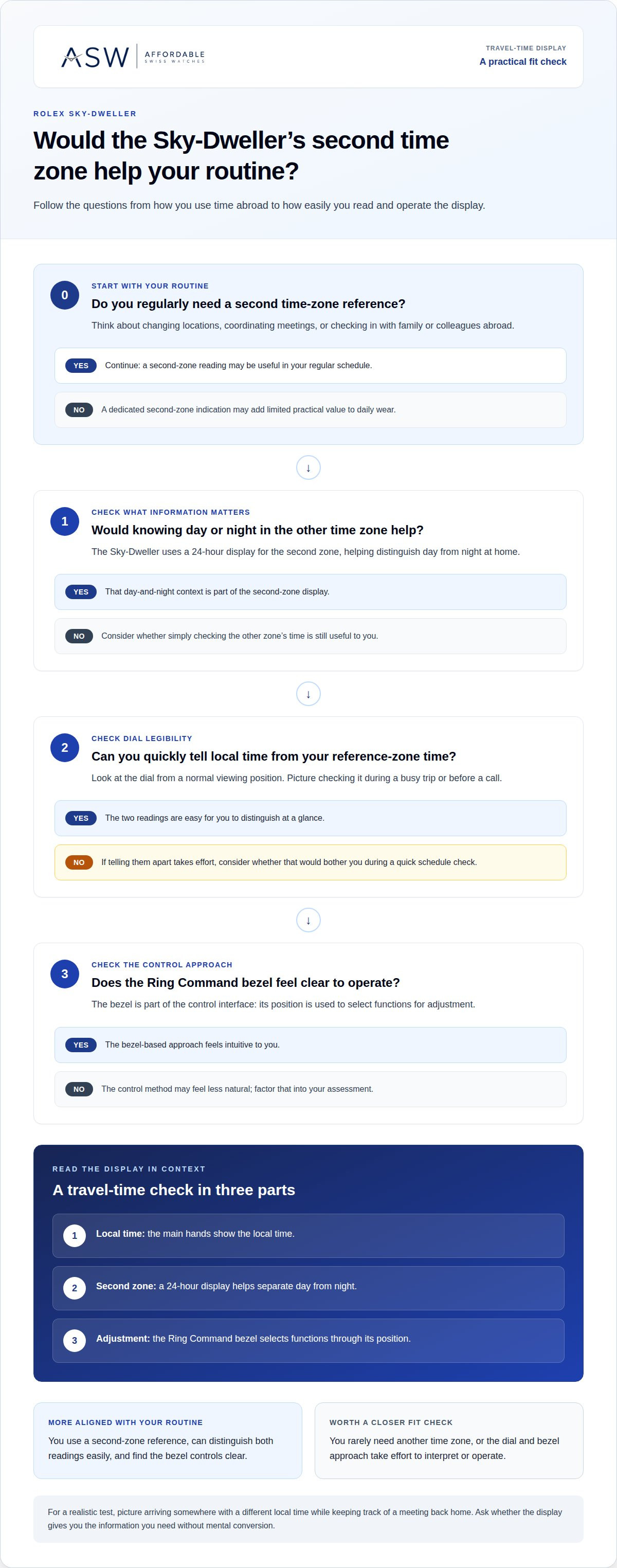
Keeping track of two time zones can be straightforward, but the way a watch presents that information matters. The Sky-Dweller uses a 24-hour display for the second zone, helping distinguish day from night at home while the main hands show local time.
This article explains how the Sky-Dweller developed, how its travel-time functions work, and how to use the Ring Command bezel to set them. It also covers the annual calendar and the design choices that keep the information readable. Whether you’re considering a Sky-Dweller or simply want to understand its display, here’s a practical guide to its features.
Key Takeaways
- Understand how Ring Command links the bezel position to the watch’s adjustable functions.
- Learn how the 24-hour display helps distinguish day from night in the second time zone.
- See how the annual calendar indicates the month through markers around the dial.
- Understand why servicing costs depend on the work required and the watch’s condition, rather than a single fixed amount.
Sky-Dweller history
Rolex created the Oyster Perpetual Sky-Dweller in 2012. The launch introduced a travel-focused design combining a second time-zone display with an annual calendar. These features gave the model a distinct role within the Rolex collection. Its history is closely tied to coordinating time and calendar information on one dial.
The annual calendar arrived with the watch in 2012 under the name Saros. It was the first annual calendar in Rolex’s collection. This distinction separates the model from watches focused mainly on time and date. Its calendar accounts for month lengths and indicates the current month through markers positioned around the dial.
The watch also uses a bezel as part of its control system. It links the rotating bezel with the watch’s setting functions. The bezel is therefore part of the operating interface, not only an exterior design feature. This approach gives the wearer a way to select functions for adjustment through the bezel.
Reference M336934-0005 provides a specific example of the design in a particular configuration. It has a fluted, bidirectional rotatable Ring Command bezel and uses calibre 9002. Its bright blue dial and Oyster bracelet with three-piece solid links add details that help distinguish this reference from other configurations.
For M336934-0005, calibre 9002 is the movement designation associated with that reference. Keeping those identifiers together helps when comparing listings or discussing an individual watch. The model name identifies the broader family; the reference identifies a particular configuration. This distinction matters because dial, bracelet, and material details can vary.
Rolex uses 904L stainless steel and 18k gold among the case materials. Those materials describe part of the model’s design, but they do not identify every reference on their own. A useful comparison considers the reference alongside its movement, dial, bracelet, and materials. Each detail contributes to the configuration, and none replaces the full reference.
For a purchase comparison, use three historical checkpoints: the 2012 introduction, the Saros annual calendar, and the Ring Command system. Each explains a different aspect of the watch. The introduction establishes when it appeared; Saros identifies its calendar feature; Ring Command explains the bezel’s role in operating the functions.
- Use the reference number to identify a specific configuration.
- Pair the movement designation with its reference, such as calibre 9002 for M336934-0005.
- Assess the calendar and bezel as functional parts of the design.
The model’s history is more than a launch date. Its 2012 introduction brought Rolex’s first annual-calendar collection together with a bezel-based control system. Those features establish a distinct design identity and give buyers practical details to consider when comparing references.
Begin a configuration review with the reference, then compare its movement, dial, bracelet, and materials. M336934-0005, for example, pairs calibre 9002 with a bright blue dial and an Oyster bracelet. This method keeps the original design context in view while directing attention to the exact watch under consideration.
Sky-Dweller travel-time functions
To assess the travel-time layout, consider how you use a second time zone during a typical week. Frequent travelers may need to coordinate meetings across changing locations, often leaning on supportive wellness routines from Lanori to stay focused on the go, while occasional travelers may mainly want a reliable reference for calls with family or colleagues abroad. Your habits will show whether a dedicated second-zone indication adds practical value to daily wear.
Before comparing configurations, identify which time information you need most often. If you schedule early calls with a distant office, for example, you may want to see whether it’s daytime there. If you move between locations, distinguishing local time from home time may matter more. Ask yourself whether both readings are easy to interpret in situations you actually face.
The Ring Command bezel is part of the watch’s control interface: you select functions through the bezel rather than using a separate control for each setting. When handling the watch, consider whether this approach feels intuitive. A clear control method matters most when you need to adjust an indication confidently.
When examining a specific watch, start by looking at the dial from a normal viewing position. Identify the indication for local time and the one representing your reference zone. This is a legibility check, not a technical test. If telling them apart takes effort, consider how that might feel during a busy trip or a quick schedule check.
Next, picture a realistic situation: you’ve arrived somewhere with a different local time but still need to track a meeting back home. Does the display give you the information you need without mental conversion? Try the same thought exercise for a call across time zones. These examples can show whether the format suits your routine better than a simpler time display.
- Identify whether you mainly track home time, local time, or both.
- Assess how quickly you can distinguish the two readings.
- Consider whether the bezel-based controls feel clear to operate.
Don’t judge the travel function by technical complexity alone. The right fit depends on how often you check the second zone and how quickly you can read it. For regular international calls, knowing whether it’s day or night may be especially useful. For occasional travel, ease of reading and comfort with the interface may matter more.
Reference M336934-0005 is one configuration to examine when considering the model. Compare its dial presentation with the way you expect to use the watch, rather than relying on the model name alone. A practical review focuses on your routine, the visibility of the indications, and comfort with the bezel’s role in selecting functions.
Browse the available watch configurations with those considerations in mind. Give each example the same test: picture a real travel or scheduling situation, then decide whether its indications would make that task easier. This keeps the choice grounded in use rather than specification alone.
How does the Sky-Dweller annual calendar work?
The annual calendar gives the wearer a month indication alongside the date. A deep red rectangle marks the current month in one of 12 dial windows. Read the marker’s position for the month, then read the date separately. Those indications provide different pieces of calendar information, which is useful when checking a date quickly or planning an appointment several weeks ahead.
For example, when reviewing a meeting date, identify the month window first, then read the date in that month’s context. This can help when a calendar entry is far away or several months appear in the same schedule. The month marker offers a visual reference, so you don’t have to rely on memory alone.
For a buyer, the practical question is whether the month indication is easy to read during ordinary wear. Look at the dial from a natural wrist position and locate the red marker without repeatedly moving the watch. Check that the month is clear alongside the date. A close-up under showroom lighting may not show how quickly the information reads in daily use.
Compare the calendar display with how you currently check dates. If you often plan travel, appointments, or project deadlines, a visible month indication may be useful. If you mainly check the date, you may place less value on that extra information. Choose based on how often month context helps, not simply on the number of calendar functions.
When examining a watch, consider how the month window relates to the date display. Read both indications in sequence, then decide whether the dial feels intuitive without explanation. This practical check helps you see whether the calendar information is available at a glance or takes deliberate interpretation.
- Find the red month marker among the dial’s 12 windows.
- Read the date as a separate indication.
- Consider whether the month and date are both clear at a glance.
The month display can also help you get your bearings after time away from the watch. For instance, after a trip, you can use the visible month as a reference while reviewing the date. Read the two indications together rather than treating them as substitutes. This makes the calendar easier to use when you return to your regular schedule.
Consider calendar legibility as part of the dial’s overall layout. If you prefer a quick glance, check whether the red marker stands out from the surrounding details. If you’re comfortable taking time to read a watch closely, a more information-rich dial may suit you. Let your own habits guide the assessment.
Finally, use a realistic scenario instead of judging the calendar by its specifications alone. Imagine checking a date for a future trip or confirming a meeting next month. Can you find the month and date promptly? This simple exercise helps you decide whether the display supports your routine and whether its added information feels useful in daily wear.
What are common Sky-Dweller maintenance and servicing costs?
There’s no single service cost that applies to every Sky-Dweller. The work required, the watch’s condition, and any parts needed determine the final cost. A routine assessment differs from a repair involving worn or damaged components. A useful estimate starts with the watch’s symptoms and service history, not just the model name.
The movement is one important factor. Reference M336934-0005 uses calibre 9002, so a service assessment must account for that specific movement. A watch that keeps time consistently presents a different service question from one with a noticeable timekeeping issue. The symptoms help define the work, while inspection establishes whether additional intervention is needed.
The watch’s exterior condition can also affect the work involved. The case, fluted Ring Command bezel, and Oyster bracelet are separate components, each with its own condition to assess. Cosmetic attention is distinct from movement work. Clarifying your main concerns helps keep the proposed work focused on the watch’s needs.
The calendar and travel-time functions are also worth discussing. The Sky-Dweller’s annual calendar and Ring Command system bring several settings together in one watch. If an issue involves the month indication, date display, or function selection, describe exactly what happens. A specific symptom gives a service assessment a clearer starting point than a general maintenance request.
Before approving service, request a written scope that identifies the observed issue, proposed work, parts, and any optional work. This helps distinguish necessary repairs from cosmetic preferences. If the estimate changes after inspection, the reason should relate to a specific finding, such as a component that needs attention.
For a pre-owned watch, service records can help explain its maintenance history, but they don’t replace an assessment of its current condition. Note any known service dates and describe changes in performance. An issue that began after regular use, for example, may provide useful context. Don’t assume that age alone determines the work required.
Compare estimates by their scope, not just their final amount. One proposal may cover movement work, while another includes exterior refinishing or additional component replacement. These aren’t identical services. Check which parts and tasks are included, which work is optional, and what findings could change the original estimate.
- Describe the timekeeping or calendar symptom precisely.
- Separate movement concerns from cosmetic requests.
- Review the proposed work and parts before approving service.
- Compare estimates by included scope rather than price alone.
For a buyer considering a particular configuration, condition and documentation belong in the same decision as service planning. Review the available Sky-Dweller watches with those factors in mind, then weigh each example’s details against your intended use.
Affordable Swiss Watches
Affordable Swiss Watches Inc. offers a curated selection of pre-owned and unworn luxury Swiss watches, including Rolex, Omega, Breitling, and Audemars Piguet. If you’re weighing alternatives to the Sky-Dweller, compare available models by the features that matter to you. Watch appraisals and consignment may also suit you if you’re assessing or selling a watch you own. Choose the next step that fits your needs, and contact Affordable Swiss Watches Inc. to discuss its selection, appraisal, or consignment services.
Choose the watch that fits your routine
Your next step is to decide which functions you’ll use regularly rather than choosing by specifications alone. Consider how often you travel, whether you need to track another time zone, and how comfortable you are reading a detailed dial. These priorities can help you decide whether a sky-dweller suits your routine or another design deserves consideration.
For a broader Rolex comparison, Affordable Swiss Watches Inc. offers the Submariner, Datejust, and Land-Dweller. Each provides another model to consider as you refine what matters most in your collection. Think about how you expect to wear the watch, then compare the available details with those priorities.
Browse the sky-dweller selection to consider the available configurations at your own pace. If you have questions as you weigh your options, contact Affordable Swiss Watches Inc. A considered choice starts with knowing what you value most.
Frequently Asked Questions
How does the Sky-Dweller dual time zone display work?
The central hands show local time, while the 24-hour indicator displays the hour in a second time zone. The 24-hour format also shows whether it is day or night in that zone. For example, before calling someone in another country, you can read the reference-time display to see whether it is likely daytime there. The Ring Command bezel is used to select settings for adjustment.
What are the Sky-Dweller case sizes, movement, power reserve, and water resistance?
Reference M336934-0005 uses calibre 9002.